
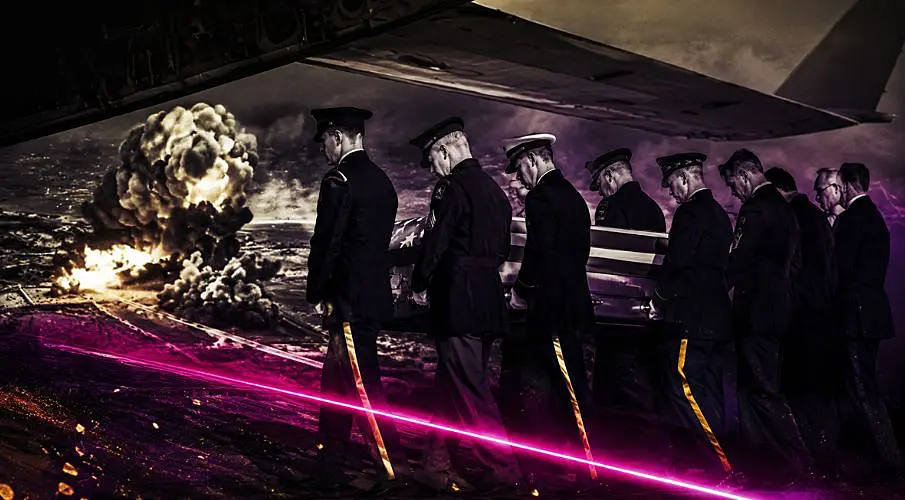
On Wednesday, Donald Trump stood at Dover Air Force Base in Delaware and saluted as the coffins of four fallen service members were carried off the aircraft. He called them great heroes while staring into the sky, looking almost bored. He said they had all made it very clear that Iran could never be allowed to have a nuclear weapon, and that was why they would be honored.
By Thursday morning, those exact four men had disappeared from the casualty list maintained by his own Defense Department. And the story doesn't end there.
Eighteen American war dead suddenly became fourteen, while the official list of fallen service members now showed only thirteen names. That is what our investigation found at 11:45 p.m. Eastern Time on July 23, 2026, which was 5:45 a.m. Central European Time on July 24. No one can say who the eighteenth fallen service member is. This military knows one person is missing, yet it cannot say who. It can count, but it cannot identify. That alone says everything about the state of this military.


The reason they were removed is Trump himself. According to three military officials, the administration deleted the four because they died last weekend, after the ceasefire Trump had declared back in April. They died during a period in which, officially, that war no longer existed, and so they were simply removed from it.
The president declared peace, so they could not have died in a war.
His spokesman first blamed a temporary data issue, then claimed there had been anomalies in the website. He accused the journalists who exposed the changes of writing a non-story because they supposedly did not understand the facts. The administration, he said, was committed to the highest possible level of accuracy. In the name of accuracy, four fallen troops disappeared before lunchtime.
A dead service member does not stop being dead because a database no longer lists the name. What disappears is the acknowledgment that the person died in this war, and with it the family's right to hear the real reason spoken out loud. Whoever decides who counts as a war casualty also decides what that war was, rewriting history without saying a single word about it. This kind of falsification no longer needs monuments. One deleted line on a government website is enough.
We were in all these wars for years and years, never-ending wars. We're in Iran for four months. I had a very sad day yesterday, I went to Dover. Four great Americans killed. 18 in two wars. 1 is too many, but it's 18, whereas in Vietnam we lost 200,000.
In his public remarks, Trump does not stick to the new number. On Thursday, he compared the casualties from this war to those of earlier wars and said that one death is already one too many, but that the total was eighteen. He is operating with two casualty counts at the same time, one for the microphone and one for the official record, using whichever one happens to serve him best.
No one understands the weight of these numbers better than Trump himself, because his own political career has been built around one of them. For years, he personally blamed his predecessor for the 13 Americans killed in the 2021 Kabul bombing. In 2024, he told a podcaster those people should never have died, that they died because of Biden and Kamala, as if the two of them had pulled the trigger themselves. The dozens of Afghans killed in that same attack never entered his calculation. His Defense Secretary is now investigating the withdrawal from Afghanistan and promised to deliver accountability to the American people, emphasizing the word in all caps. What that accountability looks like became obvious on one Thursday morning.
Less than eighteen hours passed between honoring their coffins in Dover and erasing all four names.
What happened next went beyond any sense of decency.
Trump himself explained how he experiences those ceremonies while speaking before a crowd in Marietta, Georgia, and what he said is harder to stomach than any deletion from a database. "When I go to Dover, I read the files on all the young people. And some are unbelievable. Some, you know, have a little bit, a couple of little bad things in their records." Those were the president's own words. While the coffins of fallen troops are being carried outside, he flips through their files and sorts them into categories. The ceremony at Dover recognizes no such distinction. It is the one moment when the nation receives its fallen without conditions, without asking about disciplinary records or personal history. Anyone searching those files for flaws has not misunderstood the purpose of the ceremony. They have turned it upside down. The fallen service member is no longer protected by the sacrifice they made but judged under a microscope, while the president decides whether they deserved the honor in the first place. The sentence itself collapses under its own accusation because there is simply nothing that can justify it. What remains is a man stumbling through remarks about people who can no longer answer back.
“When I go to Dover, I read charts on all of the young people. And some are unbelievable. Some are a little bit you know, they’ve got a little bit of a, little, couple of little bad things put in”
Keeping casualties out of public view is part of the system, and the law provides the opening. The Defense Department is only required to report those who have been killed, not those who have been wounded. Only after reports surfaced about four Iranian attacks the previous week did the spokesman acknowledge that the number of wounded since July 7 had climbed to nearly 100. The administration had stayed silent about three attacks in Jordan that left dozens of U.S. troops wounded and damaged multiple helicopters. Since February 28, at least 18 Americans have been killed and around 570 have been wounded. The last major public briefing on the course of the war took place in early May.
On Thursday, the Democratic members of the Senate Armed Services Committee formally demanded a complete accounting of everyone killed and wounded. In a letter signed by 12 senators, they wrote that the Defense Department had failed to provide timely and consistent reporting throughout the conflict and that its casualty reporting system now contained contradictory numbers. A retired lieutenant general who once commanded U.S. forces in Europe put it bluntly. This administration is clearly struggling to tell the truth, not only about casualties, but about the war itself. Anyone who downplays the dead is showing either an unwillingness or an inability to learn from mistakes.
While names are being erased in Washington, the war entered its thirteenth consecutive night of attacks. At 6:45 p.m. Eastern Time, U.S. forces launched another round of strikes. In Iran, it was 2:15 a.m. Friday morning. State media reported explosions near Ahvaz and Omidiyeh in Khuzestan, near Andimeshk, west of Bandar Abbas, along the southern coast of Qeshm Island, and near the village of Mesen. In Bandar Abbas, at least two people were injured. The same area had already been hit the previous week, when one person was killed and eight others were wounded. U.S. Central Command said the Strait of Hormuz remained open under American protection and announced that, as part of the naval blockade, 13 vessels had been diverted or disabled.
There was a way out on Thursday, and Trump lost it. Iraqi Prime Minister Ali al-Zaidi brought a ceasefire proposal to Tehran that he had previously received at the White House. Iran rejected it. Tehran said it had no interest in a temporary agreement that would leave control of the Strait of Hormuz unchanged, adding that this was the only proposal on the table. Iran's chief negotiator said the problem was not the delivery of messages, but America's position. Iran's foreign minister called that position illogical, driven by greed, and aimed at domination, adding that Iran had seen enough intermediaries.
What will happen if Trump follows through on his threat against Tehran and cuts off the country's supply routes has already been described by two Iranian officials. They said Iran would expand the war across the region, launch strikes against Tel Aviv, and ask the allied Houthis to shut down the Bab al-Mandab Strait. In Tehran's Azadi Square, where supporters of the government gather every evening, a military vehicle carrying upright missiles rolled through the crowd.
The markets have already delivered their verdict. Oil prices climbed above $100 a barrel for the first time since May after the Houthis announced they had struck two Saudi oil tankers, one of which was later confirmed by Riyadh. Since the war began in February, oil prices have risen by 40 percent. That same day, two border crossings came under attack, first the Iran-Iraq crossing at Shalamcheh, where two people were killed, and hours later the Kuwait-Iraq crossing at Abdali.
On Thursday, the House of Representatives voted for the second time to require Trump to obtain congressional approval before committing additional American troops. He ignored the first rebuke a month earlier. That same evening, Senate Republicans blocked the measure. Under the Constitution, only Congress has the authority to declare war. In reality, one man starts the war, and his own party sweeps aside every resolution that reminds him of that fact.
Trump now wants Iran to pay using money he has already seized from the country. He announced that future damage to international shipping would be compensated with Iranian assets under U.S. control. Those same assets were supposed to be returned to Tehran under the terms of the ceasefire that Trump himself abandoned less than a month after declaring it. The agreement also included a $300 billion reconstruction fund.
Every one of these numbers represents a personal story, says a political scientist at Duke University. That is exactly why four of them disappeared. A president who declares a war over while continuing to fight it needs casualties that fit his own narrative. The four service members from Dover did not. So they were reassigned, removed from the war itself, and pushed into the nothingness of a so-called data anomaly. Their families can now ask the spokesman when the technical glitch will finally be fixed.
Updates – Kaizen News Brief
All current curated daily updates can be found in the Kaizen News Brief.
To the Kaizen News Brief In English


Jeder Veteran sollte genau hinsehen!
Die Kriegstoten und auch Veteranen aus Vietnam nannte er Looser.
Ebenso verwundete Veteranen.
Es werden Tote gestrichen, weil sie angeblich ja nicht im Krieg gefallen sind.
Tot bleiben sie.
Vielleicht bekommen die Angehörigen bicht einmal die finanzielle Unterstützung, weil man ja sagen könnte, sie waren gerade bicht aktiv im Dienst.
Dieser Regierung ist leider alles zuzutrauen.
Auch dass sie künftig nach republikanischdn Patrioten und „Anderen“ unterteilt.
Trump selbst unterteilt jetzt schon die Gefallenen in ihm passende Kategorien.
Er hätte auch auf die Särge spucken können.
Der republikanische Senat ist ein absoluter peinlicher und feiger Haufen.
Blockieren due Resolution.
Eine Resolution, die eigentlich nicht nötig wäre, da Verfassung und Gesetz eindeutig sind.
Es sterben weiterhin Menschen, der Welthandel geht den Bach runter und alles nur wegen eines senile Soziopathen, der bei Allem $-Zeichen in den Augen hat.