
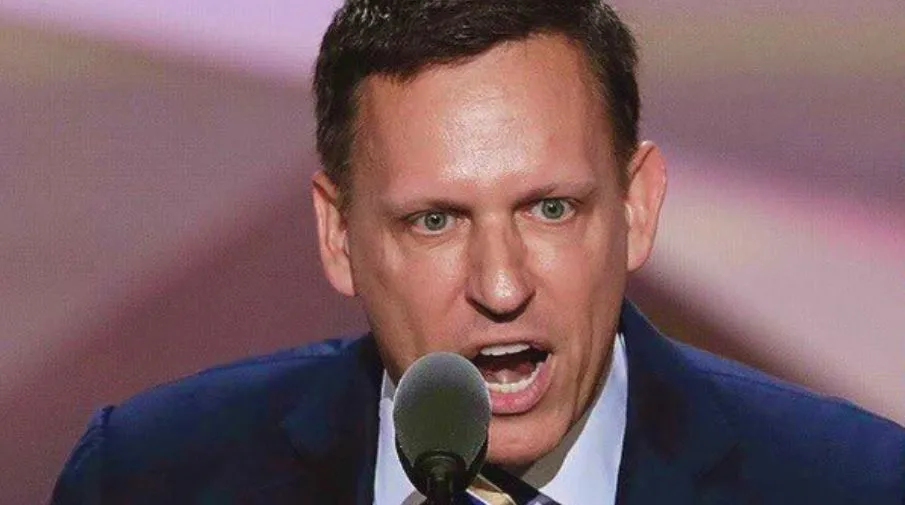
Sometimes the mere announcement of a protest is enough. A gathering scheduled for August at the Powerscourt Hotel in County Wicklow was meant to bring together guests by invitation only. It is called Dialog, it has existed for 20 years, and it is funded by Peter Thiel. On July 3, it became clear that it would not happen. The Irish groups that had mobilized against it did not even have to hold the demonstrations they had planned on the hotel grounds.
The story came to light through leaked documents and investigations by investigative journalists in June, revealing what was supposed to be discussed in the Irish countryside. The agenda included World War III, battlefield technologies, building a cult, and improving your sex life. The list makes more sense when you stop reading it as a conference agenda and start reading it as a statement about the people who put it together. Anyone who places the next world war and the creation of a cult on the same agenda has already said everything there is to know about how they view humanity.

Peter Thiel is an investor from Silicon Valley and a co-founder of PayPal and Palantir Technologies. He donated generously to Donald Trump's 2016 presidential campaign and backed the congressional campaigns of 16 far-right candidates in 2022. His company, Palantir, has come under fire because its technology supports both operations in Gaza and the crackdown on immigrants in the United States. The company is now facing growing resistance in London as well. Slowly, people involved in the campaign say, more and more people are beginning to understand what it means to hand a company like that access to citizens' data.
The statement released by the campaign after the cancellation did not bother with diplomatic language. It said the action had proven that direct action works and warned every other hotel and event venue on the island. War profiteers and techno-fascists are not welcome in Ireland. It is the kind of language rarely found in press releases, and that is exactly why it has an impact.
Read also our article: The Architecture of Control: How Peter Thiel’s Data Power and the Political Network Rockbridge Undermine Democracy
Palantir, ICE and the Billion Dollar Business of Deportation
Why Ireland of all places? That is the question that elevates this story beyond the cancellation of a single conference. The answer begins with tax policy. One American tech giant opened its first data center on the island before it even had an office there, then later established its European headquarters in Ireland. Ever since, the public narrative has been that the Irish should consider themselves lucky the giants chose them. The real balance sheet tells a different story. The country gives up the talent of its educated workforce and the output of its renewable energy, while the benefits of that relationship flow overwhelmingly in one direction. They need Ireland far more than Ireland needs them.
The price of that hospitality shows up on people's electricity bills. Irish households pay some of the highest energy prices anywhere in the European Union. At the same time, the government has allowed American tech companies to build data centers the power grid was never designed to support and granted them discounted contracts. The average Irish citizen pays more so servers somewhere else can stay cool. That is not tax policy. It is wealth redistribution by design. The same calculation does not end with electricity. The same applies to data. Nothing about it is free, and anyone using a free email account pays with everything that can be learned about them. That information is collected, turned into a commodity, and eventually finds its way back to the very people it came from, only no longer as a gift.
This is where it becomes clear just how closely technology and politics have become intertwined. If labeling an opinion as hate determines whether it remains visible, then the boundaries of acceptable speech are no longer being drawn in parliament, but inside a department whose name hardly anyone knows. It is the quietest form of censorship because it leaves no empty space behind. The deleted post simply never existed.
The government in Dublin does not come out of this story looking good, and the numbers make that clear. After the United States, Ireland is Israel's second-largest trading partner, ahead of China, and that trade consists almost entirely of technology, especially semiconductors and computer chips worth about €3 billion. A bill that was supposed to ban trade with the occupied territories was delayed for eight years and ultimately passed in a version that exempts services. What remains is an import ban on citrus fruit worth roughly €200,000. Under the Geneva Conventions, every state is obligated to do everything in its power to prevent genocide. Here, they are doing everything in their power against oranges.
Then there is the political right, and it appears far less influential than many assume. Ireland's far right is smaller than it likes to believe, campaign organizers say, a yapping little dog with no real power. During the fuel protests a few months ago, it tried to blame immigrants, but the message quickly fell apart because the people in the streets were farmers, truck drivers, mothers, and fathers protesting the cost of living, not immigration. The real problem, they argue, is something else entirely. It is not immigrants taking resources away from the country. It is the corporations that receive generous tax breaks. The country needs to look outward, not inward.
And whatever hope remains rests with younger generations who are beginning to realize that the information they get from online platforms is neither reliable nor well intentioned. It also rests on a simple realization, for which France offers an example. For the past year and a half, the country has been working to move parts of its public administration away from the products of an American tech giant and toward open-source software. The issue is not technology itself. It is the way technology is being used. If artificial intelligence were being developed primarily for science and medicine, people would fully support it. Instead, it serves a very small group determined to turn billionaires into trillionaires by widening the gap between themselves and everyone else.
Now all eyes are on Germany
While Wicklow closed its doors, Berlin is opening them wide. On September 24, 2026, the publishing giant Axel Springer will present its 2026 Axel Springer Award to Peter Thiel, honoring what it calls outstanding leadership and innovation in media and technology. The event will be streamed live online. The program includes a speech by journalist Bari Weiss, a conversation with PayPal co-founder Max Levchin about the early days of Silicon Valley, and finally the award presentation.

You have to hold the words engraved on that glass plaque up against the recipient's record. A man is being honored for achievements in media who secretly financed a lawsuit until the online magazine at the center of it was driven into bankruptcy and disappeared. More specifically, Peter Thiel secretly financed wrestler Hulk Hogan's lawsuit against the online publication Gawker. Thiel later said himself that funding the lawsuit was "one of the most philanthropic things" he had ever done.
It is an award for innovation in media, presented to a man whose most famous impact on a media outlet was helping bring about its destruction. That leaves one question for this country. In the United States, resistance to the data giants is growing. In the United Kingdom, pressure on Palantir continues to build. In Ireland, investigative reporting, a major leak, organized public opposition, and a handful of ordinary people with no political party and no special legal powers convinced a five-star hotel to cancel a booking. A date on the calendar is not an act of nature. It is a decision, and decisions can be reversed when enough people make it clear what they think of them. September 24 is still a long way off. In Wicklow, it took less than four weeks.
In the end, what remains is a hotel that canceled a reservation and the question of why that is newsworthy at all. It matters because, for the first time in a long time, someone said no without waiting for a law to tell them they could. The powerful have grown used to every door opening the moment they name their price. In Wicklow, one stayed shut. World War III and the building of a cult will have to find another venue.
Updates – Kaizen News Brief
All current curated daily updates can be found in the Kaizen News Brief.
To the Kaizen News Brief In English


Ich hoffe sehr, dass sich in Deutschland der Widerstand formiert und Tiel samt Anhang draußen bleiben muss. Leider sind wir in Deutschland mit Merz und Konsorten samt Afd schon genug gestraft
… ich denke mit Trump, Republikaner, ICE und Evangelisten reicht das Wort Strafe hier nicht mehr aus …
Leider ist Spahn (wenn auch zurück getreten) ein enter Verbündeter von Thiel.
Und man kann davon ausgehen, dass noch viel mehr Politiker mit Thiel klüngeln.
Ohne das jetzt mit Namen auszuführen.
Den Springer Verlag muss man boykottieren.
Denn wer einem Mann einen Preis für Führung und Innovation in Medien und Technik verleiht, dessen Programmpunkte sich für eine Tage auf folgende Themen konzentriert: Dritter Weltkrieg, Technologien für das Schlachtfeld, der Aufbau eines Kults und die Verbesserung des eigenen Sexlebens.
Vor allem der letzte Punkt ist so absurd, wenn man vorher von Vernichtung spricht.
Ich fürchte, dass sich in Deutschland kein massiver Widerstand formieren wird.
Und von der Politik ist bichts zu erwarten.
… das wäre schade, wenn keine Reaktion käme