
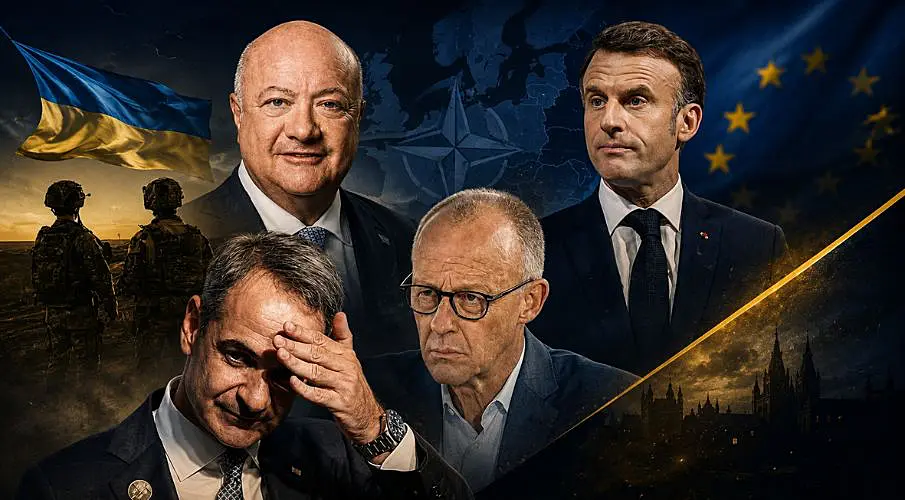
There's a sentence nobody in Brussels is willing to say out loud these days, yet it hangs over every negotiating table like a bad smell. Sanctions against Russia are sacred only as long as they hurt someone else. The moment they begin to affect domestic corporations, ethics suddenly become negotiable. The European Union's 21st sanctions package, intended as the continuation of a four-year strategy to support Ukraine, has now been deadlocked for the fourth straight day. And the reason isn't Moscow. It's the governments of six European countries.

Greece, France, Italy, Germany, Austria, and Portugal, according to five diplomats involved in the negotiations, are demanding exemptions, watering down individual provisions, or blocking entire measures. Because EU sanctions require unanimous approval from every member state, a single objection is enough to bring the entire package to a halt. And the number of objections has, as one official admitted, reached a level never seen before. This is the moment when a union that spent four years talking about unity is forced to present the bill for its own promises. And it's a conflict unfolding with unusual openness. For years, Hungary and Slovakia were publicly shamed whenever sanctions stalled, the convenient troublemakers everyone could point fingers at. This time it's the major powers themselves, the founding nations and financial backbone of the European Union, who have slammed on the brakes. The resistance has moved from the outskirts straight into the center.

Athens has proven to be the most determined holdout, and the reason can be calculated down to the last cent. Greece refuses to approve the package unless it receives an exemption allowing its shipping companies to continue transporting Russian liquefied natural gas to third countries. Behind that demand stands one name - Dynagas, the shipping company owned by billionaire George Prokopiou. Since the beginning of Russia's full-scale invasion, Dynagas has transported more than 30 million tons of LNG from Russia's Arctic Yamal project, cargo estimated to be worth more than $24 billion. One tanker alone, the Fyodor Litke, carried shipments valued at more than $4 billion. So Athens, while publicly speaking in the name of European unity, is in reality negotiating for the profit margin of a single shipping magnate.

The other five countries are no different. They simply wrap their special demands in different packaging. Germany and Portugal are pushing to remove a proposed ban on Russian fish imports because their seafood processing industries still depend on those deliveries. Just think about that. While Ukrainian cities are being torn apart by Russian missiles, one of the wealthiest nations in Europe is negotiating over cod for its processing plants. France and Italy want to weaken restrictions that would deny visas to Russian military personnel who served in the war. It's a remarkable concern that the soldiers of the invading country should still be able to enter Paris and Rome. Austria, meanwhile, once again wants roughly €2 billion in frozen Russian assets released in order to compensate Raiffeisen Bank for penalties imposed on it by Moscow. In other words, Vienna is demanding that Europe pay the bill handed down by the Russian judicial system.

The French philosopher Étienne de La Boétie asked nearly five hundred years ago why so many people willingly serve a single tyrant. His answer was that it wasn't force that compelled them, but their own willingness to place small personal advantages above greater principles. A tyrant, he wrote, is sustained not by weapons, but by the countless small hands that willingly provide him with what he needs. Those are exactly the hands now visible in Brussels. No country openly sides with Moscow, yet each one extends a helping hand through an exemption, a tanker, a shipment of fish, a visa, or money that ultimately helps keep Russia's war machine running. The voluntary submission La Boétie described now wears the respectable suit of economic policy.
Because the real scandal isn't found in any single demand. It's found in the logic behind all of them. One EU official summed it up with brutal clarity. The countries that continued doing business with Russia throughout 2022 and 2023 are now the ones being hit hardest by the newest sanctions because those sectors have become some of Moscow's last major sources of revenue. In other words, the countries that traded with the enemy the longest are now shouting the loudest against measures that would finally cut off that trade. Today's resistance is simply the bill coming due for yesterday's greed. They became so deeply entangled in Russia's supply chains that they now mistake those chains for a right. Two diplomats openly acknowledged where this is leading. Every new sanctions package risks becoming an empty shell, one warned, if more and more member states continue demanding special exemptions. The other put it even more bluntly. The moral commitment to supporting Ukraine has noticeably weakened around the negotiating table. It's a bitter admission, because a commitment that disappears the moment it becomes expensive was never a commitment at all. It was merely convenience dressed up as morality.
The delay couldn't have come at a worse time. While Ukraine continues expanding its long-range strikes against Moscow and Russian oil refineries, while Western governments still rely on their united front to increase pressure on Vladimir Putin and force Russia to the negotiating table, that very unity is crumbling simultaneously in six different cabinet rooms across Europe. It's like watching a team reach the championship game only to start arguing over the cost of their uniforms. EU High Representative Kaja Kallas confirmed last week that no agreement had yet been reached on the 21st sanctions package and that several issues remained unresolved. The 20th package had only been adopted in April, targeting primarily the energy sector, the financial sector, and sanctions evasion networks. The 21st package was supposed to expand those measures. Yet what Europe managed to accomplish in April is now falling apart in July because of resistance from within its own ranks. In just three months, determination has turned into haggling.

The diplomats themselves have identified the real reason, and it's more revealing than any economic calculation. One official explained that a government's willingness to accept economic sacrifices depends largely on whether it still views Russia as an immediate threat. The Baltic states and Northern Europe continue to see that threat as real and present. In several other European capitals, however, that sense of urgency has already begun to fade. That's where the continent's real divide lies. It isn't between East and West. It's between those who can already hear the tank outside their own front door and those who are far enough away to mistake the rumble for nothing more than something playing on television. The closer the danger, the stronger the principles.
It would be too easy to accuse these governments of simple malice. Their concerns about jobs, shipping companies, fish processors, and banks are real, and no government hoping to be reelected can simply ignore them. But this is precisely where the true test begins, the test that separates a community built on shared values from nothing more than a trade association. A union that stands together only as long as unity costs nothing isn't really a union at all. It's a fair-weather alliance. Ukraine is paying the price of this war not in billions, but in human lives. Against that reality, arguing over a fishing company or a banking penalty borders on obscenity.
So, on this fourth day of negotiations, Europe finds itself facing a question far greater than the 21st sanctions package itself. The question is whether its principles are truly principles or merely preferences that can be abandoned the moment they become inconvenient. Every country now demanding an exemption is giving its own answer. And that answer will outlive every tanker loaded with liquefied natural gas. Moscow is watching these negotiations very closely. It sees six capitals willing to sell their unity for a discount, and it now knows exactly what that unity is worth. The price has been established. Depending on the country, it's one tanker, one shipment of fish, one visa, or one banking penalty.

For months we've reported, documented, and investigated one sanctions violation after another, and almost nothing has happened. The outcry inside the European Union has remained quiet, and the public response has been even quieter. The path has been right there in front of everyone the entire time. If people simply chose it once, embraced it, committed to it, and followed it through, something would actually change, and this war would end far sooner than many believe. We'll keep investigating. And yet we're starting to ask ourselves why we continue taking enormous risks in our Russia investigations and carrying the financial burden when truths that are so expensive to uncover fail to inspire action anywhere. It's the same old lesson. The problem has never been a lack of knowledge. It's been a lack of willingness to act on it. 2026 has become a very strange year. The weather kills. The sun is at war. Thousands are dead, and the streets stand empty. You'd think this is an age that sees so much, and yet somehow remains completely still.
Updates – Kaizen News Brief
All current curated daily updates can be found in the Kaizen News Brief.
To the Kaizen News Brief In English


Mir kommt das 🤮🤮
Seit über 4 Jahren attackiert Russland die Ukraine.
Anfangs war der Aufschrei groß, die Hilfsbereitschaft (vor allem von Zivilisten) auch.
Die Bevölkerung „zahlte“ für die Sanktionen.
Höhere Energie- und Treibsroffkosten, damit eine Warenverteuerung. Höhere Heizkosten.
All das wurde von den Bürgern getragen
Man redete, wie wichtig die Sanktionen sind.
Unbestreitbar. Sanktionen sind wichtig.
Aber nur wenn sie Konsequent durchgesetzt werden und es nicht zig Ausnahmen oder noch schlimmer Schlupflöcher/Umgehungen gibt.
mit jedem Verstoß, der möglich ist, degeneriert sich die Sanktion zu einem zahnlosen Papiertiger.
Mit jedem Monat sank die mediale Aufmerksamkeit.
Orban war der große Störenfried, auch etwas die Slowakei.
Es war bequem auf ihn zu zeigen.
Nun ist Orban weg.
Und siehe da, es ist gar nicht der Orban alleine gewesen.
Ohne ihn hätte sich die Uneinigkeit Europas noch viel früher gezeigt.
Die vielgepriesene Einigkeit existiert nur, so lange sie es bichts kostet. Vir allem keine Wählerstimmen.
Due Ukraine hat auf ihre Atomwaffen für Garantien verzichtet.
Sie waren alle nicht einmal das Papier wert, auf dem sie standen.
Die Ukraine kämpft und kämpft. Entwickelt neue Drohnen etc.
Schafft es Ziele tief in Russland anzugreifen.
And Europe?
Der träge und bequeme faule Wasserkopf schaut nur auf sich.
Kabeljau, der ist natürlich unsagbar wichtig.
Die Bankstrafe auszugleichen lebensnotwendig.
Visa für russische Soldaten, die Zivilisten ermordet und ein Land völkerrechtswidrig angegriffen haben, die brauchen wir. Dann können sich diese Personen frei in der EU bewegen und Putins Propaganda verbreiten.
Einen steinreichen Milliardär boch reicher mit seinen Tankern machen, was interessieren da zerstörte Städte und tausende tote Ukrainer.
Unglaublich wie menschenverachtend die Regierungen sind.
Und leider werden sie nicht die Dinzigen bleiben.
Auch wenn es für Putin gerade etwas eng ist, er kann sich bequem zurück lehnen und abwarten.
Ein Aufstand der eigenen Bevölkerung ist bicht zu erwarten.
Aber die Einigkeit der EU und anderer Staaten bröcjelt immer weiter.
Trump machte den Anfang….
Wir in Europa werden boch ziemlich dumm aus der Wäsche gucken, wenn Putin nach der Ukraine weitere Länder ins Visier nimmt.
Ironiemodus an „noch ist Zeit russisch zu lernen“ Ironiemodus aus