
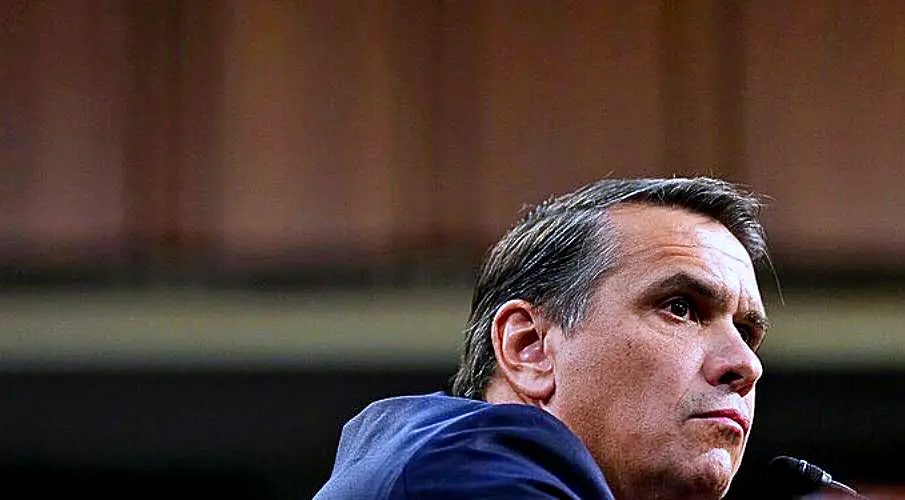
Sometimes the present tense is enough to define an entire tenure in office. Republican Senator John Kennedy asked Todd Blanche a question on Wednesday that was clearly intended as a favor: Did he consider the president a friend? Blanche replied that he was his lawyer, then immediately corrected himself. He had been his lawyer. He then added that there probably were not many people who would call their criminal defense attorney a friend. Kennedy helpfully followed up by asking whether they were enemies instead. Enemies? Certainly not.
"Are you and President Trump friends?"
BLANCHE: "I am his lawyer, uhh... was his lawyer."
Everything the Senate is currently deciding revolves around that single sentence. Blanche is set to become the 88th Attorney General of the United States after serving in an acting capacity since April, when Trump fired his predecessor, Pam Bondi, because she was not moving quickly enough in pursuing his political opponents. A single Republican "no" in the Senate Judiciary Committee would block the nomination and effectively end it. For Republicans, this is one of the rare opportunities to extract something from the president. For Blanche, it is a narrow passage that applause alone will not carry him through.
Before the hearing began, a bouquet of white roses stood at the seat of Lindsey Graham, who died over the weekend. It remains unclear when the committee will vote because Republicans must first fill his vacant seat. Rarely has an empty chair commented on a hearing more precisely.

The dispute centers on a deal that almost defies belief. In January, Trump sued the Internal Revenue Service for at least $10 billion, claiming it had failed to prevent the disclosure of his tax returns during his first term. In the end, he received an apology, a $1.8 billion fund for alleged victims of political persecution by the Justice Department, and an order shielding him, his family, and his companies from IRS audits. Richard Durbin, the committee's ranking Democrat, summarized it this way: One of the acting attorney general's very first official acts was to create a nearly $2 billion slush fund for people who assaulted police officers on January 6 while simultaneously freeing the president from tax liability.
Durbin to Blanche: "You have shown that you are still Donald Trump's personal attorney. Your tenure can be summed up in the four words you said to President Trump: 'I love you, sir.' This nation deserves an attorney general who loves the Constitution more than any single president."
John Cornyn of Texas, a former judge who had already lost his primary to a Trump backed challenger and therefore had little left to lose, dismantled the arrangement with the patience of a law professor. He had the text of the tax provision displayed on a board behind him and pointed out that nowhere in writing had Trump, as the plaintiff, agreed to abandon the fund. Had Blanche spoken with the president about the settlement, he asked, considering Trump had demanded $10 billion but ultimately settled for an apology? Blanche said no, explaining that the president had been represented by outside counsel and that they had not spoken until the matter was over. Cornyn countered that the lawsuit had been directed against the IRS and the Treasury Department, yet the exemption, according to its wording, extended to other agencies as well. Would that also cover an investigation by the Securities and Exchange Commission? Blanche answered that it was standard language and that only the IRS, and indirectly the Treasury Department, were bound. Cornyn responded with a sentence worth remembering: He heard what Blanche was saying, but he simply did not read it in the agreement.
Republican Senator John Cornyn is not guaranteeing his support for Acting Attorney General Todd Blanche. Speaking to reporters, he said he still has concerns about the now abandoned anti weaponization fund, which he described as "inappropriate."
Marcus Tullius Cicero, who once prosecuted a corrupt provincial governor and witnessed firsthand how that man's allies treated loyalty as though it were a legal principle, expressed the idea that matters here. The greatest danger to a republic, he wrote, comes not from those who openly violate the law, but from those who administer it as though it were their personal property. Anyone who sees public office as the continuation of a private mandate has already decided, in his own favor, the difference between what is honorable and what is merely useful, without ever asking the question.
The order dated May 19 consists of a single page whose contents are compressed into one long, sprawling sentence that tax attorneys say no practicing lawyer would ever have written. Its effect is twofold. The IRS must halt all audits and investigations involving Trump, his family members, their companies, and vaguely defined associated persons. It is also prohibited from opening any new inquiries into tax returns that have already been filed by this broadly described group. Since the IRS normally has three years to reopen and reassess tax returns, everything the Trumps may have done in recent years effectively disappears. During the hearing, Blanche suddenly narrowed the scope. He claimed the only beneficiaries were the plaintiffs - Trump, two of his sons, and the Trump Organization - and that only the IRS was bound. The agreement, he insisted, was not forward looking, and future tax returns would remain subject to review.
How extraordinary that is becomes clear when compared with the IRS's own longstanding practice. Since questions arose during the Nixon era, the agency has audited the sitting president's tax returns every single year, regardless of who occupies the White House, and has consistently sought to avoid even the appearance of granting favorable treatment to those in power. Settlements over audits do occur, but they apply only to the parties involved and to the specific dispute at issue. Blanche's order, by contrast, refers to matters that are pending or may become pending and distributes immunity to a group that no one can clearly define.
Whether any of this is lawful remains uncertain. No representative of the IRS signed the document, unlike the now abandoned fund, which at least bore the signature of the agency's commissioner. The only signature on the order is Blanche's. The IRS answers to the Treasury Department, not to him, and several legal experts question whether an attorney general has the authority to tell the IRS whom it may or may not audit. The agency has refused to say whether it is even complying with the directive. Federal law prohibits the president and his associates from directing tax audits, although it appears to contain an exception for the attorney general. Anyone who carries out such an order from the White House could ultimately face prison if a future administration decides to investigate.

On Monday, two days before the hearing, Federal Judge Kathleen M. Williams ruled in a 56 page opinion that Blanche's order directly violated the prohibition against political interference in tax audits. She found that Trump had filed his lawsuit in bad faith in order to extract concessions from the government and could no longer describe audit immunity as part of a legitimate settlement. She did not rule on the broader legality of the arrangement and dryly observed that the question of whether members of the executive branch may privately grant themselves and former clients sweeping immunity along with billions of taxpayer dollars for legally undefined grievances had never even been presented to her for review. Nevertheless, during the hearing, while answering Durbin's questions, Blanche continued referring to the agreement as a settlement, openly contradicting that very ruling. Earlier, he had dismissed the decision in comments to Durbin as little more than an attack on him personally.
The value of the arrangement can only be estimated because tax records are confidential, which, after all, was the very issue at the center of Trump's lawsuit. According to earlier reporting, a single audit could have cost him more than $100 million. A congressional report released in 2022 showed that the IRS had raised substantial questions about his tax filings. His most recent financial disclosure listed income of at least $2.2 billion for the previous year. Equally remarkable is what was left unsaid. The Justice Department had several viable legal defenses available against Trump's lawsuit but chose not to raise them, even though IRS attorneys had specifically recommended doing so.
Cornyn remained undecided after the hearing. He said he did not have to make a decision yet, so he would not. Blanche had answered his questions directly, but those answers did not necessarily lead to the conclusion that the fund was truly dead. It could be revived at a later date. He admired Blanche's public service, but acknowledged that it was a difficult position to go from serving as the president's personal attorney to serving in his Cabinet. Thom Tillis of North Carolina, who is also on his way out, is leaning toward supporting Blanche but wants legislation that permanently eliminates the fund. He wanted to stick a fork in it, he said, while simultaneously accusing Democrats of exploiting the issue. He is also troubled by Trump's pardon of the Binance CEO, prompting him to call for reform of the presidential pardon process, although he appeared satisfied once Blanche promised a review. In the end, he described Blanche's performance as outstanding.
While Blanche spoke, about 12 women wearing white T-shirts sat in the visitors' gallery. The shirts read that Epstein's survivors were still waiting. Blanche declared that no administration had ever been as transparent with the Epstein files as this one, claiming that millions of pages had been released. He did not mention that those disclosures came only after his administration had attempted the previous summer to block further releases and was forced by Congress to proceed. He admitted mistakes, saying that roughly one percent of the files had to be corrected after publication. He declined to meet personally with the women in the gallery, instead offering a meeting with a staff member and citing ethical rules that might prevent direct contact. Durbin accused him of dancing on the head of a pin. Blanche replied that he was not dancing at all. He is also accused of using his meeting with Ghislaine Maxwell to help shield the president from political fallout. Meanwhile, House Oversight Committee Chairman James Comer said he intends to question Blanche in his own Epstein investigation once the confirmation process has concluded.
SEN. KENNEDY: "Other than himself, who, if anyone, did Mr. Epstein traffic young women to?"
BLANCHE: "Based on the evidence we have at this time, we did not have evidence that Epstein trafficked young women to other men." - (This statement is almost impossible to surpass in terms of irresponsibility and directly contradicts every established finding and every investigation conducted to date. Ongoing investigations, including those in Europe, continue to strengthen that body of evidence. - Editor's note) – (Diese Aussage ist an Untragbarkeit kaum zu überbieten und widerspricht sämtlichen Erkenntnissen und bisherigen Recherchen. Die laufenden Recherchen, auch in Europa, erhärten dieses Bild zunehmend.- Anmerkung der Redaktion)
The rest of the record reads like a catalogue. As Durbin noted to audible laughter in the hearing room, Blanche's Justice Department pursued former FBI Director James Comey over photographs of seashells. The prosecution of immigrant Kilmar Armando Abrego Garcia was dismissed as a vindictive abuse of prosecutorial power, with Blanche playing the central role. Blanche said he did not order the arrest of Newark Democratic Mayor Ras Baraka outside an immigration detention center, but acknowledged that he approved it. The charges collapsed only days later for lack of evidence. Blanche personally authorized subpoenas against journalists who reported on the inadequate defensive systems of the Qatari gifted aircraft that is being converted into the next presidential aircraft. He insisted the government was not targeting reporters, saying they were merely witnesses, like witnesses to a traffic accident, and that prosecutors simply wanted to know who had leaked classified information to them.
Richard Blumenthal questioned him about David Gentile, an investment manager convicted in a $1.6 billion fraud that wiped out portions of the retirement savings of thousands of small investors. Trump commuted Gentile's sentence, after which federal prosecutors in Brooklyn began examining whether money had changed hands in connection with the commutation. A member of Blanche's office raised concerns, and shortly afterward the investigation was shut down. Blanche would not even confirm that such an investigation had existed. He described reports about it as products of leaks and suggested they contained falsehoods, without identifying a single one, while his department has never publicly disputed the reporting. In conversations with conservative podcasters, he has spoken at length about ongoing investigations involving Trump's political opponents.
Senator Blumenthal to Blanche: "Agents should not fire into vehicles unless there are weapons inside."
Sheldon Whitehouse confronted Blanche with criticism from federal judges who have stripped Justice Department attorneys of what the law refers to as the presumption of regularity - the traditional assumption that government officials act honestly and lawfully. When asked how much longer he intended to tolerate FBI Director Kash Patel, Blanche called the question extraordinarily obnoxious and expressed complete confidence in Patel. He denied hiring Jared Wise, a January 6 participant who served on his staff before leaving earlier this year. Cory Booker was told that he was free to ask questions but not to dictate the answers when he challenged Blanche over the arrests of political opponents. Amy Klobuchar was told that antitrust cases were not being resolved based on political connections, despite experts within Blanche's own department reaching a different conclusion. Asked about Jack Smith, who brought two criminal indictments against Trump and has for months offered to testify under oath about his investigations, Blanche dismissed the issue, saying transparency was the best solution. Republicans, however, continue to refuse a public hearing with Smith. Throughout the hearing, Blanche put only two small degrees of distance between himself and the president. He said judges should not be removed from office simply because of unpopular rulings, and when asked whether Trump could run again in 2028, he replied that he did not believe he could.
WHITEHOUSE: "How long do you intend to put up with that Kash Patel character? Are you good with his airplane trips? Are you confident he's not drinking on the job? Are you sure none of his travel is a pretext for personal activities, like visiting girlfriends? Are you sure he knows what he's doing?"
BLANCHE: "That is an extraordinarily obnoxious question. I have complete confidence in Director Patel."
WHITEHOUSE: "Good. Then you own that."
Then there is the family connection. Blanche's father in law founded Check-Mate Industries, a manufacturer of firearm magazines. His mother in law now serves as the company's chairwoman and chief executive officer. In April, shortly after his promotion, Blanche described himself at the National Rifle Association's annual meeting as a member of the firearms industry and promised a fundamental change. Everyone in the industry, he said, would recognize that this administration was doing more to restore rights than any administration in American history. Since then, according to Senator Adam Schiff, his department has announced more than 30 regulatory changes that would significantly reshape federal firearms law, changes from which Check-Mate and the firearms industry stand to benefit. Among them is the restoration of the loophole that exempts gun show sales and certain private transactions from background checks. At the time, Blanche said the department had listened to the industry's leading representatives, a statement that was perhaps more candid than he intended. In November, he visited one of the company's manufacturing facilities, which proudly announced that it had the honor of hosting the Deputy Attorney General, sharing photographs posted by his mother in law showing Blanche wearing jeans and a hooded sweatshirt. The Justice Department has refused to say whether the visit was official business. It has also refused to say whether Blanche or his wife have any financial interest in the company. Check-Mate does not appear anywhere in his 2025 financial disclosure. John Feinblatt, president of Everytown for Gun Safety, has called for Blanche to recuse himself from all firearms related matters, arguing that everything points to him placing his family's business interests ahead of public safety. By comparison, Jeff Sessions recused himself from the Russia investigation, and Eric Holder stepped aside from a case involving journalists.
The defense relied on rhetoric. Committee Chairman Chuck Grassley compared Blanche's critics to the boy who cried wolf and suggested Democrats take a long look in the mirror. Blanche himself opened by saying he had come to earn the public's trust and then attacked his predecessors, accusing them of turning the Justice Department against a former president and thereby destroying public confidence in the justice system. Adam Schiff, whom Trump has repeatedly said should face criminal prosecution, asked what had become of the Todd Blanche who had once earned respect as a federal prosecutor in New York. Blanche fired back. He was still here. He was exactly the same man. His guiding principle, he said, was to do the right thing and put criminals behind bars. Giving legal advice, he insisted, did not mean being a yes man. Chuck Schumer declared on the Senate floor that anyone capable of representing a habitual liar had no integrity. Every senator was allotted just ten minutes - the shortest speaking time in a modern confirmation hearing.
When Blanche finished, he walked into a conference room where cheers and applause could be heard through the open door. His confirmation is, in many ways, only symbolic because he could continue serving as Acting Attorney General until the end of the administration even without Senate confirmation. What is really being decided is something else entirely - whether the Department of Justice should become an extension of one man's will. The most honest answer to that question came from the nominee himself, in the present tense, before he caught himself and corrected it.
Updates – Kaizen News Brief
All current curated daily updates can be found in the Kaizen News Brief.
To the Kaizen News Brief In English


Wirklich erschreckend, was bei dieser Anhörjng zu Tage trat und gesprochen wurde.
Auch diese abfällige Äußerjng gegenüber den Epstein-Opfern.
Am Meisten schockiert mich, dass Blanche zu 100% die Zustimmung bekommen wird.
Weil Republikaner, selbst scheidende, kein Rückgrat besitzen.
Ihn zu bestätigen ist ein weiterer Schritt im Abbau der Demokratie und hin zum Terrorstaat.
…ja die anhörung war die reinste geisterbahn und zeigt auf was in US 2026 los ist