
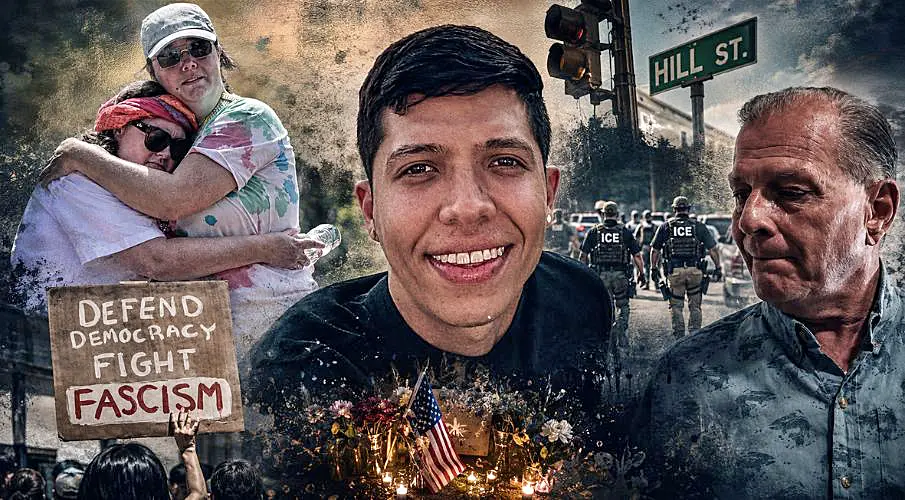
Biddeford, Maine (KB) - Joan Sebastian Guerrero was 25 years old, originally from Colombia, legally employed in the United States, and in possession of a Social Security number. At around 7:00 Monday morning, he died at an intersection in the coastal town of Biddeford, about 15 miles southwest of Portland, struck by bullets fired by a federal officer with the Immigration and Customs Enforcement agency, ICE. Neighbors identified him while authorities initially withheld his name. He leaves behind a wife and a three year old daughter who was at the scene as her father lay bleeding on the pavement.

It was the second time within a single week that ICE agents opened fire on a vehicle and killed someone, and at least the ninth death during an encounter with federal immigration officers since President Trump launched his intensified immigration crackdown. What elevates this case beyond the statistics is a statement that the Department of Homeland Security itself was forced to correct later that same day.
The department initially stated that ICE agents had been surveilling the last known address of an individual with a final order of removal. According to the agency, a person who was in the country illegally left the residence in a vehicle, officers attempted a traffic stop, and the driver then used the vehicle as a weapon against them. Fearing for public safety, an officer opened fire. Senator Angus King, an independent senator from Maine, said after speaking with Homeland Security Secretary Markwayne Mullin that the deceased had received a removal order and had been the subject of an arrest warrant.
A few hours later, Mullin called again. The information had been wrong. The man who had been shot was not the person they had been looking for.
According to King, quoting the secretary's own words, they had been looking for someone else, and the man they shot was not that individual.

That leaves one sentence hanging in the air that no bureaucratic language can soften: A family father with legal authorization to work was shot dead in broad daylight even though the agency had not even been looking for him. Italian philosopher Giorgio Agamben coined the term bare life for that zone in which a human being remains subject to the law while simultaneously losing its protection. The state of exception, he wrote, ceases to be the exception and becomes the rule once the sovereign is allowed to decide whose life counts under the law and whose does not. Guerrero, legally employed, holding a Social Security number, and supporting a family, entered precisely that zone where membership in the legal community vanished in the space of a single second. The fact that the agency first declared him to be the wanted man and only later withdrew that claim demonstrates how arbitrary the line between protected life and disenfranchised life has become.

The accounts given by local residents paint a picture that is difficult to reconcile with the official version. Mia Covino, 26, heard four or five gunshots and threw herself to the floor. Looking out the window, she saw two plainclothes officers wearing green vests and a white vehicle slowly spinning in circles. One of the officers was hanging onto a door handle while shouting that the man had tried to run him over, as the other officer attempted to calm him down and told him to stop. A second vehicle, apparently belonging to the officers, rammed the circling car and brought it to a stop. The officers then pulled the blood covered driver from the driver's seat.

Daniel Boucher, 71, tearfully described a sound like firecrackers and a small car sitting sideways at the curb, with an SUV behind it. The wounded driver had still managed to move the vehicle until the SUV rammed it again. Boucher clearly heard the injured man say that he had tried to stop. When Boucher confronted the officers about what had happened, the shooter replied that the man had tried to run him over. Valerie Brinkman, who had been standing at her sink praying, heard someone shout after the gunfire that nobody should get out of the vehicle.

Em Akerly initially mistook the gunshots for a backfire and summed up her disbelief in a single sentence: She did not know what the man had done, but he did not deserve to be executed in the street.

Daniel Boucher said Guerrero had still been alive after the shooting and, after being pulled from the vehicle, said, "I tried to stop." He was bleeding heavily from the head.
Four bullet holes were visible in the driver's side of the windshield, as photographs from the scene show. The officers involved were not wearing body cameras, just like the agents who opened fire in Houston a week earlier. That leaves exactly the piece of evidence that could answer King's central questions: What exactly did the man do with his vehicle, were the officers actually in danger, and did that danger reach a level that justified the use of deadly force? The Maine Attorney General's Office, which is investigating alongside the Department of Homeland Security's Office of Inspector General and the FBI, stated that preliminary witness accounts indicated the driver fled toward the officer. The shooter has been placed on administrative leave. Illyrian Sherifi, who lives above a nearby laundromat, heard four gunshots, and one question stayed with him: Why are these officers not better trained in de-escalation? A man is dead, he said, and nobody knows whether the shooting was lawful, but that man should have been turned over to the proper authorities through a lawful process.
Guerrero was well known in the neighborhood. Sadie Dilboy said he regularly came into her laundromat, often with his daughter, giving her coins to buy candy from the vending machine. She described him as a good man who always cleaned up after himself. Mary Hayes, who lives nearby, described seeing a woman collapse to her knees while a little girl with a pink rolling backpack cried. She said she heard a wail that came from the soul, the sound of a life changed forever. The Colombian Consulate stated that it is in contact with U.S. authorities.
Five Hours on the Pavement
One detail makes what happened even harder to bear. After the shooting shortly after 7:00 a.m., emergency responders arrived approximately 10 to 15 minutes later, according to witnesses, but Guerrero succumbed to his injuries. After officers pulled him from the white Kia and handcuffed him, his body remained in the street for approximately five hours while crime scene investigators processed the evidence and investigators conducted their work. The intersection remained closed until approximately 2:30 p.m.

His daughter, barely three years old, stood beside him in her pajamas, a small pink rolling bag at her side, trying to smell the flowers while a woman nearby cried out that they had taken the little girl's father away.

Witnesses also said officers surrounded Guerrero with their guns drawn, repeatedly shouting the word "gun" before opening fire. Residents reported hearing as many as seven shots. That evening, the Boston office of the Department of Homeland Security's Office of Inspector General assumed responsibility for the investigation. A vigil was scheduled for that evening, and further large scale protests are expected on Tuesday.
The case joins a week marked by deadly violence involving the nation's immigration enforcement agency. On July 7, an ICE agent in Houston shot and killed 52 year old Lorenzo Salgado Araujo, a Mexican construction worker and father of three who had lived in the United States for more than 30 years without legal status. Federal agents in unmarked vehicles followed him as he drove members of his construction crew to work. He, too, was not the actual target of the operation. The arrest warrant was issued for two other migrants, including a Guatemalan national whom authorities believed was inside the van Araujo was driving. Just as in Houston, the officers involved were not wearing body cameras, and there, too, witness accounts conflict with the official version.

Read also our article: “You Tried to Run, Didn’t You?” - The ICE Agent Said as the Man Bled to Death
Both deaths follow the killings of Alex Pretti and Renee Good, two American citizens who were shot and killed by ICE agents in January during federal operations in the Twin Cities region of Minnesota. Those deaths sparked nationwide outrage, and only after months of delay did federal authorities finally turn over the evidence to the State of Minnesota.

The shootings come during a period of dramatically intensified immigration arrests. During the final five days of June alone, ICE arrested more than 10,000 people. Daily arrests doubled during the final week of June and continued to climb. The numbers indicate that the administration is no longer targeting only individual cities but is expanding enforcement operations nationwide. Representative Chellie Pingree of Maine summed up the disbelief felt by many with one simple question: Why Maine?

The state has lived with this federal presence for months. In January, a statewide enforcement campaign known as Operation Catch of the Day began, a reference to Maine's fishing and lobster industries. The administration announced it would target the most dangerous undocumented criminal migrants but ended the large scale operation after only a few days and hundreds of arrests. Between the beginning of Trump's second term and March 11, 2026, the latest date for which data is available, ICE arrested 546 people in Maine. Approximately 45 percent of them had a criminal history. During the comparable 416 day period before Trump returned to office, that figure had been approximately 69 percent. The numbers contradict the claim that enforcement is focused primarily on violent criminals. Some of those arrested had been convicted of serious offenses. Others were detained solely because of unresolved immigration proceedings or had been arrested but never convicted.
Maine, a state with an aging population, has welcomed immigrants for decades. They now make up approximately five percent of the state's population and have helped revitalize the local economy. Somali refugees began arriving in the early 2000s, followed by immigrants from other African nations and the Middle East. More recently, growing numbers have come from Latin America, many of whom now live in Biddeford, a working class coastal city of approximately 22,000 residents. Local residents say ICE agents continued appearing there almost daily even after the officially announced operation had ended.

Following the fatal shooting by an ICE agent in Biddeford, major protests broke out outside the office of Republican Senator Susan Collins. Angry demonstrators even forced their way into the entrance area of her office at 160 Main Street before police intervened.
Within hours, protests had formed across the city. Hundreds marched to Biddeford City Hall chanting that the streets belonged to the people. Others gathered outside the office of Republican Senator Susan Collins demanding that she be voted out of office. Signs read that ICE should leave, that ICE agents were domestic terrorists, and that ICE belonged in coffee, not on the streets. An attorney with the Maine chapter of the ACLU placed Biddeford alongside Houston and Minneapolis. One speaker called the shooting a tragedy that had only been a matter of time because this administration had turned immigration into something criminal, where people are hunted down and shot in the streets.


Governor Janet Mills said that after federal authorities corrected their original statements, the tragedy had become even more disturbing and demonstrated the reckless and chaotic manner in which immigration operations are being carried out in Maine and across the country. She said it had to end. Biddeford Mayor Liam LaFountain called for a full and transparent investigation, acknowledging that there were still no answers. ICE itself said only that, as with every officer involved shooting, this case would also be investigated.

The family of Joan Sebastian Guerrero is now receiving support from all sides. The measure has finally run full in Trump's America. Civil rights organizations, a coalition of attorneys, elected officials, and investigative journalists have come together in a virtual crisis meeting where we are coordinating the next steps with the toughest possible legal and journalistic approach. We have once again intensified our work on the ongoing ICE cases and have even pulled a team back from another investigation. Action must be taken - and action will be taken. We ask our readers to support our work. As grim as it may sound, it is a war.

What Remains
The intersection of Pool Street and Hill Street, where a bloodstain remained visible on the crosswalk until well into the afternoon and flowers were placed against a utility pole. A man stood there holding a sign that read: They murdered a father.
Updates – Kaizen News Brief
All current curated daily updates can be found in the Kaizen News Brief.
To the Kaizen News Brief In English


Ich bin nur noch schockiert. Die arme Familie, das arme Kind. Wie haltet ihr das nur aus? Vielen Dank wie ihr Euch für die Opfer einsetzt. Leider machen es nur noch wenige. Danke an das ganze Team.
…es ist einfach schockierend und macht sprachlos
ICE sind Verbrecher genauso wie die Gestapo. Jeder der dafür sorgt, dass sie nicht belangt werden, oder dieses billigt, ist mitschuldig an den Verbrechen.
…da gebe ich dir recht, es muss folgen haben
Ich habe keine Worte… Aber Danke für Eure tolle Arbeit. Es ist beängstigend, schockierend.
…und fehlen auch die worte noch, es ist heftig
Was ist das für ein Grauen. Das arme, arme Kind, mein Gott. Die USA war einmal, jetzt nicht mehr. Wie schlimm muß es für alle Beteiligten sein. Ihr habt meinen größten Respekt was ihr für die Menschen leistet
…unvorstellbar was seit trump in US passiert, es ist kaum zu beschreiben das leid
Unfassbar!
Und wieder erstmal das typische Narrativ „das Opfer hat die ICE Mitarbeiter angegriffen“
Konnen diese Menschen nachts noch schlafen bei all den Lügen und Grausamkeiten?
Aber das fragte ich mich auch bei SS, Gestapo und den Personen, die in den KZ als Wachleute und Exekutierer gearbeitet haben.
Wie kann die Welt das ignorieren und Trump ständig hofieren?
Hier müssen drastische Reisewarnungen her.
Und es muss endlich deutlich verurteilt werden.
Und die AfD feiert es noch 😞 Die dürfen hier nie an die Macht kommen.
AfD Verbot jetzt!
…ja, wir sind alle weiter wie im nebel, aber jetzt wird alles getan um dem einhalt zu gebieten