
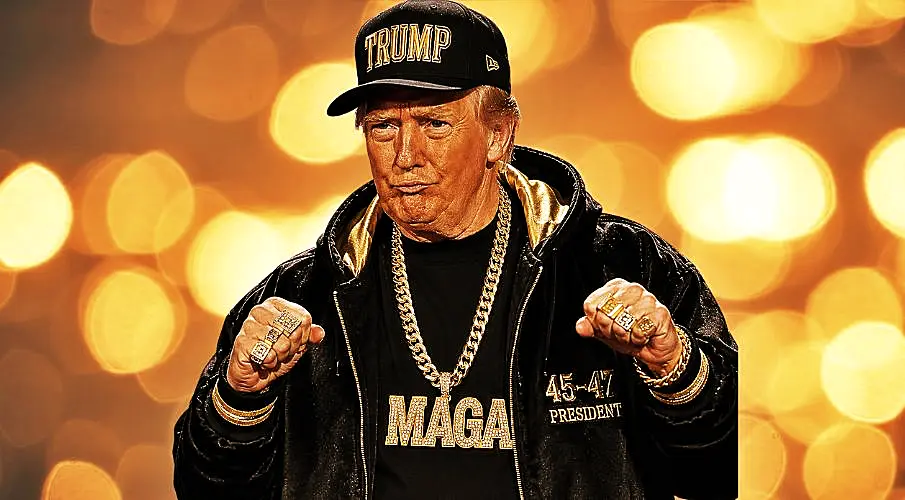
Washington, oppressive heat, a luncheon at the White House. The President of the United States has just spent forty minutes speaking, which, by his standards, almost qualifies as restraint, especially since he had already spoken at length in the Oval Office shortly beforehand. One might assume that now it is the guests' turn. But Donald Trump has a better idea. Should we play a little music, he asks, immediately offering his own explanation. That way, no one has to talk to each other. Everyone can just listen to the music. He then announces his personal playlist, promises everyone a little fun, and as journalists are escorted out of the room, YMCA blares over the heads of the silent guests.
One has to grant this man a certain honesty. Where other rulers spent decades building elaborate systems to prevent their subjects from talking to one another, censorship offices, secret police, informants at every table, Trump simply reaches for the remote control. Why go through the trouble of stopping people from talking when a disco hit accomplishes exactly the same thing. It is the efficiency of an entertainer applied to the art of governing. No gulag, just a loudspeaker. No ban, just a catchy beat. And one suspects he genuinely considers himself an exceptionally gracious host. So you don't have to talk to each other, he says, as though he were relieving his guests of an unpleasant obligation, as though making conversation with the person sitting next to them were one of those burdens from which a true humanitarian graciously sets people free. At last, no one has to pretend they care what someone else thinks. At last, everyone is free to remain silent and consume while the music fills the awkward silence that might otherwise force someone to form an original thought. What a benefactor this president is, a liberator from the burden of conversation.
The ancient philosophers, who foolishly believed that human beings become fully human only through conversation, would have struggled with a scene like this. They imagined the good life as people sitting together, wrestling with words, with truth, with better understanding. How hopelessly outdated. They had never heard YMCA. Had Socrates known that the question of the good life could be answered by a single disco classic, he could have spared himself all the trouble with the cup of hemlock. There is no need to argue with the Athenians. One simply has to play them the right playlist.
Because that is where the real skill lies. An old fashioned dictator would have ordered the guests to remain silent, immediately exposing himself, provoking resistance, creating martyrs. Trump orders nothing. He offers. He invites everyone to have fun. He packages silence as kindness and disenfranchisement as hospitality, and the guests nod gratefully because, after all, no one is actually forbidding them from doing anything. No one takes away their right to speak. They simply make speaking unnecessary. That is progress. Oppression has learned to smile, and now it wears headphones. It is also telling that he chose this particular song. A track Trump has turned into his personal signature, one that has followed him through every campaign like a loyal dog, a song containing not a single dangerous thought, one that everyone can shout along with without ever truly listening. It asks nothing. It demands nothing. It merely wants people to raise their arms and spell out the letters. The perfect anthem for a room where having an independent thought would already be considered a disruption. When YMCA is playing, no one has to talk anymore, and no one wants to.
One could dismiss all of this as the harmless eccentricity of an old man who cannot tolerate silence and prefers listening to his own voice. Perhaps that is exactly what it is. The problem is that this old man is not sitting at his kitchen table. He occupies the most powerful office in the world, and what he considers a charming little idea becomes a daily exercise in teaching that only one person speaks while everyone else listens. First at the lunch table, with a wink. Later somewhere else, without one.
In the end, the music keeps playing as the guests walk away, well fed, entertained, and comfortably silent. A president took conversation away from them and presented it as an act of hospitality, and no one objected. How could they. The music was playing.
Updates – Kaizen News Brief
All current curated daily updates can be found in the Kaizen News Brief.
To the Kaizen News Brief In English


