
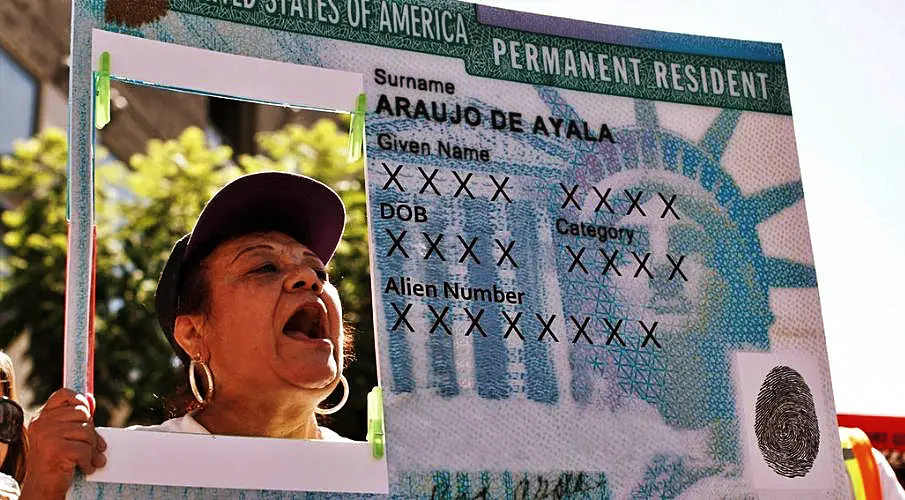
For decades, one of the established components of the American immigration system was that people legally present in the United States could change their immigration status directly inside the country. Those who met the requirements did not necessarily have to pack their bags, leave their lives behind, and fly to another country to wait for government decisions. Students moved into work programs after graduation, people with employment visas built careers, spouses of American citizens applied for permanent residency, and refugees and individuals with protected status tried step by step to build stability into their lives. For many, this process was not an exception but a practice that had existed for decades.

Now the Trump administration wants to intervene at exactly that point. On Friday, U.S. Citizenship and Immigration Services unexpectedly announced a change that created confusion and concern within hours. Foreign nationals temporarily staying in the United States who wish to apply for a Green Card would, in principle, now be required to leave the country and submit their application in their country of origin. Exceptions would only apply in so called extraordinary circumstances. What exactly qualifies as extraordinary initially remained largely undefined.
Shortly after the announcement became public, immigration attorneys and aid organizations became overwhelmed with activity. Phone lines lit up, email inboxes filled. People wanted to know whether spouses would suddenly be required to leave the country, whether ongoing cases would be affected, or whether families could be separated. Many of those questions initially remained unanswered. USCIS stated that it was returning to what it described as the original purpose of the law. People with student visas, temporary work visas, or tourist visas come to the United States for a specific purpose and should leave again after that purpose has been fulfilled. The agency essentially stated that temporary residence should not automatically become the first step toward permanent immigration.

Legal experts, however, do not see this as an ordinary administrative change. Doug Rand, a former USCIS adviser during the Biden administration, expressed his assessment in unusually direct terms. In his view, the goal of the policy had been openly stated. Senior figures in the administration had repeatedly said they wanted fewer people to receive permanent residency because a Green Card ultimately serves as a pathway to American citizenship. The possible consequences extend far beyond individual immigration procedures. According to figures from the Department of Homeland Security, approximately 1.4 million Green Cards were issued in 2024 alone. More than 820,000 of those went to people who were already inside the United States and adjusted their status there. For more than twenty years, well over half a million people per year typically used this process. Only during the COVID period did those numbers temporarily decline.
The consequences become especially visible in family situations. More than seventy percent of all people who obtained a Green Card through marriage completed the process within the United States. In 2024 alone, that involved roughly 250,000 people. For many families, this could create circumstances extending far beyond legal questions. An American citizen could suddenly learn that a spouse must leave the country in order to continue the application process outside the United States. Children could be separated from a parent. Families who have lived together for years could be forced to continue their lives across multiple countries.

Aid organizations are already warning about precisely that scenario. World Relief stated that certain families could find themselves in situations with virtually no workable way out. People could be required to return to their home countries to complete immigration processing even when those countries may not process visas or may lack the necessary structures.
The situation could become particularly complicated for people from countries already affected by American restrictions. The Trump administration has already taken steps limiting or complicating entry from numerous countries. In some cases, full travel bans exist. In others, visa procedures have been restricted or suspended. That raises a question attorneys immediately asked following the announcement. What happens to people who are required to leave the country but may ultimately be unable to return?
Afghanistan demonstrates how complicated these situations can become. The American embassy there was closed following the withdrawal of U.S. troops in August 2021. People from Afghanistan therefore do not even have a functioning American diplomatic mission in their own country through which such a process could take place. Shev Dalal-Dheini of the American Immigration Lawyers Association also voiced strong criticism. In her view, the new regulation could fundamentally alter a decades long practice. Those affected could include spouses of American citizens, individuals with humanitarian protection status, employment visa holders, physicians, skilled workers, students, and holders of religious visas. Another problem also exists. Even now, people at some American consulates abroad wait more than a year for appointments. If hundreds of thousands of additional cases are added, waiting times could increase even further.
Immigration attorney Robert O'Malley from Michigan reported concerned clients shortly after the policy was released. People were asking whether spouses would have to leave the country and whether families would be able to remain together. His response was cautious. He explained that he himself first needed to review the new six page document before making reliable recommendations. Even with the announced exceptions, much remained unclear. USCIS stated only that individuals with economic value or special national interest would likely continue using the current process. Which professions might qualify initially remained unanswered. Whether highly skilled workers, physicians, or people with H-1B work visas would fall under that category was not addressed.
For hundreds of thousands of people, a situation filled with uncertainty emerged within only a few hours. This is not only about forms or immigration documents. It is about homes, jobs, children, marriages, and future plans. It is about people who have spent years building their lives in the United States and who are now suddenly confronted with a question that even many immigration attorneys could not answer on Friday:
Must a life that is already taking place in America now first leave America in order to stay there?
Updates – Kaizen News Brief
All current curated daily updates can be found in the Kaizen News Brief.
To the Kaizen News Brief In English


Wie furchtbar! Hoffentlich gibt es da einen handwerklichen Fehler. Muss so eine Gesetzesänderung nicht von Senat und Kongress beschlossen werden?
Mein Account ist rudimentär gerettet Und für mich wichtig, er kann oder sie nicht an Bezahlfunktionen oder an mein WhatsApp. ZWEI Monate darf ich den Namen des Accounts von AI Mess nicht ändern. Wie finde ich Dich auf Instagram? All die tollen Menschen sind für mich gerade weg. Und das trifft mich hart. Und die Community vermisse ich sehr, weil ich ja immer noch keine Lösung für Mobilität habe und hybride Veranstaltungen und Mitgliederversammlungen selten sind. Und ich zu dem Thema noch viel lernen muss. Ich warte jetzt ab, ob der Hacker mich in Ruhe lässt. Grüsse bitte alle lieb von mir.
https://www.facebook.com/photo/?fbid=122235765266434116&set=a.122100076610434116 = alle von Dir herzlich gegrüßt incl Wasserstandsmeldung- Instagram haben wir, aber nutzen wir kaum, weil dort die Einspielvariante anders ist und uns für die Arbeit einfach die Zeit fehlt = https://www.instagram.com/the_kaizen_blog/ – Ist aber für die kommenden Monate geplant den Account auszuzubauen – Ganz liebe Grüsse
…hier die ersten Grüsse
Nun auch die Greencard und diverse andere Visa.
„…Nur in sogenannten außergewöhnlichen Umständen soll es Ausnahmen geben. Was genau als außergewöhnlich gilt, blieb zunächst weitgehend offen….“
Auf jeden Fall darf man sich nie Trump-kritisch geäußert haben.
Und bestimmte Länder, wie Trump es entscheidet, werden grundsätzlich ausgenommen sein.
Es werden erneut Millionen Menschen in den USA in eine emotionale und wirtschaftliche Unsicherheit gestossen.
Waskommt als Nächstes?
Überprüfung von Staatsbürgerschaften?
Wersich Trump-kritisch geäußert hat, dem wird ein „erschleichen“ der Staatsbürgerschaft vorgeworfen?
Ich davon aus, dass dagegen schon zig Klagen eingereicht worden sind?
Letztlichwird es wahrscheinlich vorm Marionetten Supreme Court entschieden…. in einigen Jahren.
Bis dahin bleibt die Angst und Unsicherheit. 😞
… komplett irre der typ und der schaden für amerika wird grösser und grösser