
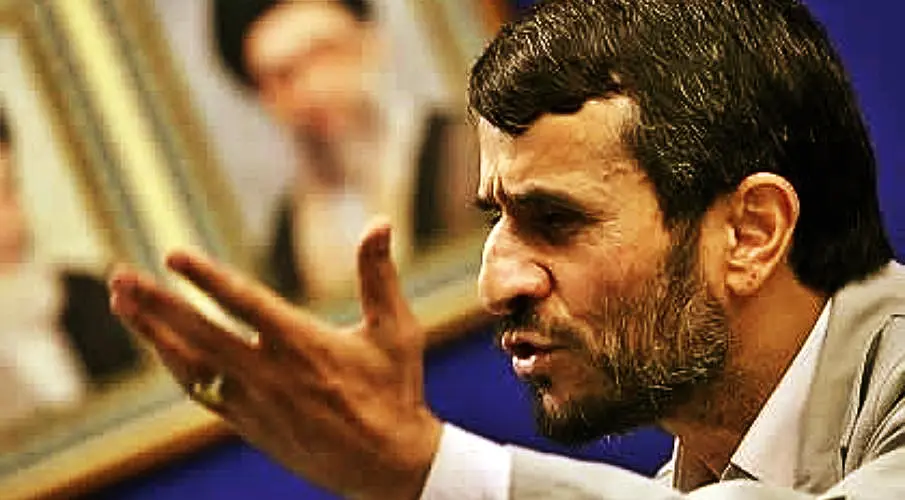
Just days after the war began, Donald Trump publicly stated that it would be best if "someone from the inside" took control of Iran. At the time, the remark sounded like one of those statements that are made quickly and disappear just as quickly. Now, reports from American government officials paint a much larger picture. According to those reports, discussions behind closed doors apparently involved far more than missile sites, nuclear facilities, or military infrastructure. In the background, there was allegedly a plan aimed at politically reshaping Iran. Even more surprising than the idea itself, however, is the person who, according to several individuals involved, was supposedly part of those considerations: Mahmoud Ahmadinejad.

For many people outside Iran, Ahmadinejad remains one of the most recognizable faces of the Islamic Republic. Between 2005 and 2013, he served as the country's president. His years in power were marked by harsh attacks on Israel, open confrontations with the United States, strong support for Iran's nuclear program, and an uncompromising approach toward domestic political opponents. Internationally, he became a symbol of Tehran's hard line. That is why the notion that American and Israeli officials may later have viewed him as a possible figure in a new political order now appears all the more surprising.
According to several American sources, Israeli planners were reportedly working directly with Ahmadinejad as part of a broader concept. Reports indicate that he was informed about parts of the plan. The objective allegedly extended far beyond military strikes. According to those accounts, behind the air campaign there was a multi stage concept designed to end with a new political leadership in Tehran.
But the plan apparently began to unravel on the very first day of the war
According to statements from American government officials and people close to Ahmadinejad, the area surrounding his residence in Tehran became the target of an Israeli strike. The attack allegedly was not intended to kill Ahmadinejad but rather to free him from what amounted to de facto house arrest. Ahmadinejad was reportedly injured but survived. People from his circle later stated that the strike deeply shook him. Afterward, he allegedly began distancing himself more and more from ideas involving a political restructuring.

Since then, Ahmadinejad has made very few public appearances. Conflicting reports exist regarding both his whereabouts and his health condition.
Additional confusion emerged during the first days of the war. On March 1, multiple media outlets, citing Israeli sources, reported that Mahmoud Ahmadinejad had been killed in Israeli airstrikes. The reports spread around the world within hours. But serious contradictions soon followed. Iranian officials were initially unable to confirm his death. Later, people close to him even stated that Ahmadinejad had survived the attack. A seemingly confirmed death report thus turned into one of those moments that repeatedly accompany wars: information races around the world while confirmed facts often arrive much more slowly.
The very selection of Ahmadinejad appears unusual. Unusual may actually be too weak a word. During his presidency, he became known for statements that sparked outrage around the world. He openly supported Iran's nuclear program and was among the fiercest critics of American and Israeli policy. At the same time, however, his political trajectory had become increasingly complicated in recent years.

His relationship with Iran's leadership steadily deteriorated. Ahmadinejad accused parts of the system of corruption and abuse of power. He repeatedly attempted to run again for president. In 2017, 2021, and 2024, the Guardian Council blocked his candidacy. Supporters were arrested. His movements were restricted. Within the leadership, he increasingly came to be viewed as difficult to control.
Even so, one question remained: why would someone like Ahmadinejad be considered as a possible figure at all?
According to American officials, during the early stages of the war there was a search for people who operated within the Iranian system while also potentially being willing to work with the United States. The effort reportedly was not focused on traditional opposition figures. Instead, the search targeted individuals with relationships inside the existing power structure who might also be willing to pursue a different political direction.
Even within American circles, serious doubts reportedly existed. Several government officials were said to have viewed the idea of bringing Ahmadinejad back into a leadership role with skepticism.

While the White House publicly stated that military objectives were limited, internal discussions apparently painted a larger picture. According to Israeli defense officials, the war was intended to unfold in multiple phases. Airstrikes and the elimination of key leadership figures were supposed to destabilize the existing power structure. At the same time, influence operations and additional forces within the country were supposed to generate further pressure.
The hope behind it was obvious. Tehran's leadership was supposed to lose control. Afterward, an alternative government was expected to emerge.
A central part of those plans, however, appears never to have become reality.
On the first day of the war, Israeli airstrikes hit multiple targets in Tehran. According to available reports, Ayatollah Ali Khamenei was also killed. Until his death, Khamenei had served as Iran's Supreme Leader and as the country's highest political and religious authority. He died on February 28, 2026. With his death, the Islamic Republic lost its central power figure, whose influence extended across the military, the judiciary, and nearly every decisive state structure. Yet the expected political chain reaction never materialized. The leadership did not collapse. The political system remained functional.
Looking back, that point now appears to have been one of the greatest miscalculations. The assumption that military pressure alone would be sufficient to rapidly collapse an existing power structure apparently proved far more complicated than expected.
Ahmadinejad's contacts outside Iran are also noteworthy in this context. In recent years, he made several trips that triggered speculation. In 2023, he traveled to Guatemala. In 2024 and 2025, he visited Hungary. There he spoke at a university with ties to then Hungarian Prime Minister Viktor Orbán, who is considered a close ally of Benjamin Netanyahu.

Shortly before the attacks against Iran began, Ahmadinejad returned from Budapest. When the war started, many observers noticed how unusually restrained he remained. For someone who had spent years portraying Israel as the principal enemy, his public response was strikingly quiet.
Even months later, parts of those earlier discussions apparently have not completely disappeared. According to several individuals, David Barnea, head of Israel's foreign intelligence agency Mossad, continues internally to hold the view that the plan could have had a strong chance of success if fully implemented.
Whether Ahmadinejad would ever actually have been willing to assume such a role remains an open question.
One thing alone appears certain. Behind the official explanations about missiles, infrastructure, and military targets, a much larger operation seems to have been hidden. And the very man who once became the global face of Iran's uncompromising hard line suddenly appears to have become part of a completely different equation.
To be continued ...
Updates – Kaizen News Brief
All current curated daily updates can be found in the Kaizen News Brief.
To the Kaizen News Brief In English


Was für eine Recherche!
Wenn man das liest, würde man denken, dass Hollywood übertreibt.
Aber 2026 übertrumpft die Realität jede Dystopie.
Die USA haben aus der Geschichte nichts gelernt.
Afghanistan, Syrian, Iran und Iran.
Der Iran ist nicht Venezuela.
Wo man Jemanden aus dem „inneren Kreis“ an die Macht bringt und den dann kontrolliert.
Israel und USA müssen ja derart dumm sein, den Wolf im Schafspelz –Ahmadinedschad- an die Spitze bringen zu wollen.
Einen Antisemiten, USA Hasser, islamischen Hardliner.
Der soll dann nach der Pfeife der USA und Israel tanzen? Haben die sich das echt so vorgestellt?
Dazu fällt mir echt nichts mehr ein.
…kannst du absolut verfilmen diese geschichte, und ja, Amerika hat nichts gelernt aus den ganzen dingen – hat mit trump dazu noch einen geschädigten präsidenten im oval sitzen