
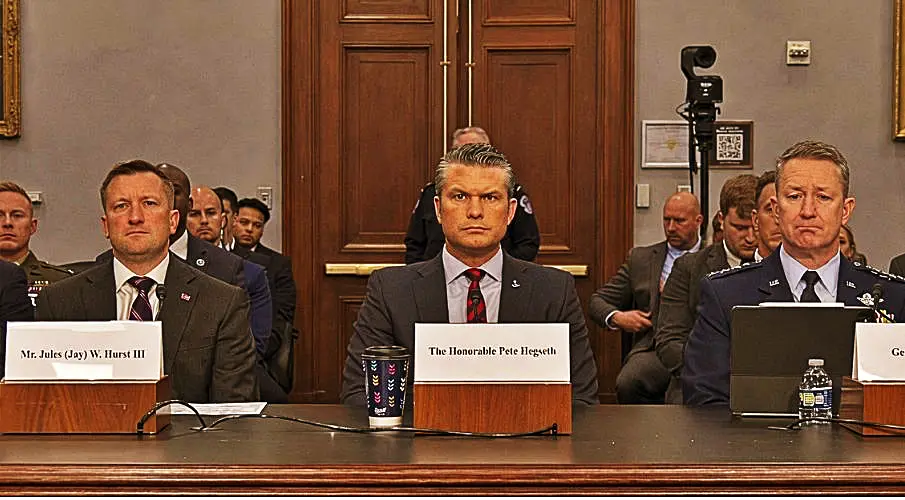
Washington - Long before Pete Hegseth even entered the hearing room, that tense atmosphere already hung over Capitol Hill, the kind that usually emerges in Washington when even members of the president’s own party begin growing nervous. Protesters against the war stood outside the doors. Some held signs high in the air, others shouted slogans against Donald Trump. Inside the chamber, activists wearing pink shirts sat in the back rows. When Hegseth finally took his seat alongside General Dan Caine and Pentagon Comptroller Jay Hurst, a woman suddenly stood up, raised her hands covered in fake blood into the air, and shouted at the defense secretary that the American public did not support this war. Seconds later, security officers escorted her out of the room. Other demonstrators later walked out of the hearing in protest.
Officially, the day was supposed to focus on the Pentagon budget - nearly $1.45 trillion for the coming year. But after only a few minutes it became obvious that almost nobody was seriously interested in discussing normal budget numbers anymore. The entire day revolved around Iran, exploding war costs, the blocked Strait of Hormuz, depleted weapons stockpiles, damaged American bases, an administration without a clear funding strategy, and the growing question of whether the White House is now effectively bypassing Congress altogether.
One detail stood out immediately during Hegseth’s opening remarks. Unlike two weeks ago, he barely mentioned the war against Iran in his prepared statement at all. For days, the White House has visibly tried to create the impression that the fighting is largely over. Only recently, the administration officially informed Congress that hostilities had ended.
But inside the Capitol, even many Republicans no longer seemed to believe that.
Because while Washington publicly speaks about a ceasefire, roughly 15,000 American troops remain stationed in the region. More than 20 warships are still operating around the Strait of Hormuz. The American naval blockade against Iran continues unchanged. Just last week, American warships once again intercepted Iranian attacks. At the same time, the Pentagon openly discusses new escalation plans, additional troop movements, and further military options.
And with every passing week, the costs continue to rise.
Pentagon Comptroller Jay Hurst told lawmakers that war expenditures have now reached roughly $29 billion. Just two weeks ago, the same administration was still talking about $25 billion. Four billion dollars in additional costs within only a matter of days. Yet even that figure apparently represents only part of the real burden.
Hurst openly admitted that the $29 billion does not even include the damage to American military bases across the Middle East. More than a dozen facilities were damaged during Iranian missile and drone attacks. Which bases will actually be fully rebuilt, how expensive the repairs will become, and whether allied countries will cover part of the costs are all questions the Pentagon currently says it cannot answer.
Those statements visibly unsettled Congress.
At the same time, the administration continues demanding additional billions without submitting a complete supplemental war budget. Democrats and Republicans repeatedly pressured Hegseth to finally provide concrete numbers.
Republican House Defense Appropriations Chairman Ken Calvert openly stated that Congress needs to begin work on an additional war funding package as soon as possible. “The sooner, the better,” Calvert said in substance. But Hegseth avoided virtually every specific answer.
“Whatever we need, we will request,” he said.
Exactly when. How much. Through what mechanism. None of those questions were answered. Again and again, the same impression emerged - the administration is visibly trying to reveal as little concrete information as possible while simultaneously demanding more billions.
That became especially clear when Senator Patty Murray directly asked Hegseth how expensive the reconstruction of damaged military bases would become. Hegseth did not respond with numbers. Instead, he answered with a counterquestion: “What is the cost if Iran gets a nuclear weapon?”
The room briefly fell silent.
That style of response continued throughout almost the entire day. Every time lawmakers demanded concrete figures, timelines, or strategic details, Hegseth immediately pivoted back toward broad statements about national security, American strength, or the dangers of a nuclear-armed Iran. At the same time, the administration increasingly contradicted itself.
Because on one hand, the White House still attempts to portray the situation as a ceasefire. On the other hand, Hegseth openly discussed the fact that the United States has already prepared new escalation plans.
“We have a plan to escalate if necessary,” he said. At the same time, he added that the military also has plans for withdrawals and force repositioning.
Shortly afterward, Hegseth also confirmed that the American escort missions for commercial shipping - the so-called “Project Freedom” - could be fully resumed at any moment if Donald Trump ordered it. That made the claim of a concluded military operation appear even more absurd.
The situation became especially embarrassing when Hegseth attempted to explain the ceasefire itself.
“A ceasefire mostly means the firing stops,” he said.
The statement visibly irritated even journalists inside the chamber. At the same time, the military had already confirmed new incidents, Iranian attacks, and ongoing operations throughout the region. Senator Lisa Murkowski eventually addressed the contradiction directly.
If 15,000 American troops remain deployed, more than 20 warships continue operating, and an active naval blockade is still underway, then it is difficult to claim that hostilities have ended.
“In other words - it does not look like hostilities have ended,” she said.
Murkowski has now become one of several Republicans openly criticizing the Trump administration for effectively bypassing Congress in this war. Under American law, a president generally requires congressional authorization after 60 days if military operations continue. The White House now argues that the ceasefire effectively pauses that timeline. Hegseth made it completely clear that the administration has no intention of seeking new authorization.
If Donald Trump decides to massively escalate the war again, he already possesses all necessary powers. Trump has “all the authorities he needs under Article Two.” That position is precisely what now makes even Republicans increasingly uneasy. At the same time, fears continue growing that the United States is sinking deeper and deeper into a conflict whose long-term consequences almost nobody can clearly explain anymore.
The debate over the Strait of Hormuz became especially heated.
Senator Susan Collins openly discussed the fact that American consumers are already feeling the effects. Gasoline prices are rising. Diesel prices are rising. Heating oil is becoming more expensive. At the same time, she said it appeared as though the administration changes its strategy almost daily. Then Collins asked the question that practically everyone in the room wanted answered.
Did the administration ever seriously account for the possibility that Iran could block the Strait of Hormuz?
General Dan Caine spoke for several minutes without actually answering the question. He merely explained that the military routinely evaluates many scenarios and that he would not publicly discuss conversations with the president.
He completely refused to provide a direct answer.
Later, Hegseth escalated the situation even further.
Before senators, he claimed that the United States ultimately controls the strait because “nothing goes through that we do not allow.”
The statement appeared remarkable because reality still looks very different.
Iran continues controlling large parts of movement throughout the region. The trade route remains heavily disrupted. Tanker insurance costs continue surging. International shipping companies are changing routes. Energy prices react almost daily to new incidents.
Senator Chris Coons therefore confronted Hegseth unusually aggressively.
Again and again, Coons asked how the administration actually intends to fully reopen the trade route. At the same time, he warned against confusing tactical successes with a functioning long-term strategy. “You may have achieved tactical successes, but you are approaching a strategic failure,” Coons said clearly. Hegseth responded with increasing irritation and accused critics of deliberately downplaying American military successes.
Senator Jeanne Shaheen also clashed with Hegseth.
Shaheen pointed out that Iran still remains capable of carrying out drone attacks. Hegseth attempted to minimize the threat and argued in substance that pulling old drones “out of collapsed caves” is entirely different from producing new weapons. Shaheen rejected the argument. If Iran still retains nearly half of its operational capabilities and remains capable of injuring American troops or allies, then the administration has obviously not won the war, she argued.
At the same time, concerns about American weapons stockpiles continued growing.
Hegseth repeatedly claimed that discussions about ammunition shortages had been “greatly exaggerated.” The United States still possesses enough of everything it needs.
Yet government officials simultaneously confirmed once again that large quantities of missiles, bombs, and military equipment had been transferred from Europe and Asia into the Middle East. That reduces readiness in other regions - particularly regarding China and Russia.

General Caine repeatedly tried calming lawmakers and stated that the United States still possesses sufficient ammunition for current operations. At the same time, however, it became increasingly clear that Washington must dramatically expand production capacity simply to replace existing losses.
Deep tensions also emerged on foreign policy during the hearings.
Senator Mitch McConnell delivered an unusually open statement about the importance of American alliances. Without mentioning Donald Trump directly, he warned against damaging traditional partners in Europe. NATO remains the world’s most important military alliance, he argued.
McConnell also once again defended support for Ukraine and explicitly stated that the United States can learn a great deal from Ukrainian experience in drone warfare.
Shortly afterward, lawmakers also addressed the planned relocation of 5,000 American troops out of Germany.
Chris Coons openly stated that the United States is sending a dangerous signal to European allies at exactly the wrong moment.
Senator John Kennedy also spoke during the hearing.
Kennedy generally supported the administration’s overall direction, but simultaneously warned against isolating America internationally.
“America First does not have to mean America Alone,” he said in substance. Allies must carry their share of the burden, but the United States still needs partners.
Additional tensions ultimately emerged over Pakistan.
Senator Lindsey Graham reacted with visible anger to reports claiming Iran may have positioned military aircraft on Pakistani airfields in order to shield them from American airstrikes.
“I do not trust Pakistan any farther than I can throw the country,” Graham said.
When Hegseth and General Caine refused to comment and stated they did not want to jeopardize ongoing negotiations, Graham nearly exploded with frustration.
“No wonder this damn thing is going nowhere,” he said angrily.
But the war itself is no longer the only source of conflict. Funding for the Pentagon budget is also becoming a political liability. Hegseth continues attempting to push large parts of the defense budget through the so-called reconciliation process - a mechanism that allows Republicans to bypass Democrats in the Senate.
But even Republicans now warn against the strategy. Tom Cole openly stated that it is risky. If Republicans lose their majority in the future, this entire funding structure could collapse. McConnell also indirectly criticized the approach and warned against financing permanent military expenditures through temporary emergency mechanisms. At the same time, yet another development shook the administration.
FDA Commissioner Marty Makary resigned following intense pressure. The apparent trigger was a dispute over the approval of flavored e-cigarettes. Makary reportedly refused to authorize such products because they particularly target younger consumers. The news spread through Washington almost in the background during the hearings - but it further reinforced the impression of an administration where conflicts are now escalating on multiple fronts simultaneously.
By the end of the hearings, one impression above all remained.
The Trump administration is simultaneously trying to politically portray this war as finished while militarily preserving the ability to escalate it at any moment. That contradiction now dominates Washington. Officially, the White House speaks of a ceasefire.
In practice, the Pentagon and military leadership are already once again discussing new attacks, additional billions in costs, further troop movements, damaged bases, depleted weapons stockpiles, and a permanent American military presence in the Middle East. And that is exactly why the questions inside Congress became sharper and sharper by the end of the day. Many senators and representatives no longer simply want to know whether the United States is militarily successful.
They want to know how long this war will continue. How expensive it will ultimately become. How far Donald Trump is willing to go. And whether anyone in Washington still possesses a political strategy that extends beyond bombings, blockades, and endless demands for more billions.
Updates – Kaizen News Brief
All current curated daily updates can be found in the Kaizen News Brief.
To the Kaizen News Brief In English


Der Preis für all diese Verantwotungslosigkeit wird für die Menschen in USA und für die Welt ungemein hoch werden. Das menschliche Elend was dabei entsteht kann ich mir kaum vorstellen. Ich denke USA hat in allem verloren.
..
👍
1,45 Billionen Dollar…. diese Zahl muss man sich erstmal auf der Zunge zergehen lassen.
Eine Summe, die sich ein Normalbürger kaum vorstellen kann.
Es ist kein Geld für Medicaid, SNAP, Schulbildung, Veteranenhilfe etc da.
Aber Hegseth will 1,45 Billionen Dollar ohne ein einziges Mal konkret zu beziffern wofür.
Keiner vorm Ausschuss hat eine klare Antwort gegeben, nicht Einer.
Stattdessen blabla mit Nebelkerzen.
So etwas passiert, wenn man einen mittelmäßigen FOX Moderator zum Verteidigungsminister macht, der sich dann selber im Kriegsminister umbenennt.
Wer braucht denn den Kongress dazu?
Man braucht den Kongress ja auch nicht für den Irankrieg….🤬🤬🤬
Das Schlimmste ist, dass Trump trotz allem noch knapp 40% Unterstützung hat.
Und die Republikaner werden, wenn es um die Filibuster Abstimmung herum, für die 1,45 Billionen Dollar für Trump stimmen…. das zieht sich wie ein roter Faden.
Bisschen Kritik, aber dann doch der Trump Sache die Stimme geben.