
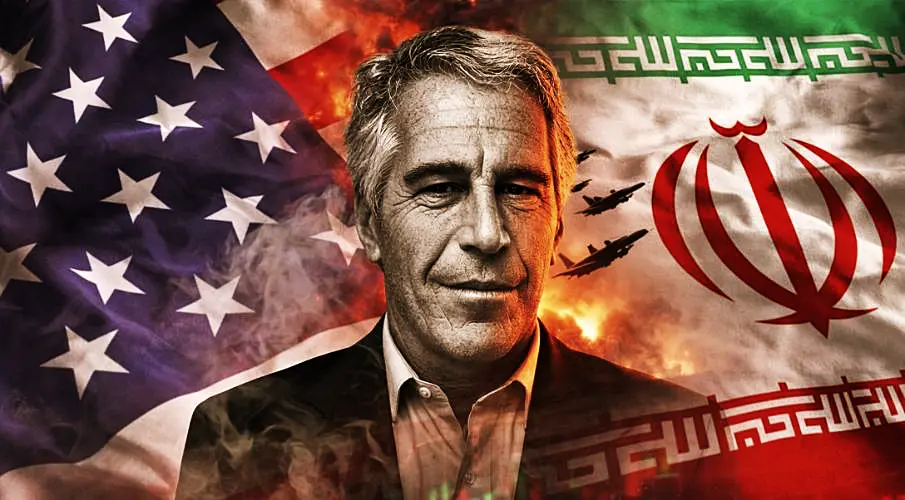
In the summer of 2014, Jeffrey Epstein was not sitting somewhere on his island or in a luxurious apartment in Manhattan. He was walking through Washington, meeting officials from the U.S. Treasury Department, talking about cryptocurrencies, Iran sanctions, terrorist financing and international money flows. Years later, it now looks like one of those stories almost nobody took seriously at the time and that suddenly carries an entirely different significance today.
Because while American warships are now stopping tankers connected to Iran, wallets are being seized and billions of dollars move through cryptocurrencies across the Middle East, published emails and internal records show that Epstein appeared in the middle of discussions about exactly this development more than ten years ago.
In August 2014, Epstein traveled to Washington. According to his records, he met representatives from the Office of Terrorist Financing and Financial Crimes at the U.S. Treasury Department. Also present was Philip West from the law firm Steptoe, which was heavily involved in international sanctions issues. The officials wanted to understand how Bitcoin and other digital currencies could eventually be used to evade sanctions, pay for weapons shipments or move money outside traditional banking systems.
At the time, Iran was under enormous pressure. The Obama administration was trying to tighten economic pressure on Tehran while simultaneously advancing nuclear negotiations. It was during this exact phase that American security agencies began realizing that cryptocurrencies could one day become a problem for Washington’s global financial power.
Iran was also watching the development closely. In Tehran, there was deep mistrust toward Bitcoin at the time. Some officials even viewed the technology as a possible American trap or an instrument of Western intelligence agencies. Nevertheless, Iran began regulating cryptocurrencies in 2014 because sanctions were increasingly cutting the country off from the international financial system.
By then, Epstein had long been moving through circles where intelligence agencies, finance, arms dealing and international politics overlapped. Back in the 1980s, he already had ties to Adnan Khashoggi and Stan Pottinger. Khashoggi was deeply involved in international arms deals and played a role in the Iran-Contra affair. Pottinger worked with offshore structures, embargo evasion schemes and covert financial networks. Epstein did not know this world from files or reports. He knew it through personal relationships.
After his Treasury Department meeting, Epstein wrote to Joi Ito from the MIT Media Lab. The officials, he claimed, were “not particularly intelligent” and extremely convinced of themselves. Later, he complained to Kathryn Ruemmler, Barack Obama’s former White House counsel, saying the meeting had felt like a lecture at a community college.

Still, he remained closely connected to the developments. Directly after the Treasury meeting, Epstein spoke privately with William Burns. At the time, Burns was one of the Obama administration’s most important negotiators in the conflict with Iran and was leading talks over the Iranian nuclear program. Years later, he became CIA director under Joe Biden.

This is where the story becomes especially explosive. Because one day after the meeting, Epstein wrote to Peter Thiel. He offered to arrange a meeting between Burns and Thiel. In the message, Epstein described Burns as the “best and most respected diplomat in the government.” So while Washington was trying to pressure Iran with new sanctions, Epstein was simultaneously moving between the leading U.S. negotiator on Iran and one of Silicon Valley’s most powerful figures.
At that point, Peter Thiel was already far more than just an investor. Through Palantir, security contacts and his connections within the American technology world, he himself operated close to intelligence and national security structures. The fact that Epstein tried to connect Burns and Thiel shows how tightly diplomacy, the tech industry and financial questions were already intertwined at the time. The fact that Epstein attempted to bring William Burns and Peter Thiel together during ongoing Iran negotiations still raises questions to this day. It was precisely during this period that Washington began understanding that cryptocurrencies and new financial technologies could eventually alter geopolitical power structures.
Read also our investigation: The Architecture of Control: How Peter Thiel’s Data Power and the Political Network Rockbridge Undermine Democracy
Only days after Epstein’s Washington visit, the United States announced new sanctions against Iranian companies, banks and ships. Shortly afterward, Burns traveled again to Geneva for talks with Iranian representatives. Soon after that, Burns reportedly met Epstein again in New York, according to published records. Burns has since stated through a spokesperson that he only met Epstein briefly and knew nothing about his background. Once he learned more, he ended contact. According to Burns, they never discussed cryptocurrencies or Iran.
At the same time, Epstein deepened his connections within the early crypto scene. Years earlier, he had already begun exchanging ideas with developers, hackers and investors working on Bitcoin. As early as 2011, he wrote to British-Iranian developer Amir Taaki, saying the idea behind Bitcoin was brilliant but carried dangerous implications.
Particularly remarkable were his conversations with Italian hacker Vincenzo Iozzo. The two discussed how cryptocurrencies could remain anonymous while still being accepted by banks and governments. Iozzo explicitly warned Epstein against destroying Bitcoin’s anonymity. For Washington, that was exactly the nightmare scenario. The more anonymous cryptocurrencies became, the harder it would be to technically enforce sanctions against countries like Iran or trace financial flows.
Once every transaction became fully traceable, Iozzo wrote, anyone could eventually see who bought, paid for or owned what. For advertising companies, that would be the perfect dream. For ordinary people, it would be the worst nightmare. Today, the statement feels almost disturbingly relevant as governments, corporations and security agencies around the world increasingly try to monitor digital payment flows.
At the same time, the Silk Road case shook the crypto world. The platform used Bitcoin for anonymous drug trafficking and illegal business. After Ross Ulbricht’s arrest, Epstein exchanged messages with Boris Nikolic, a close adviser to Bill Gates, about the investigation. Epstein appeared less disturbed by the crimes themselves than by the mistakes made by those involved.

In 2014, Epstein then began investing heavily in the infrastructure behind Bitcoin. Together with Joi Ito, he invested in Blockstream, a company helping shape the technical future of the Bitcoin network. Shortly afterward, Epstein established contacts with Brock Pierce, one of the co-founders of Tether. While the Obama administration was trying to increase economic pressure on Iran, a parallel digital financial world was emerging that could increasingly bypass traditional sanctions mechanisms.
Only weeks later, Epstein already began restructuring his own financial systems around cryptocurrencies. In an email to his attorney Erika Kellerhals, he wrote that bank certificates needed to be changed so Bitcoin could be used. The message shows that Epstein no longer viewed cryptocurrencies as merely a theoretical subject. While Washington was still trying to understand how digital currencies could be used for sanctions evasion, arms trading or terrorist financing, Epstein was already working on adapting his own banking and payment structures for exactly that purpose.

Epstein also remained closely connected to the officials involved after his Treasury Department meeting. Particularly striking was his communication with Anne Shere Wallwork, a senior employee at the Office of Terrorist Financing and Financial Crimes. In emails, Epstein announced plans to hold additional meetings with the Treasury Department together with Joi Ito. At the same time, he pointed out that Larry Summers was also part of this environment. Summers was not just anyone. He had served as U.S. Treasury Secretary under Bill Clinton and was one of the most influential economic policymakers in the United States. Epstein was suddenly operating in the middle of a network connecting former senior government officials, crypto investors, technology developers and the agencies trying to understand how digital currencies could reshape sanctions and international financial systems.

At the time, Tether was still called Realcoin and was a small project. Today, the stablecoin has become one of the most powerful instruments in the global crypto market. Tether connects traditional dollar reserves with digital payment systems operating outside normal banking networks.
That exact system now plays a central role in the conflict with Iran. While the United States attempts to seize Iranian crypto wallets and block digital financial structures, Tehran now actively uses cryptocurrencies to bypass American sanctions. Billions of dollars move through crypto exchanges and platforms such as Binance. Oil deals, shipping payments and international transfers are increasingly handled digitally.
According to multiple reports, some shipping companies now even pay crypto fees for passage through the Strait of Hormuz. Iran uses this system to shield payments from American access. At the same time, the U.S. Treasury Department is seizing wallets and digital assets allegedly connected to Iran.
In the middle of this development, another old Epstein associate appears again - Howard Lutnick. The current U.S. Commerce Secretary was not only Epstein’s neighbor and business associate. His company, Cantor Fitzgerald, now manages large portions of Tether’s U.S. Treasury reserves.
Read also our article: Investigation shows: US Commerce Secretary Howard Lutnick Lied - Six Years of Business With Epstein
According to company statements, Cantor Fitzgerald now holds Treasury assets worth more than $140 billion tied to Tether. That makes the firm directly connected to the stablecoin now playing a central role in the international crypto market. Lutnick later publicly claimed he cut ties with Epstein in 2005. But U.S. Justice Department documents and investigations paint a different picture. They show contacts continuing until at least 2018, including meetings on Epstein’s private island and joint payment-related projects. During a congressional hearing, Lutnick has since admitted himself that he visited Epstein’s island in 2012.
Looking back, what stands out most is how early Epstein understood that cryptocurrencies would eventually become far more than a toy for tech forums or speculators. Years before governments openly discussed stablecoins, central bank digital currencies or crypto sanctions, he was already moving between diplomats, hackers, Wall Street, Silicon Valley and government officials.
Today, those exact issues sit at the center of the global power struggle between Washington, Iran, China and Russia. Cryptocurrencies already play a role in sanctions, oil trading, weapons procurement and international payments. And in the middle of the earliest discussions about all of it, the same name keeps appearing again and again - Jeffrey Epstein.
Updates – Kaizen News Brief
All current curated daily updates can be found in the Kaizen News Brief.
To the Kaizen News Brief In English


Es schockiert mich immer wieder, wie das Netzwerk der Boshaftkeit sich ausweitet.
Epstein reicht so weit in die Wirtschaft, zu Kontakten mit wichtigen Entscheidungsträgern.
Allen gemein ist, dass sie angeblich alle nur mal kurz Kontakt mit Epstein hatten.
Alle leiden wohl diesbezüglich unter kollektiver Anmesie.
Diese Recherche zeichnet ein ganz anderes Bild.
Sie belegt, wer wann welche Kontakte mit Epstein hatte.
Viele bekannte Namen tauchen auf.
Manchmal nur als Arbeitgeber eines Epstein Kontaktes, manchmal als direkter Kontakt
Es ist ein Treibsandsumpf.
Ein Fakt taught auf.
100 Fragen hängen dran.
Legt man eine Sache frei, hängt ein ganzer Rattenschwanz mit dran.
Alleine Epstein kann 100 Menschen für Jahre zur Offenlegung einbinden.
Danke, dass Ihr da dran bleibt.
Ist etwas dran am CNN Bericht, dass Mitgefangene von Ghislaine Maxwell best raft werden, wenn sie sich schlecht über Maxwell äußern?
War gestern ein Bericht bei CNN