
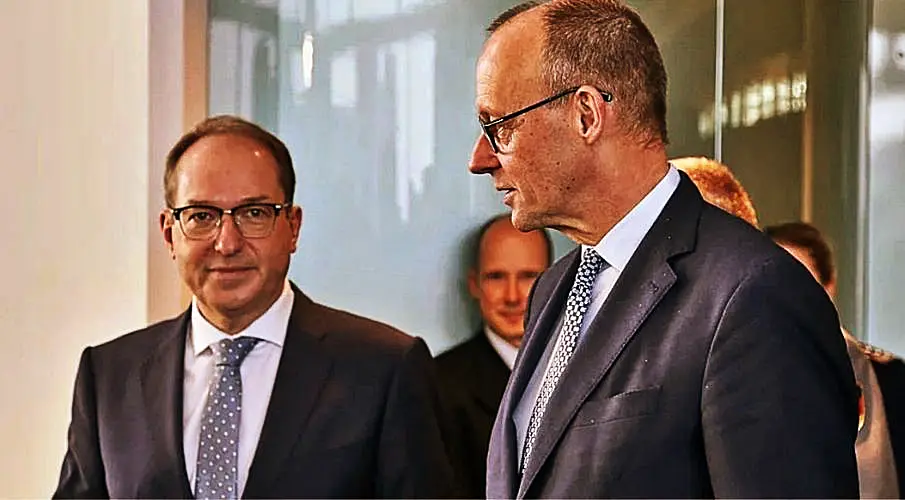
Inside Germany’s security agencies, concern over Iranian directed attacks in Germany has been growing for months. While Chancellor Friedrich Merz and Interior Minister Alexander Dobrindt continue publicly presenting the threat in restrained terms, intelligence officials internally are warning far more aggressively about possible attacks, sabotage operations and covert activities on German soil. Behind the scenes, this has reportedly led to major tensions between political decision makers and parts of the intelligence community.

The frustration is apparently especially severe within regional security agencies. Multiple senior German security officials report that authorities there increasingly believe the federal government is publicly downplaying the threat too heavily. While Merz stated as recently as March that there was currently no indication of an elevated threat level inside Germany, intelligence officials have reportedly become far more direct both internally and in conversations with lawmakers. In their assessment, the war between the United States, Israel and Iran has clearly increased the danger of terrorist actions in Germany.

Germany itself is increasingly becoming a direct focus of Tehran. The German government politically and logistically supports American military operations in the Middle East. US bases on German soil are being used for operations. From the perspective of Iran’s leadership, that makes Germany a direct adversary. Security agencies therefore fear so called hybrid attacks. These refer to operations not carried out directly by Iranian agents themselves, but through recruited intermediaries, criminal networks or ideologically aligned groups.
According to German security officials, roughly 50 suspected Iranian operations or operational plans inside Germany had already been identified before the war began. Those structures are reportedly still active. Some groups are financially supported, others pressured or deliberately recruited. Jewish institutions are considered particularly vulnerable. According to security sources, two Jewish institutions in Germany are currently viewed as possible targets of ongoing Iranian planning.
At the same time, German authorities have for years observed a shift in Iranian operational methods. Instead of deploying their own agents directly, Tehran increasingly works through proxies. According to several security officials, the methods strongly resemble Russian intelligence structures. For Iran, this approach is cheaper, more flexible and harder to prove. In addition, there is growing concern about connections to organized crime in Europe. German investigators now see links between Iranian networks and biker gangs, smuggling structures and individuals tied to organized crime circles. People with Iranian roots are reportedly approached especially often because they can allegedly be pressured or recruited more easily.
How seriously the threat is now being viewed was demonstrated by an incident in Munich. Last month, an Israeli restaurant in the university district was attacked. Perpetrators smashed windows and threw explosive devices into the building. No one was injured. A group calling itself Harakat Ashab al-Yamin al-Islamiyya claimed responsibility. According to its own statements, the organization now claims more than a dozen similar actions across Europe, including incidents in Belgium, Britain and the Netherlands. A planned attack on a Bank of America building in Paris was also attributed to the group. French authorities, however, were able to prevent the attack.
German intelligence agencies reportedly discovered indications that the group received financial and logistical support from Iranian connected circles. At the same time, Iranian exiles living in Germany are increasingly coming under pressure. Particularly alarming are reports surrounding a major anti Iranian government demonstration in Munich in February involving roughly 250,000 participants. According to German authorities, Iranian intelligence operatives mixed among the demonstrators. Later, individual participants were reportedly threatened, intimidated and physically attacked. The attackers allegedly deliberately referenced information about relatives of those individuals still living in Iran in order to demonstrate both their identities and their capacity for intimidation.

Publicly, the German government long spoke very little about these incidents. Only now has the Interior Ministry acknowledged that ongoing investigations into possible Iranian operations in Germany exist. Behind the scenes, however, concern is apparently growing that Germany has already been pulled far deeper into this conflict than many politicians publicly want to admit.
To be continued ...
Updates – Kaizen News Brief
All current curated daily updates can be found in the Kaizen News Brief.
To the Kaizen News Brief In English


Merz hält es wahrscheinlich für „zu komplex“.
Das es terroristische Zellen in Deutschland gibt und sich bedauerlicherweise viele junge (islamische) Männer radikalisieren, ist nicht neu.
Das konnte man schon bei dem Angriffs Israels gegen die Hamas aufgrund des furchtbaren Anschlages sehen.
Der Anschlag wurde gefeiert 😞
Zitat: „….. Die Bundesregierung unterstützt die amerikanischen Militäraktionen im Nahen Osten politisch und logistisch. US-Stützpunkte auf deutschem Boden werden für Operationen genutzt. ….“
Genaudas ist auch die Begründung des Iran für seine Angriffe auf die Nahost Staaten.
Auch andere europäische Länder und UK werden in den Fokus rücken.
All das ist Wasser auf den Mühlen der AfD und anderer Rechtspopulisten.
So kann man Politik auch beeinflussen.
Man beginnt einen Krieg, wohlwissend dass das angegriffene Land bekannt für Anschläge ist.
Nur die Angst es könnte was passieren, schaltet bei Vielen das Gehirn aus.
Und prompt wird rechtspopulistisch gewählt.
…problem ist, das regierung bzw staatssekretäre nicht gerade optimal mit den behörden kooperieren