
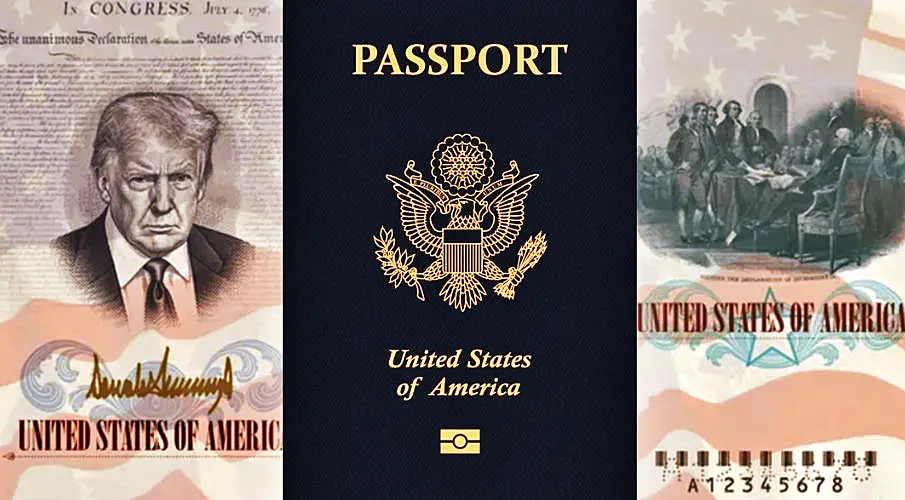
There is a moment in the history of every autocracy that does not begin with tanks. It begins with a form. With a stamp. With a document that suddenly carries a different face - and no one finds it worth the effort to ask out loud why. Donald Trump wants his portrait printed in the US passport. Clearly placed, superimposed over the Declaration of Independence, his signature in gold beneath it. According to information from the State Department, work on this design is currently underway. A limited run of 25,000 passports is planned for now, final approval is still pending. It sounds like bureaucracy. It smells like something else.

The U.S. passport has long featured historical imagery, including Mount Rushmore with multiple presidents carved in stone, the Declaration of Independence, and landscapes as collective symbols of a republic that never pledged itself to a single man. The signature in the document belonged to the Secretary of State, not the president. That line was not a formality. It was a quiet understanding that the state is larger than the person who happens to run it. Trump erases that line - not with a speech, not with a law, but with a print order. The most effective form of expanding power is always the one that looks like routine administration.
No other country in the world does this. Not France, not Russia, not China. Even the regimes people like to compare do not print their head of state into the travel documents of their citizens - which either signals restraint or simply reflects that other methods are preferred there that use less ink. The passport is the most neutral document a state issues. No opinion, no loyalty, just the factual statement: this person exists, and we stand behind it. Trump turns it into a declaration. His.
The pattern is not new, only more shameless in his second term. Buildings carry his banners, programs carry his name, a platform for medication runs under TrumpRx - as if the brand name were the therapy and the logo the cure. The Treasury is planning coins with his face, a one-dollar coin for circulation, a commemorative coin in maximum size, officially justified by the 250th anniversary of American independence. As if independence had waited 250 years for its final embodiment - and finally found it in a man from Queens with a gold elevator in a high-rise.
What is taking shape here is not narcissism. Narcissism is a private condition, treatable, discreet, at most uncomfortable at family gatherings. What is taking shape here is state architecture. The systematic merging of a person with an institution - pursued so long and so tightly that the difference stops being visible. Not because it disappeared. But because habit works faster than memory.
Anyone crossing a border with this passport in the future will not be carrying their country. They will be carrying a man. Whether they voted for him or not, whether they admire him or despise him - the document does not ask. It shows a face. And that face has placed its signature in gold beneath it, as if the Declaration of Independence had been a contract that had waited centuries for the right signature. The most dangerous politician is not the one who lies - lies can be proven, attacked, contained. The most dangerous politician is the one who has stopped distinguishing between himself and the state. Not out of confusion. Out of conviction. With the calm certainty of a man who wakes up in the morning and no longer considers the difference between his property and that of his country a relevant category.
That is the real process behind this print order. Not a design decision, not an anniversary, not a collector’s edition for patriots with too much space on their shelves. But the gold-signed message to everyone holding this passport in their hands: I am the state. And you carry me with you now - whether you want to or not.
Updates – Kaizen News Brief
All current curated daily updates can be found in the Kaizen News Brief.
To the Kaizen News Brief In English


Hat Donny „Orange“ Trump schon einen Stern im Weltall? Demnächst wird er Amerika umbenennen… in….?
Wenn Männer – und nur Männer – schon zu Lebzeiten oder sogar, wenn sie noch an der macht sind, solch einen Personenkult nötig haben, dann haben die Menschen unter ihnen nichts mehr zu lachen. Und bis zur Zementierung der Diktatur ist es auch nicht mehr weit. Solche Männer hießen Stalin, Hitler, Idi Amin … und jetzt reiht sich der Sohn von Immigranten dort ein. Weh Dir, Welt!
Ist das ganze überhaupt rechtlich möglich?
Unabhängig davon, dass sie Trump eh nicht daran hält (siehe die Münze, die in den Umlauf kommen soll, obwohl ein Gesetz verbietet, dass ein amtierender Präsident auf aktiver Währung ist)
Wer mit einem solchen Pass, da limitiert muss man sich ja ins Zeug legen um einen zu bekommen (wahrscheinlich mit Aufpreis, der in Trumps Tasche wandert) ein Visum beantragt oder einreisen will, sollte direkt abgewiesen werden. Denn daran erkennt man die absolutely Trumpisten.
Man kann nur hoffen, dass es bei der limitierten Auflage bleibt und nicht Alle auf dieses gruselige Bild in ihrem Pass schauen müssen.
Mir würde es da 🤮🤮🤮