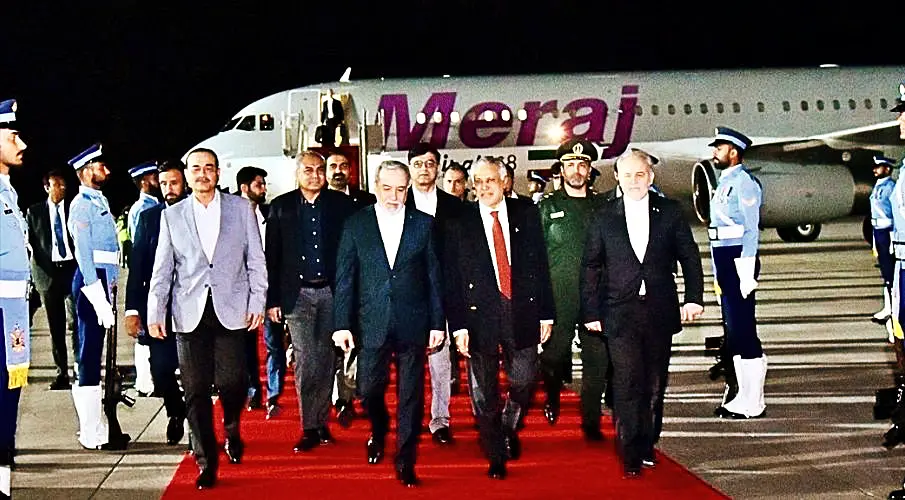
While decisions are made in Washington about what is no longer allowed, and in Islamabad about whether talks will even take place, life is changing elsewhere without announcement. A visa expires, an account remains empty, a connection breaks. This is not fate. It is the handwriting of those who decide without bearing the consequences. As Abbas Araghchi lands in Pakistan, the reception is clear. Ishaq Dar and Asim Munir are waiting. Talks are supposed to take place. But almost at the same moment, Tehran makes it clear that there will be no direct negotiations with the United States. Messages are conveyed, not exchanged. Pakistan mediates because the sides are not sitting across from each other.
While Tehran emphasizes that there will be no direct talks, Washington is moving in the opposite direction. Karoline Leavitt explains that Steve Witkoff and Jared Kushner are on their way to Pakistan to speak with Araghchi. The goal is to hear the Iranian position and create movement toward an agreement. Progress is mentioned, details are not provided. At the same time, JD Vance remains in the United States but is expected to be ready to travel to Pakistan on short notice if deemed necessary. Marco Rubio and the national security team also remain on standby.
What emerges is a scene that cannot be resolved. On one side, it is stated that there will be no talks. On the other side, those very talks are being prepared. Communication is taking place, but not where it becomes visible. At the same time, decisions are being made about what remains economically possible. Scott Bessent makes it clear that there will be no extension of exemptions. Not for Iranian oil, nor for Russian supplies. The blockade stands. Oil is no longer supposed to flow. This is not a statement, but a decision
The consequences do not unfold only through markets. When such decisions are made, the paths through which money, goods, and livelihoods are built begin to change. Supply chains become tighter, more expensive, more uncertain. Those who depend on them feel it immediately. In Istanbul, it becomes visible what this means. For many Iranians, Turkey has for years been a place between two states. Not stable enough to stay, not safe enough to return. Short term visas that must be renewed again and again. Every application costs money, every delay can cause everything to collapse.
Sadri sells pastries and thinks about her daughter. She had to return to Tehran because a visa was not extended. An appointment was missed, an application not filed, money was lacking. That is all it takes. A checkpoint, a night in custody, then the decision to return voluntarily before deportation blocks everything. Another woman works as a student during the day and at multiple jobs at night. Eight months in the country, constantly under pressure. She says she loves Iran and would defend it. At the same time, she sees no future there. In Turkey, it is barely enough to survive. Two places, two bad options. These stories do not run alongside politics, they are created by it. When sanctions are tightened, when talks do not take place, when markets are closed, it does not affect only states.
And while all of this is happening, there is still talk of dialogue. Shehbaz Sharif speaks of cooperation and a peaceful solution. Words that are necessary, but that stand against what is being decided at the same time. At the end of a day, what remains is not a clear picture, but several at once. Talks are taking place and not taking place. Sanctions are being tightened. Families are being separated. Money can no longer be moved.
The talks in Islamabad can continue or fail. The blockade can remain or fall. For many people, the outcome is difficult to grasp. It determines whether they can stay or must leave.
And that is exactly the point. Not what is said. But what follows from it.
Updates – Kaizen News Brief
All current curated daily updates can be found in the Kaizen News Brief.
To the Kaizen News Brief In English


Und als Mensch steht man daneben.
Meist fassungslos.
Wütend, entsetzt, traurig und vor allem hilflos.
Wir können nur warten und hoffen.