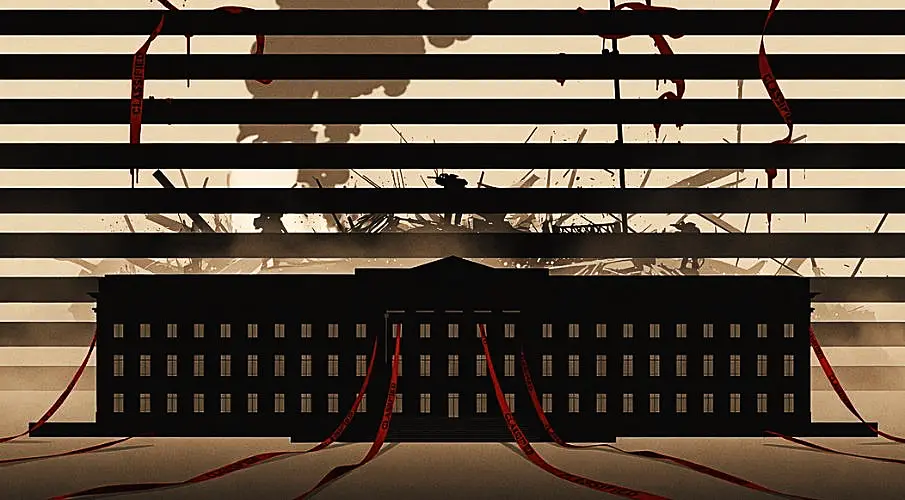
While the United States and Israel have been striking targets in Iran since February 28, remarkably little is visible. No clear images, no reliable assessments of hits, hardly any verifiable information about damage. What looks like military secrecy goes further. Internal directives show that the Pentagon is not only withholding its own information, but is actively influencing what private companies are even allowed to say.
At the center is an instruction from the US Space Force sent to operators of commercial satellites. It precisely defines which wording should be avoided. Terms that could imply an assessment are unwelcome. Phrases such as a target was destroyed or neutralized are not to be used. Instead, companies are to remain purely descriptive. A building is not destroyed, but partially collapsed. No result, only an observation. This linguistic control affects exactly those companies whose images serve worldwide as the basis for reporting.

When language is controlled, the view of war changes as well
These internal slides from our investigation show how precisely it is defined which language may be used when describing war damage. Terms such as “target destroyed” or “neutralized” are prohibited, instead only visible changes are to be described, without any classification. Even in the case of massive damage, no statement about military effect may be made. The guidelines also apply to private satellite companies whose images are used worldwide. This not only limits information, but deliberately narrows the meaning of these images. For the public, a distorted picture of the war emerges because key assessments are missing. This is where the danger lies: when language is controlled, perception is controlled as well, trust is lost, and a society loses the basis for informed decisions.
Around one hundred US companies hold government licenses for reconnaissance and Earth observation satellites. The industry generates several billion dollars annually and supplies both military and civilian customers. The most important players include Maxar Intelligence, Planet Labs, BlackSky Technology, and Spire Global. Together they operate hundreds of satellites, deliver images, measure emissions, analyze damage. A large portion of their revenue comes directly from contracts with the US government. That is exactly where the pressure point lies.
Officially, these guidelines are recommendations. In practice, companies follow them. Those who depend on the state do not contradict it. This creates a system in which private firms no longer freely interpret information, but adhere to state-defined linguistic limits. The result is a second layer of control. Not only government agencies decide what is published, but also private providers who bind themselves to these guidelines.
This development became visible immediately after the attacks began. Planet Labs drastically restricted access to imagery. First, a delay of 96 hours was introduced, shortly afterward a complete two-week blackout for images from the entire war zone. Officially a company decision, made after discussions with the military and intelligence services. In practice, it fits exactly into the line of the new guidelines.
The pressure extends further. When the AI company Anthropic refused to make its system available for certain military uses such as mass surveillance or autonomous weapons systems, the Pentagon responded with a clear signal. It openly discussed using the Defense Production Act to force cooperation. A legal framework that allows the government to compel companies to support military objectives.
The current practice has a history. Even under the previous administration, cooperation with private companies was systematically expanded. The then Director of National Intelligence Avril Haines signed a directive intended to deepen exactly this cooperation. Intelligence agencies were instructed to expand partnerships with non-state actors and make them a permanent part of their work, even if this involved legal or security risks.

Avril Danica Haines (born August 27, 1969) is an American lawyer and former senior government official. She served as the Director of National Intelligence (DNI) from January 21, 2021, to January 20, 2025, becoming the first woman to lead the U.S. Intelligence Community and the seventh Senate-confirmed DNI.
Today it is becoming clear where this leads. In areas such as artificial intelligence, cybersecurity, drone technology, and satellite reconnaissance, companies possess capabilities that were once reserved exclusively for states. They provide data, analyze information, and thereby shape the public perception of conflicts. At the same time, they are financially closely tied to government clients. This creates a network in which economic dependence and political influence intertwine.
In the case of the Iran war, this system is visible for the first time in this level of consistency. Military information is not only kept secret, but actively controlled in its presentation. Terms are replaced, statements softened, images delayed. The public sees less and understands less. And that appears to be intentional.
The real question is no longer whether information is being withheld. That is always the case in wars. What matters is who decides how that information may be formulated. When private companies that are considered independent data providers are in practice subject to state language control, the boundary shifts. Not openly, not officially, but noticeably.
What appears outwardly as restraint is in reality a precisely controlled information environment. And it works because the interface between state and business no longer has a clear separation.
These investigations do not write themselves. They arise from the will to name things as they are. Our war reporting, our investigative work are links in a chain that only achieves its full impact when it is complete. Because only when the picture is complete do consequences become possible. Support us. For a world that might become a little better than the one we are describing right now
MAKE KAIZEN POSSIBLE →Updates – Kaizen News Brief
All current curated daily updates can be found in the Kaizen News Brief.
To the Kaizen News Brief In English


Hervorragend beschrieben. Habe es genau so schon seit langem befürchtet. Die öffentliche Wahrheit ist vorbereitet, die private Wahrheit ist der intellektuelle Rückzug gegenüber dem staatlichen System. Kommunistische Staaten haben es seit Jahrzehnten vorgelebt, in der DDR war das Staatsraison. Quo vadis veritas?
Vielen Dank
„Wessen Brot ich ess, dessen Lied ich sing“
Dieses alte Sprichwort ist gerade aktueller denn je.
In Zeiten, wo Satelliten, Drohnen und KI Informationen sammeln, kann der Datenfluss leider eingeschränkt werden.
Je nach Erforderlichkeit.
Wer Informationen kontrolliert, kontrolliert die Meinung und steuert die Macht.
Früher waren es Kriegsberichterstatter die versucht haben valide Informationen aus Krisengebieten zu schmuggeln.
Abweichend von staatlichen Stellen.
Heute seid Ihr es.
Danke dafür
Auf dem Weg zum vollen totalitären Regime und die dummen Schafe trotten immer noch hinterher. Mal gucken, ob die Midterms stattfinden und was dann dabei herauskommt….