
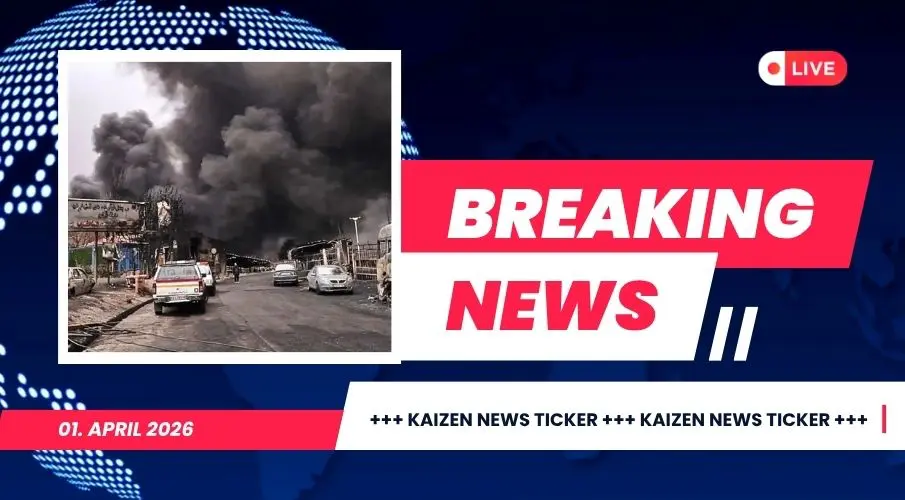
Emirates on the brink of entering the war - Hormuz becomes a military question!

The United Arab Emirates are preparing to open the Strait of Hormuz by military force if necessary and are, for the first time, openly aligning themselves with a potential war coalition. A state that long balanced economic interests with political caution is becoming an actor willing to be part of the conflict itself. Diplomatically, the Emirates are pushing a resolution in the UN Security Council intended to legitimize such an operation, while at the same time lobbying the United States as well as European and Asian partners for a joint approach.
This shift is driven by concrete attacks. Iranian missiles and drones have struck the Emirates heavily in recent weeks, more severely than other states in the region. Airports, hotels, and critical infrastructure have been targeted. The economic damage is visible. Air traffic is collapsing, tourism is suffering, the real estate market is losing momentum, companies are sending employees into forced breaks or laying them off. The promise of stability on which Dubai’s business model rests is suddenly in question.
At the same time, the military debate is intensifying. The Emirates are examining how they could intervene themselves, for example in mine clearance or through logistical support. The idea of taking control of strategic islands such as Abu Musa is also being discussed. This island has been held by Iran for decades but is claimed by the Emirates. Such a move would further escalate the situation.
Other Gulf states are moving in the same direction but remain more cautious. Saudi Arabia and Bahrain support the political line against Iran without yet committing their own troops. Bahrain is introducing the planned resolution in the Security Council. A vote is expected, but a veto by Russia or China is possible. France is working on an alternative draft. Even if no agreement is reached, the Emirates are signaling readiness to act.
The strategic importance of the Strait of Hormuz leaves little room for maneuver. A significant share of global oil trade passes through this route. Iran is using its control over the area to build pressure, speaking of permanent monitoring and possible transit fees. For the Gulf states, this would be an intrusion into their economic foundation. They want to prevent Tehran from gaining lasting influence over the use of the route.
Militarily, the situation remains uncertain. Experts point out that reopening the passage will not be decided at sea alone. The coasts and adjacent areas would also have to be controlled. Even individual drones, mines, or small boats could block the route again at any time. That is exactly what Iran is counting on. The leadership in Tehran is signaling that it is prepared to further expand the conflict and deliberately target infrastructure in the Emirates if they actively intervene.
The Emirates are thus facing a decision with far-reaching consequences. A military step could reopen the Strait of Hormuz in the short term but at the same time cement a long-term conflict with Iran. Relations with investors and international partners would also come under pressure. But for the leadership in Abu Dhabi, the risk now appears lower than the prospect of leaving a strategic bottleneck under Iranian control permanently.
Iranian missile hits US base - American soldiers narrowly escape
Footage shows how an Iranian missile strikes a US military base in the Middle East - and how US soldiers taking cover there narrowly escaped. This is not a report about a near miss somewhere in the desert. This is the moment this war takes on a different quality. While Washington speaks of defeated enemies, Iranian missiles are flying at American soldiers. Not at infrastructure, not at empty facilities - at people in uniform who duck and hope. The soldiers exist.
JD Vance had stated that Iran’s conventional military was effectively destroyed. Pete Hegseth spoke of a war that would go down in the history books. And then an Iranian missile lands on a US base, and American soldiers run for their lives. Tehran knows that. Washington does too. The difference is who talks about it.
93 percent bad press - and of course the press secretary is to blame
Trump says he receives 93 percent negative coverage. Some said even 97 percent. And then, almost casually, the sentence: maybe Karoline Leavitt is doing a bad job. Should we keep her? You sit with that and think of Karoline Leavitt, who stands in front of cameras every day and defends things that cannot be defended. Who explains a president who contradicts himself before she has finished the sentence. Who smiles when journalists ask questions that have no honest answer.
And now Trump is publicly considering whether to keep her. Because the press is bad. Not because he is waging a war whose costs are rising every day. Not because American soldiers at a base in the Middle East have just dodged an Iranian missile. Not because more than 20 farmers have taken their own lives. The press is bad - and the press secretary carries the blame. It is the oldest trick in this repertoire. If you do not like the message, you shoot the messenger. The fact that the messenger in this case is his own press secretary only makes it slightly more absurd than usual.
Elections under pressure - violence, intimidation, and a president who still declares victory
Violence against election observers in Bor
The images from Crvenka or Bor represent an election day that officially passed calmly and yet was marked by extreme tension. International observers report violence outside polling stations, threats, and groups of partially masked individuals deliberately showing presence. Marta Kos, EU Commissioner for Enlargement, calls the events clearly unacceptable and points to numerous incidents documented during the vote. The EU delegation in Serbia also speaks of irregularities and calls for consequences.
Voting took place in ten municipalities, a political test for President Aleksandar Vucic after months of protests. Despite the reports, he declares a complete victory for his party. At the same time, students and journalists report attacks by organized, government-aligned groups. Vucic rejects responsibility and accuses his opponents of inflaming the situation.
Observers from the Council of Europe see the process inside polling stations as largely in line with the rules but express alarm at what happened outside. Threat scenarios, aggressive confrontations, and a climate difficult to reconcile with free elections. That is exactly where the problem lies, because elections do not end at the door of the polling station.
The political situation in the country remains tense. The trigger for the protests was the collapse of a train station roof in Novi Sad that killed 16 people. Since then, criticism has been directed at the government and power structures. On Tuesday, the situation escalates again in Belgrade as police move against protesters and the university is searched. Staff speak of growing pressure on the institution.
Serbia is formally on the path toward the European Union, but reality shows a different picture. Close relations with Russia and China, accusations against the government over restrictions on freedoms, and a political environment that is increasingly under strain. Elections are scheduled for the coming months, but it is already clear that they will be closely monitored.
Court blocks cuts - judge sees attack on disfavored voices

A federal judge sets a clear boundary for the Trump administration and permanently blocks the attempt to end federal funding for NPR and PBS. The decision by Judge Randolph Moss strikes at the core of the plan because it not only stops the move itself but also exposes the reasoning behind it. For the court, this is not about budget questions but about targeted influence on content. Moss is unusually direct. It is hard to imagine clearer evidence that government action is aimed at opinions the president does not like and seeks to silence. This places the political nature of the measure at the center and removes its legal basis.
NPR and PBS are among the most important publicly funded media outlets in the United States. Their funding has been politically contested for years, but a direct intervention of this kind elevates the conflict to another level. The decision makes clear that even a president cannot freely decide which voices remain and which do not. For the Trump administration, the ruling is a setback because it not only stops the specific plan but sets a clear boundary for similar actions. At the same time, it strengthens the role of independent media in an environment where political attacks on reporting have long become routine.
Network under control - Russia expands censorship, users find ways around it

We have reported on this multiple times already. Russia is tightening its grip on the internet and doing so systematically. New laws allow authorities to shut down mobile data connections without explanation. At the same time, so-called white lists are being created with permitted sites and apps, while a large share of popular services, especially from abroad, remains blocked. Anything outside this selection disappears from access. Technically, the state relies on comprehensive control. Every provider must install systems that analyze data traffic and selectively cut connections. This deep packet inspection is being expanded further, with the aim of monitoring all traffic. At the same time, connections are deliberately slowed so that services appear to stop working. Even global infrastructure such as Cloudflare is restricted in a way that pages only partially load.
In addition, a growing system for identifying individual users is emerging. A database with device identifiers is planned that could allow targeted blocking of SIM cards. Search queries are also coming into focus. Anyone searching for content classified as extremist risks punishment. Control is thus shifting from access to behavior. The reaction among the population is clear. Millions are turning to VPN services to bypass restrictions. But here too, the state is responding, blocking hundreds of providers, removing apps from stores, and investing in technology that detects and blocks such connections. Even instructions for use are being pushed out of the internet.
At the same time, new paths are emerging. Protocols such as VLESS are in high demand, as are decentralized networks that operate without traditional infrastructure. Messaging services could integrate these technologies in the future and create new routes around restrictions. But access is becoming more difficult. In the end, a development is taking shape in which not everyone can keep up equally. Those who are technically skilled find ways. Many others rely on what remains accessible. And that is increasingly state-controlled content.
Last update Iran war: a war without limits - attacks, markets, threats, and a president between withdrawal and escalation

The war is visibly expanding. In Kuwait, a drone strike hits a fuel tank at the international airport, a large fire breaks out, there are initially no injuries. At the same time, Bahrain reports another fire after an Iranian attack, while Saudi Arabia intercepts drones again. Off the coast of Qatar, a tanker is hit, more than 20 ships have been attacked since the war began. The Strait of Hormuz remains under constant pressure, while Donald Trump declares that the United States will not take responsibility for keeping the passage open. Other states are responsible, he says, openly placing responsibility for one of the world’s most important trade routes into question.
At the same time, the military situation continues to escalate. Israel strikes a pharmaceutical facility in Iran that it says supplies fentanyl for a chemical program. Tehran rejects this and calls it an attack on medical infrastructure. In Lebanon, the Israeli military reports the killing of a senior Hezbollah commander in Beirut, while further strikes cause deaths and injuries. In Syria, President Ahmad al-Sharaa attempts to stay out of the conflict and makes clear that his country does not want to be drawn into another war. The figures on the American side show the scale. 348 US soldiers have been wounded so far, 13 have been killed. Some of the wounded have been able to return to duty, but attacks on bases, particularly in Saudi Arabia, continue. Trump himself says he wants to end the war within two to three weeks and at the same time declares the objective already achieved, Iran has no nuclear weapon. How he arrives at this assessment remains unclear. At the same time, he threatens further attacks on infrastructure, specifically mentioning bridges, if there is no agreement.
While the military situation escalates, markets react nervously and at the same time inconsistently. Stocks in Asia rise sharply, driven by hopes of a quick end to the war. Strong gains are seen in Tokyo and Seoul, Hong Kong and Shanghai also move higher. At the same time, oil prices are rising again and are well above 100 dollars per barrel. Economic reality is thus not following a clear line but oscillates between hope and risk.
Everyday life also reflects the escalation. The United Arab Emirates are closing their borders to Iranian citizens, entry and transit are largely halted. Earlier, facilities such as the Iranian hospital in Dubai were already closed. The hospital was among the oldest in Dubai and had existed since 1972. These are steps that go far beyond symbolism and further strain relations in the region.
In the evening, Trump is expected to address the nation in a televised speech. It comes at a moment when the war has already spread across multiple theaters and the question remains whether the announced short duration is realistic. Between attacks, political signals, and economic reactions, a picture is emerging that does not point in a clear direction.
A note for our readers

There may be delays from time to time. We are doing everything we can to report as quickly as possible - but the situation in Iran is tense, internet outages are almost constant, and people are finding alternative ways to communicate, which takes time and can be very demanding. But we are doing everything to ensure that no gaps arise.
From hell, the only way is down
That is why we continue to document. Not because war is something wonderful, not because it sells well - it does not - but because those who do not wish the world well, who profit, live out power fantasies, and turn democracy into subjugation, are waiting for exactly that moment when people stop. When documentation stops, society forgets. And a society that forgets will eventually hear things it has never heard before. One must face that. Also for the next generation. We will have enough time to sit later.


Nun scheint ein Nahost Staat in den Krieg eintreten zu wollen.
Was mich daran so extrem traurig stimmt, dass es erst 4 Wochen nach Kriegsbeginn passiert.
Und nicht weil iranische Zivilisten zu hunderten getötet werden.
Sondern, weil es Attacken auf das eigene Land gibt.
Und vor allem weil der wirtschaftliche Wohlstand mit der blockierten Strasse von Hormus wankt.
Es ist das Geld, was interessiert, nicht die Menschen 😞
Im Nachhinein soll jetzt vor dem UN Sicherheitsrat der Angriff auf den Iran legitimiert werden.
Nicht von den USA, denen ist sowas egal, sondern diesmal von einem beyroffenen Nahoststaat.
Es bleibt abzuwarten, wie die UN entscheidet.
Wie Iran, USA und Israel agieren.
Es werden weiterhin Menschen bombardiert, werden verletzt und sterben.
Meine Gedanken gehen an alle Betroffenen und ihre Familie.
So schlimm es ist, aber es ist „wichtig“ (das klingt nicht so, wie ich es meine), dass auch US Basen getroffen werdenund US Soldaten verletzt werden.
Denn nur das können Trump und seine Entourage nicht unter den Tisch kehren.
Das kommt bei den US Bürgern an, nicht die vielen Toten im Iran.
👍
Kruzifix Barbie würde ich keine Träne nachweinen.
Im Gegenteil, ich würde mich freuen, wenn er sie entlässt.
Ansonsten Trumps typisches Muster, Schuld sind immer die Anderen 🤬
…wird spannend ob sie bleibt, da warten viele auf 2028 um besonders sie juristisch an die wand zu fahren
Serbien, genau wie die Türkei etc sollten ihren Beitrittsstatus verlieren.
Generell sollten derzeit EU Mitgliedschaften auf Eis gelegt werden.
Wir brauchen in der EU nicht noch mehr Autokratien, die demokratische Grundwerte mit Füßen treten.
Man kann auch Handelsabkommen schließen, ohne dass es gleich eine EU Mitgliedschaft geben muss.
…die eu muss auf jeden fall einige dinge verändern, das fängt bei den kriterien auf und bei möglichkeiten des ausschlusses auf
Russland vom Überwachungsstaat zur absoluten Kontrolle.
Fehlt nur noch, dass sie irgendwann jedem Bürger Chips implantieren, mit denen Jeder in Echtzeit geortet werden kann.
Diese Kontrolle betrifft ja nicht nur Russen.
Sondern auch Personen außerhalb mit denen kommuniziert wird.
Eine gruselige Vorstellung.
….wäre putin zuzutrauen
Sehr gut, dass ein Richter Trump Steine in Bezug auf PBS und NPR in den Weg legt.
Aber auch das wird Trump bis zum Supreme Court bringen.
Und bei den Marionetten, ist das zu erwartende Ergebnis nicht gut.
Heute wird doch über Birthright Citizenship vir dem Supreme Court verhandelt, oder?
ja, mit einem trump vorort im saal
Bitte passt weiter auf Euch auf.
Es wird immer schlimmer und Eure Stimmen sind wichtig.
…ich danke dir/euch