
Tehran - Rosa DeLauro is not known for going quiet when she is angry. The Democrat from Connecticut, a longtime member of the Appropriations Committee, sat across from Ambassador Mike Waltz and said what is not supposed to be said, because it sounds too direct, too exposing, too precise: we are getting no information. No numbers. No explanation of what the money is for and where it is going.

The Pentagon wants 200 billion dollars from Congress.
Almost a quarter of the entire annual budget of the Department of Defense. In a single request. For a war that officially barely exists, that has not been declared, not been justified, not been debated - and that is still being fought, every day, with rising costs and shrinking answers. So far, Congress has not received a single page of details.
Marco Rubio has not held a regular press conference at the State Department for months. Not one. The Secretary of State of the United States, responsible for a war that has spread across multiple regions, does not speak publicly. He does not speak before Congress, not before journalists, not before the country. He speaks when he chooses to, with selected media, government friendly voices, outlets and publications that do not ask uncomfortable questions or whose questions are at least predictable. That is not an accident.
The Pentagon operates the same way. Media access is limited, controlled, curated. Those who get in were selected. Those who report critically do not get in. Those who do not get in report based on press statements written in a way that answers questions no one asked. The major independent outlets that have reported from conflict zones for decades are outside. Pro government media are inside. Rubio did not invent this system. But he uses it with a consistency that stands out. For a man who once presented himself as a foreign policy voice of the Republicans, he has become remarkably quiet - except where silence helps him and speaking would not.
The Strait of Hormuz is nearly at a standstill. American fighter jets and attack helicopters circle above the Persian Gulf while below almost no ships are moving. One of the most important trade routes in the world, through which a significant share of global oil and gas passes, is close to being blocked. Iran is using mines, missiles and drones. That is enough. Shipping collapses, the oil price sits above 108 dollars per barrel, the S and P 500 is heading toward a fourth consecutive week of losses.

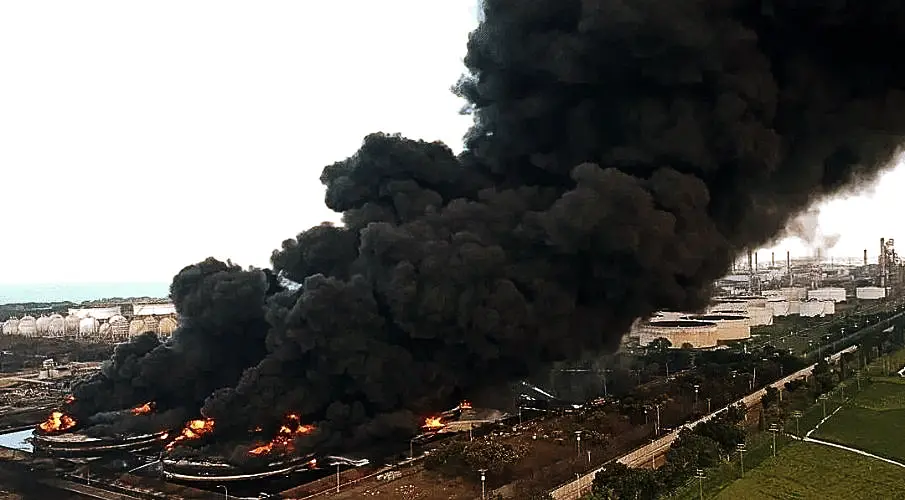
In Kuwait, the Mina al Ahmadi refinery is burning for the second time in two days. Sirens sound in Jerusalem and northern Israel. Israel strikes Tehran. Saudi Arabia, Bahrain, Kuwait and the United Arab Emirates report intercepting drones and missiles. In Bahrain, falling debris sets a warehouse on fire. The war is no longer regional. It has stopped being somewhere. It is everywhere.
A war that drives no one into the streets
The war is here, the images are here. Burning facilities, destroyed infrastructure, rising oil prices. And still the streets remain largely quiet. In Berlin, Frankfurt, New York - there are protests, yes. But they are small, scattered, without pressure. Nothing like 2003, no moment that forces politics to stop. In the United States, the situation is divided. Some take to the streets against the war, others justify it or even celebrate it. Parts of the Iranian diaspora support attacks on the regime. The lines do not run only between states, but through societies themselves. That takes the force out of any movement. In the Middle East it is louder, but also more dangerous. Protests shift quickly, are politically used or escalate. In Iran itself, anger is directed at more than the war. Economy, repression, power - everything is exposed. The conflict acts like an amplifier, not the cause.

By now, one has to be very resourceful to get images and information out of Iran.
And the environment? It is burning too, but it does not mobilize. Oil terminals are on fire, supply chains are shaken, risks are rising. But there is no visible movement against it. These images exist only because investigative journalists go where it is life threatening. They risk everything to keep the war visible - while the rest of the world watches.

Der Arbeitsplatz: Teheran, 16. März 2026 – The workplace: Tehran, March 16, 2026 - as long as someone reports on the ground, truth exists as a possibility. If that too falls silent - not through a ban, but through indifference - then the war is not the real problem. Then it is the silence afterward, the one no one notices.
And yet: no global outcry, no pressure from the streets. What remains is a strange picture: a war with global consequences - and a public that watches. Loud online, quiet in real life.
And in Washington, no one explains it.
Donald Trump says: it will be over soon. He offers no explanation. Treasury Secretary Scott Bessent announces that the United States may lift sanctions on Iranian oil to calm the market - a step that contradicts years of American policy, announced quietly, without debate. At the same time, Trump attacks NATO allies for not sending warships. He writes: cowards, and we will remember. Then he says he asked Benjamin Netanyahu to stop attacks on Iranian energy facilities. Escalation and restraint. Threat and reassurance. Everything at once, everything official, nothing explained.

“Without the U.S.A., NATO IS A PAPER TIGER! They didn’t want to join the fight to stop a Nuclear Powered Iran. Now that fight is Militarily WON, with very little danger for them, they complain about the high oil prices they are forced to pay, but don’t want to help open the Strait of Hormuz, a simple military maneuver that is the single reason for the high oil prices. So easy for them to do, with so little risk. COWARDS, and we will REMEMBER! President DONALD J. TRUMP”
This is not a communication strategy. It is the absence of one.
The numbers that describe this war are not at the margins. Iran reports at least 1,348 civilians killed, a human rights organization in Washington reports 1,369. In Lebanon, more than 1,000 people have died. In Israel, at least 14 people were killed by Iranian attacks. 13 American soldiers have been killed. In the first week alone, the costs exceeded 11 billion dollars. 200 billion in total, possibly. And Congress has not received a breakdown. No specification. No document. Nothing.
Pete Hegseth and Marco Rubio are not required to explain under oath why the United States entered this conflict. Republican lawmakers block public hearings. Senator Ron Johnson gives the reason: one does not want to show division to the enemy. Senator Bill Hagerty calls public questioning very unhealthy. It is worth pausing on these phrases. Public oversight as weakness. Parliamentary control as risk. The idea that an elected body asks what taxpayer money is used for and why people are dying is treated not as duty, but as a problem. And if one follows that thought to the end, one arrives at a question that is uncomfortable: if control is weakness, what is strength?

Individual voices within their own ranks speak up. Susan Collins considers hearings sensible. Lisa Murkowski asks why the war is barely discussed. Brian Fitzpatrick wants officials questioned publicly. These are exceptions, not a movement. Intelligence agencies cast serious doubt on the official justification for entering the war. An imminent threat that would justify military action has not been convincingly demonstrated. And yet the war continues. And yet the costs rise. And yet Congress remains largely silent.
Somewhere between burning Kuwait and 200 billion dollars without a breakdown lies the question no one officially wants to ask: what is the goal? Not the declared one. The actual one. The one being pursued while rockets fall and ships stop moving and the numbers rise. That goal is no longer clearly visible. Maybe it never was. Maybe that is exactly the condition in which this war is being fought - without a clear end, without public accountability, without anyone saying when it is enough. Rosa DeLauro asked. She did not get an answer.
That says more than any number.
Updates – Kaizen News Brief
All current curated daily updates can be found in the Kaizen News Brief.
To the Kaizen News Brief In English


Leider wird es keine Antworten auf diese Fragen geben.
Schlicht, weil man es nicht beantworten kann. Es gibt einfach keine Erklärungen.
Die Republikaner und Demokraten verlieren sich in einem Spiel aus Macht und Schuldzuweisungen.
Die Republikaner noch zusätzlich im Bestreben Trump zu schützen. Um jeden Preis.
Den Preis zahlen aber Andere.
Nicht Trumps Entourage, nicht der Kongress, nicht der Senat.
Nicht die Milliardäre und Millinäre die auf Trumps Schleimspur surfen.
Nein es ist der Gros der Bevölkerung.
Steigende Preise wohin das Auge reicht.
Tote US-amerikanische Soldaten.
Hunderte Tote, tausende Verletzte im Nahen Osten.
Die Weltwirtschaft in einer der größten Krisen.
Warum es weltweit keine Proteste gibt?
Ich weiß es nicht.
Vielleicht weil die Medien es „schön reden“?
Vielleicht weil die Menschen „müde“ geworden sind?
Vielleicht weil sich Gleichgültigkeit breit macht?
Vielleicht weil aus diesen Demonstrationen kaum Konsequenzen folgen?
Vielleicht weil Demonstrationen oftmals vom rechten und auch linken Extremismus für eigene Zwecke gekapert werden und dann bedauerlicherweise mit Gewalt enden.
Vielleicht weil auch die Politik zum großen Teil inaktiv bleibt.
Vielleicht weil die Menschen in ihrem kleinen Umfeld schon zu kämpfen haben?
Oder es ist eine Mischung aus Allem.
Ich erinnere mich an den Kuwait Krieg.
Es gab unmittelbare spontane Großdemonstrationen „ohne Frieden gehen wir nicht nach Haus“
In den USA gab es die letzte Groß-Demonstration gegen den Vietnamkrieg.
Es gab keine Demonstrationen als Russland 2014 die Krim annektierte… vor der Haustür Europas.
Es gab auch keine Demonstrationen als Putin die Ukraine vor 4 Jahren überfiel.
Das alles macht mich sehr nachdenklich und traurig.
Bitte passt auf Euch auf.
ich danke dir – und leider steht die wlt schon lange nicht mehr auf gegen das, was nicht passierte sollte. die gründe dürften tatsächlich vielfältig sein und pauschal sich nicht beantworten lassen.
Ich kann es euch gar nicht oft genug sagen… HUT AB vor eurem Mut und eurer genialen Arbeit!
vielen, vielen Dank
Ich lese Euren Blog jeden Tag. Oft bin ich fassungslos und bestürzt über die News.
Das liegt absolut nicht an Euch, den Ihr würdet sicher lieber gute News bringen…
Eure Arbeit ist so wichtig und wertvoll! Ich erzähle so vielen Menschen davon in meinem Umfeld und so mancher hat seine Meinung über das aktuelle Geschehen schon geändert.
Danke für Eure unermüdliche Arbeit, die ich gerne unterstütze. Auch wenn’s nicht viel ist, so hoffe ich doch es hilft Euch.