
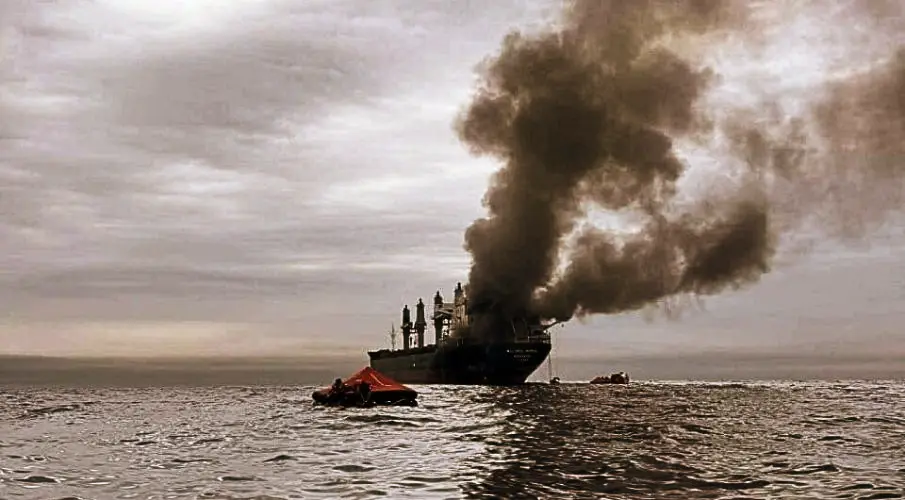
The Strait of Hormuz is one of the most sensitive points of the global economy. Through this narrow sea passage between Iran and Oman flows a large portion of global oil trade. Since the beginning of the American Israeli attacks on Iran this route has effectively been blocked. Tankers avoid the passage, insurers withdraw, prices rise. President Donald Trump is now trying to force traffic through again with military pressure. On Saturday Trump publicly called on other states to send warships to the Strait of Hormuz in order to keep the passage “open and safe.” On his network Truth Social he wrote that many countries would send ships. He mentioned Britain, China, France, Japan and South Korea. He did not name concrete commitments. Here too it once again becomes clear how unprepared the attack on Iran was.
The call shows how difficult the military situation has become. Even if Iran’s air defenses are heavily damaged the country can still threaten the sea route. Small drones, mines and fast boats are enough to disrupt shipping traffic. Trump himself acknowledged that Iran would retain such capabilities - “no matter how hard they are hit,” as he wrote. The conflict has now lasted three weeks. During the night the American embassy in Baghdad was attacked. Two Iraqi government officials confirmed the attack. Sirens wailed and thick clouds of smoke rose from the embassy compound.
The U.S. embassy later stated that Iran backed militias had repeatedly shelled the so called International Zone in Baghdad. American citizens were once again urged to leave Iraq immediately. The consulate in Erbil should also be avoided for security reasons. A Shiite militia initially did not claim responsibility for the attack. Only a few hours earlier another building had been destroyed in Baghdad. In the wealthy Arasat district a house was heavily damaged by an explosion. Fighters from the Shiite group Kataib Hezbollah sealed off the area. Later the organization stated that three of its members had been killed in an attack.
At the same time the situation in the Gulf is escalating. In the United Arab Emirates smoke rose above the port of Fujairah, the country’s only major oil terminal outside the Strait of Hormuz. Authorities confirmed a fire after a drone was shot down. Debris had fallen into the port area. According to official statements there were no injuries. Tehran simultaneously expanded its threats. The semi state Iranian news agency Tasnim called on people to leave the port areas of Jebel Ali in Dubai, Khalifa in Abu Dhabi and Fujairah immediately. These locations were now legitimate targets, it said. The reason given was that American forces were present there among civilian facilities. While the conflict in the Gulf escalates a second front is also burning.

In Lebanon Israel continues its airstrikes after Hezbollah launched rockets again. The Shiite organization is closely linked to Iran. According to Lebanese authorities more than 800 people have already been killed in this new phase of the war, more than 2,000 injured and more than 800,000 displaced. On Friday an airstrike hit a health center in the southern Lebanese town of Burj Qalawiya. The health ministry reported twelve dead - doctors, paramedics and nurses who were working during their shift.
The Israeli armed forces stated that they were aware of the reports about the strike and were reviewing the incident. International organizations are also raising alarm. The head of the World Health Organization Tedros Adhanom Ghebreyesus said that since March 2 there have been 27 confirmed attacks on health care facilities in Lebanon. Thirty people were killed and 35 injured. Health workers must always be protected, he said.
Meanwhile the Strait of Hormuz remains blocked. The longer the passage stays closed the more strongly global markets feel the consequences. A significant portion of global oil trade passes through this narrow sea route. Tankers wait outside the danger zone, shipping routes are diverted, insurance premiums rise. With his call to other states Donald Trump is now trying to bring an international fleet into the region. But the decisive question remains open: whether other countries are willing to allow themselves to be drawn militarily into a war that has long extended far beyond Iran.
Updates – Kaizen News Brief
All current curated daily updates can be found in the Kaizen News Brief.
To the Kaizen News Brief In English


Soeben im Netz einen aktuellen Beitrag gesehen: Keines der von DT um Hilfe angeflehten Länder sei bereit, sich militärisch in seinen Krieg hineinziehen zu lassen. Hoffentlich bleiben sie dabei!
👍
Trump und Netanyahu brechen einen völkerrechtswidrigen Krieg vom Zaun.
Kein UN Mandat, keine Zustimmung vom Kongress, keine Abstimmung mit „Allierten“.
Sie haben es einfach beschlossen.
Trump dachte, das ist in 2-3 Tagen erledigt, dass der Iran sich ergibt und er alles übernehmen kann, vor allem Öl und Uran.
Trump weiß gar bichts über den Iran.
Netanyahu geht es um Auslöschung.
Nicht nur des Iran, sondern aller mit ihm verbundenen „Organisationen“.
Die Hamas ist geschwächt, aber sie rüstet auf. Denn Trumps „Friedensplan“ wird nicht umgesetzt, die Hamas ist nicht bereit sich zu entwaffnen.
Den Iran überlässt Israel den USA.
Dafür konzentriert sich Israel auf den Südlibanon.
Und Iran hat Allen mit Konsequenzen gedroht, die die USA unterstützen.
Keiner außer den USA und Israel hat diesen Krieg gewählt oder gewollt.
Trump verdient Milliarden mit dem hohen Ölpreis.
Putin verdient ebenfalls Milliarden und profitiert zusätzlich von den aufgehobenen Sanktionen der USA (Trumps Begründung, „ich wollte Öl für die Welt“ war da der absolute Lacher).
Und jetzt sollen die Länder, die er verraten, mit Beleidigungen und Zöllen überzogen hat und ihnen mehrfach gedroht hat, die Strasse von Hormus sichern?
Auch wenn es schmerzhaft ist, das soll er mal schön alles Alleine machen.
Wer so groß behauptet, dass die Länder sich begeistert beteiligen, muss endlich mal eins auf den Deckel bekommen.
Ich hoffe, dass sich Keiner darauf einlässt.
Wobei Macron angedeutet hatte, dass Frankreich bereit wäre …..
Und wie ich all die Weicheier kenne, werden sich noch Viele auf Trumps Schleimspur einreihen 😞 wie so oft.
Dabei ist es dringend an der Zeit ihn endlich mal im Regen stehen zu lassen.
So wie er seit einem Jahr mit der Ukraine, der NATO, Europa, westlichen Staaten macht.
…wir können 50% der Bilder nur zeigen, weil wenn du dass ganze ausmass zeigst, fällst du vom berühmten stuhl
Das glaube ich Dir sofort.
Soll doch sein „Board of Peace“ helfen … oder wofür war es nochmal? (Ironie)
Ach ja, damit Trump sich die Taschen füllen kann🤬
…das board kannst du schlicht in die tonne treten
Und dann liest nan so etwas 🤬
https://www.n-tv.de/mediathek/videos/politik/Thiele-fordert-deutsches-Engagement-bei-Hormus-Sicherung-id30472761.html
…ein echter schlaumeier, ja alle reinziehen, wie das dann ausgeht, sollte jedem klar sein