
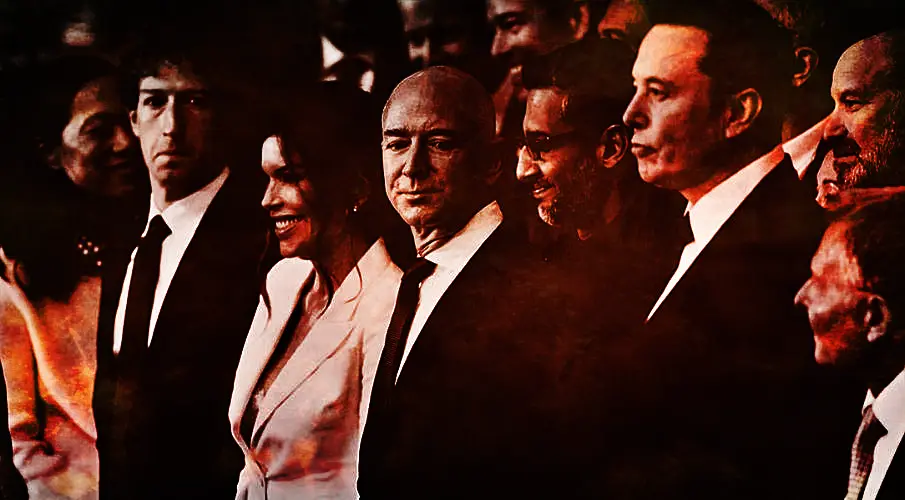
An essay in scenes - about distance, weight and the front yard
The bone one must not touch
Somewhere in the world a man wakes up and does not know that he has become richer this morning. Not because he worked. Because the market opened. Because numbers in computers rose while he was still asleep. At the beginning of February 2026 Elon Musk’s fortune exceeded 800 billion dollars - in one night, without witnesses, without work, simply like that. The twelve richest Americans together own more than two trillion dollars. Six years ago it was a quarter of that.
Somewhere in the world a woman wakes up and calculates. She calculates every morning. The salary. The rent. The electricity. The weeks until the next first of the month. She is not an accountant by profession - she has become one because the money is not enough, and whoever does not calculate loses. 44 percent of the world’s population live at or below the threshold of 6.85 dollars a day.
Between these two people lies a distance for which there is no fitting word. Not poor and rich - that sounds like a fairy tale, like two camps that at least inhabit the same world. But they do not inhabit the same world. They breathe the same air. That is all they share.
What a continent manages.
What no one needs - and yet has.
One cannot imagine 800 billion dollars. That is not a weakness of the mind. It is a limit of the brain, which was built for life on the savanna, for herds and fires and counting fruit. For numbers of this size there is no image. There is only the quiet shock when one stares long enough at the digit until it stops being a number - and begins to mean something else. Power. Inaccessibility. A new kind of gravity.
King Mansa Musa traveled to Mecca in 1324 with 60,000 companions and tons of gold. Cities along the route fell into inflation because he spent so much of it. Historians estimate his fortune at perhaps 400 billion dollars. He too today exists only as a comparison - as a reference point for someone who surpasses him. Seven centuries later.
That says nothing about the person. It says everything about the system that makes such numbers possible - and about the time that has learned to find them normal.
In the past great fortunes arose from land, raw materials, factories - from things one could touch, that had limits, that were eventually full. Today it arises from patents, software, brand promises and the expectation of future profits. Companies can grow for years without earning a single cent of profit as long as investors believe in their future. Capital multiplies through mere hope - and the old economic policy tools stand beside it as if they had been built for another world. Because they were.
Thomas Piketty described this dynamic: the return on capital grows faster than the overall economy. Whoever possesses wealth can increase it through dividends, interest and rising stock values. Wages, on the other hand, rise slowly, if at all. Since 2009 the number of billionaires worldwide has nearly doubled. In the year 2024 their combined wealth grew by 5.7 billion dollars - per day.
Tax policy adds to this. Between 1985 and 2010 the average corporate tax rate worldwide fell from 49 to 24 percent. States compete with offers for capital. The International Monetary Fund now openly describes that even large economies provide tax advantages that were once associated only with small tax havens. Whoever has money pays less of it. That is not a mistake of the system. That is the system.
There is a specific moment in the life of a person with little money that is rarely named. It is not the moment when one becomes poor. It is the moment when one stops imagining that things could become different.
It does not arrive loudly. It arrives like a slow realization while flipping through a magazine, while passing a house one will never buy. While seeing a job advertisement for which one did not attend the right school. While calculating - always while calculating. At some point one stops dreaming about what could be possible and begins managing what is.
The poorer half of the adult world population together owns two percent of global wealth. The richest ten percent control 75 percent. What remains is distributed among everyone else - the lost middle that receives neither help nor upward mobility.
These numbers do not indicate injustice. They describe a geometry. A shape of the world, grown so slowly over decades that it appears natural. Like gravity. Like something that has always been so.
It was not always so. It does not have to remain so. That is the frightening part - and the only thing that still leaves space.
The world no longer belongs to everyone in the same way. The large world - the one of satellites and platforms, of legislation and the seas - belongs to a very small number of people. Not symbolically. In reality.
The rest share the front yard.
The front yard is not bad. It has trees. It has neighbors. There are celebrations and warmth and stories told in the evening that are worth being told. But the door to the house remains closed. One sees the lights. One hears the music. One knows that decisions are made there that affect the lives of everyone - including those outside. Perhaps especially those.
Elon Musk invested 120 million dollars in the campaign of Donald Trump. Shortly afterward he assumed leadership of the newly created Department for Government Efficiency. Jeff Bezos bought the Washington Post in 2013 - in 2025 the editorial staff announced that the focus would shift more strongly toward personal freedom and market principles. Musk uses his platform X daily for political influence and conflicts with governments. That is not conspiracy. That is mechanism. Whoever has means moves things. Whoever has none hopes someone else will move them in the right direction.
And yes — some do give back. George Soros has devoted 76 percent of his wealth to charitable causes, Bill Gates has placed the majority of his fortune into his foundation, and MacKenzie Scott has donated $26 billion in just seven years. But the 25 most generous American billionaires together have given away only about 14 percent of their wealth. Elon Musk has donated 0.06 percent. Larry Page 0.03 percent. Philanthropy is good. It is not an answer to inequality. It is a small consolation prize for a very large problem.
One says: wealth is inherited. That is true - but the interesting part is what else is passed on. The school, the networks, the tone of self confidence. The way wealthy children enter rooms as if they had a right to be there. The way other children learn to be quiet, to make themselves small, to apologize for their mere existence.
Around 40 percent of all wealth assets are passed between generations - not as classic million dollar inheritance but as networks, access, starting capital. Alumni associations, exclusive clubs, political organizations: whoever belongs gains easier access to government contracts, to investors, to the right doors. A cycle that is maintained not through malice but through inertia. Systems continue because no one actively ends them.
And those who succeed anyway - Bezos, Zuckerberg, Musk, not heirs of great dynasties, climbers through talent and luck and structure and the right moment in the right decade - are taken as proof that it works. That the system is open. That whoever wants can succeed. What they actually prove: there are exceptions. Exceptions do not justify a rule. They are the story one tells oneself so that the rule remains bearable.
There is a specific exhaustion that arises from scarcity. Not the physical one. The cognitive one. Whoever has little thinks more - not out of interest but out of necessity. Every decision has weight. Buy the wrong thing. Spend too early. Make the wrong choice and carry the consequences for a month. That costs something one cannot regain: attention. Energy. The ability to think big.
Joseph Stiglitz described how extreme inequality slows economic growth - because households with low income spend a larger portion of their money and thus generate demand, while wealthy households save a larger share. When too much wealth is bound at the top the entire economy becomes more sluggish. But that is the macroeconomic perspective. The human one is different.
The poor do not dream less. They dream differently. More concretely, more cautiously, with less room upward. A vacation, not a villa. A repair, not a new purchase. A pause, not freedom. The horizon does not shrink because of lack of imagination. It shrinks because experience teaches it.
And yet the dreams do not disappear. They become quieter. They move into the drawer of maybe someday, of if someday. One sometimes opens it still. In the evening, in silence, when the calculation for today is finished.
There is no clean moral. No ending that says: it does not have to be this way, so we will change it. The proposals exist - Gabriel Zucman calls for a two percent wealth tax annually on fortunes above 100 million euros, the Netherlands plans from 2028 a tax of 36 percent on unrealized gains from stocks and cryptocurrencies, economists and legal scholars discuss global minimum taxes, international ownership registers, the breakup of large platforms. Lina Khan, former head of the American competition authority FTC, argues that the marketplace platform, logistics and retail divisions of a corporation should be separated. Investments in early childhood education. Greater permeability in schools and universities.
Between proposal and reality lies the same distance as between the two bedrooms: the one in which someone sleeps while his account grows, and the one in which someone calculates before closing his eyes. The political influence of great fortunes makes deep reforms difficult. While wealth continues to grow, the power of those who possess that capital grows with it - and with it their ability to prevent exactly the reforms that would limit it.
What remains is the image. The camera slowly zooming out. Below the front yard - lively, loud, full of life, full of people who every day make the best of what belongs to them. Above the windows, illuminated, quiet. And the distance between them - not as complaint but as fact. As a question one must ask: what maintains this distance? Who benefits from it? Who pays for it?
Who pays - daily, invisibly, silently - has long been known.
Updates – Kaizen News Brief
All current curated daily updates can be found in the Kaizen News Brief.
To the Kaizen News Brief In English


