
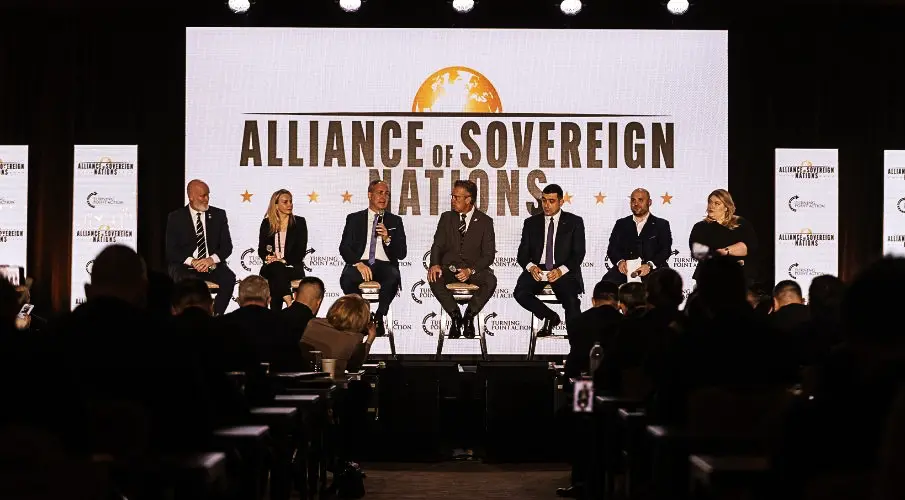
While the AfD in Baden-Württemberg was approaching an important election, its candidate for the office of minister president was conspicuously absent. Markus Frohnmaier was not in Rottweil, but in Washington. At the beginning of March a network gathered there that is still barely understood in Europe. Under the name “Alliance of Sovereign Nations,” politicians from many European countries met together with leading figures of the American MAGA movement. Officially the topic was national sovereignty. In reality a political structure emerged in Washington that reaches far beyond ordinary party contacts.

The conference was supported by Turning Point Action, an organization from the circle of conservative activist Charlie Kirk. It mobilizes voters, organizes campaigns, and builds political networks. The meeting was initiated by Republican congresswoman Anna Paulina Luna, a central figure in the younger wing of the MAGA movement. The event was led by Speaker of the House Mike Johnson. In Washington a platform was thus created that explicitly aims to connect international political forces that oppose supranational structures.

The organizers speak of an alliance to protect national self determination against “unelected global institutions.” Behind this formula lies an agenda directed squarely against European integration. States are expected to place their own interests above international cooperation. National identity is to become the central political reference point again. European regulation, common institutions, and supranational decision making structures are seen in this logic as obstacles.

The letter now in our possession is explosive because it provides a concrete example of how European right wing parties attempt to buy direct access to political networks in Washington. The document comes from the American lobbying and consulting firm BGD Legal & Consulting from Atlanta. It is addressed to the Romanian party AUR (Alianța pentru Unirea Românilor). It was signed on March 31, 2025 by the firm’s partner Daniel Lee Delnero.
The content is clear: the company offers to establish contacts for the party with “prominent Americans” and to advise it in building media and political networks in the United States. For this service BGD demands 1.5 million dollars. The fee was to be paid within 30 days after signing the engagement letter. In return the firm commits itself to providing the party with access to important political actors in the United States. The letter explicitly refers to “networking opportunities with prominent American figures.” The document also contains a clause according to which the agreement can be terminated if such contacts do not materialize in April 2025. Delnero also explains that he will serve as the main contact person and, if necessary, involve additional companies or individuals in the lobbying work.
Politically this document is relevant because it shows that a European party was willing to pay very large sums for direct political access in Washington. The goal was obviously not only classic public relations advice but the construction of a political network in the environment of the American right. The danger lies in the possible internationalization of political influence structures. If parties in Europe attempt to buy access to political centers of power in the United States through expensive lobbying contracts, a system emerges in which national political processes can increasingly be influenced by external networks.
This becomes particularly problematic in combination with the political positions of the actors involved. The Romanian party AUR has repeatedly spoken out against European aid to Ukraine and hinted at territorial claims toward Ukraine. At the same time it seeks direct access to influential circles in Washington through lobbying firms. The letter therefore shows more than a normal lobbying relationship. It documents an attempt to deliberately build and financially organize transatlantic political connections. In an environment in which European right wing parties, American MAGA networks, and at times also pro Russian positions come into contact with one another, such a contract takes on far greater political significance.
Among the participants were, in addition to twelve American members of Congress, politicians from numerous European countries. Social media analyses show delegations from Austria, Belgium, Bosnia and Herzegovina, Georgia, Germany, Moldova, Romania, Serbia, and Croatia. Parties of the European right were particularly strongly represented. Markus Frohnmaier traveled together with his AfD colleagues Marc Bernhard and Anna Rathert. From Austria came Petra Steger of the FPÖ, from Belgium Barbara Bonte of Vlaams Belang. Croatian politician Stephen Nikola Bartulica also took part. A large delegation was provided by the Romanian party AUR under the leadership of George Simion, accompanied by its Moldovan ally Vasile Costiuc.

This group is connected by a common political line: rejection of European integration, aggressive migration policy, and a strong emphasis on national identity. At the same time contacts with Moscow repeatedly appear in their environment. Within the FPÖ a clearly pro Russian wing existed for years. In 2016 the party even signed a cooperation agreement with Putin’s party “United Russia.” Representatives of the FPÖ and Vlaams Belang also participated in the “observer missions” organized by Russia during the so called Crimea referendum in 2014 that was intended to legitimize the Russian annexation.
Within Romania’s AUR there are also positions that accommodate Moscow’s interests. The party has repeatedly spoken out against military and financial support for Ukraine. Its chairman George Simion publicly demanded that Ukrainian territories with Romanian minorities must be “returned.” Because of such statements he was banned from entering Ukraine in 2024.
A second group of participants at the Washington conference is politically more heterogeneous but connected through its proximity to Russia. Among them were Georgian politician Nikoloz Samkharadze, Serbian politician Željka Cvijanović from the presidency of Bosnia and Herzegovina, her colleague Radovan Kovačević, and Arno Gujon of the Serbian Progressive Party. Their political line differs from that of many Western European parties, but they share open or indirect support for Russia.

Markus Frohnmaier (left) and Daniil Bisslinger (right), 2015 - Daniil Bisslinger is a Russian political activist and publicist who was connected to national conservative networks in Russia and maintained contacts with far right milieus in Europe.

An excerpt from Manuel Ochsenreiter’s “action plan” for Markus Frohnmaier for the German federal elections in 2017.
The document carries the title “Frohnmaier election campaign / action plan (draft)” and describes a planned strategy for Markus Frohnmaier’s Bundestag campaign in 2017. It presents Frohnmaier as a candidate of the AfD and then chairman of the youth organization “Junge Alternative.” Two major campaign events in the Stuttgart region were planned, among them with the then Vienna vice mayor Johann Gudenus of the FPÖ as well as with Italian politician Matteo Salvini and FPÖ member of the European Parliament Harald Vilimsky. The events were intended to focus thematically on international politics, with Frohnmaier appearing together with the invited guests. The document lists central political messages of the campaign, including German sovereignty vis a vis the EU and NATO, better relations with Russia, conservative positions against LGBT policy, and criticism of the American military presence in Europe. At the same time the document explicitly calls for support for the campaign. In addition to material assistance it emphasizes media presence in Russian media as particularly important in order to position Frohnmaier within the party as a leading voice in foreign policy questions.
The German AfD politician Markus Frohnmaier occupies a special role within this network. Since 2014 he has maintained contacts with Russian government representatives and political networks. Documents from 2016 and 2017 show that in Moscow discussions even took place about deliberately supporting his political career. Internal papers described him as a possible “controlled ally” who could represent Russian interests within German politics. After the start of Russia’s war of aggression against Ukraine Frohnmaier remained on this line. He spoke out against German weapons deliveries and did not present Russia as a threat to Germany.

Markus Frohnmaier (left) and Daniil Bisslinger (right) had already appeared together in 2014 and at the time formed a political duo.
At the same time Frohnmaier increasingly sought contacts within the American MAGA movement. In December 2025 he had already traveled to the United States, where he met among others the American diplomat Darren Beattie and the undersecretary for public diplomacy and public affairs at the U.S. State Department, a position without direct foreign policy decision making authority, Sarah Rogers. These conversations concerned political developments in Europe and the new American security strategy published in November 2025.
Excerpt from our investigation on Sarah Rogers - the full article can be found here: – den gesamten Artikel finden Sie hier: Official Incitement – How Sarah B. Rogers of the U.S. State Department Casts Germany as an Extreme Enemy Image

Text above: “This may be a clumsy attempt to avoid the conditions observed in Europe and the United Kingdom, where citizens go to prison for quoting the Bible or even for silent prayer. But the problem with ‘hate speech’ laws – one of many – is that they are enforced by the very people who coddle actual violent fanatics as long as they appear subordinate.” (January 13, 2026)
Text below: “Countries have long banned and restricted visas on opaque, arbitrary ideological grounds. Lauren Southern was banned from the United Kingdom around 2018 because she mocked Allah as ‘gay’ and ‘trans.’ Media and commentators who were silent on or endorsed those decisions now accuse the Trump administration of its policies.” (January 14, 2026)
End excerpt
This strategy contains passages that explain the political environment of the Washington conference. They emphasize national identity, warn about migration, and question supranational institutions. At the same time it explicitly states that political movements should be supported that oppose the power of European institutions. Against this background the founding of the “Alliance of Sovereign Nations” does not appear like an ordinary meeting of ideologically related parties. Instead a network emerges that connects political forces on both sides of the Atlantic. The goal is international cooperation between movements that want to strengthen nation state politics and weaken supranational structures.
Contacts between European parties and MAGA circles have different motivations. For George Simion and his party AUR it is also about gaining support in the domestic political conflict in Romania. Simion stands in direct opposition to the pro European president Nicușor Dan. American contacts could represent political weight in this struggle that Romanian parties alone cannot achieve. For Markus Frohnmaier as well, access to Washington represents political capital. His contacts with Russia isolate him in parts of European politics. Relations with MAGA networks could give him an alternative international platform.
Within the MAGA movement there are also their own interests in such alliances. Parts of the American technology and financial elite see European regulations as an obstacle to their economic projects. Particularly in the areas of digital platforms, artificial intelligence, and cryptocurrencies the rules of the European Union are considered strict. The so called “Brussels effect,” meaning the global impact of European regulation, is perceived by many of these actors as a threat.
In this context European parties that want to limit the political influence of the EU gain strategic significance. They could block decisions, weaken European standards, or intensify national conflicts within the Union. In this way a political system emerges in which different interests converge. European parties seek international support for their national projects. Parts of the American right want to push back the influence of European institutions. At the same time Russian networks use every opportunity to deepen political divisions within Europe.
The conference in Washington shows how these forces can be connected. Representatives of the MAGA movement, European right wing parties, and politicians with proximity to Moscow no longer meet only by chance or informally. They build structured contacts, coordinate political strategies, and create shared platforms. The language of the participants remains strikingly similar. They speak of sovereignty, national identity, and resistance against global institutions. But behind these terms a political alliance is emerging that goes far beyond ideological proximity. It connects actors whose interests intersect in one point: the weakening of the European Union.
What becomes visible here is a project that does not unfold within individual states. It is a transatlantic network of political forces attempting to place pressure on European integration from outside and inside at the same time. Washington, Moscow, and several European capitals are connected within this structure. The meeting in March in Washington was therefore more than a conference. It was a moment in which these connections became visible. And it marks the beginning of a phase in which political alliances emerge beyond classical partnerships. A phase in which national parties become part of an international system whose common denominator is resistance against the European Union.
Updates – Kaizen News Brief
All current curated daily updates can be found in the Kaizen News Brief.
To the Kaizen News Brief In English


Um es kurz zu sagen, mir wird Angst und bange!
Denn diese Netzwerke (auch BSW will da mitmischen) verschwinden nicht mit Wahlen.
Sie werden sich weiter mit ihren antidemokratischen Ansichten in Strukturen oder Köpfen festsetzen.
Und es werden leider immer mehr. Wo man hinschaut.
Die Staaten hinter dem ehemaligen Eisernen Vorhang wenden sich offen und deutlich gegen Europa, hin zu Russland.
Allen voran Ungarn und Rumänien.
EU-Beitrittskandidaten sorechen offen über ihre Nähe zu Russland und zur Ablehnung gegen die Ukraine.
Aus Russland und den USA fließen Millionen in diese Netzwerke.
Trollfarmen, Bots, die Desinformationen und russische bzw faschistische Propaganda verbreiten.
Und Europa diskutiert über wichtige Themen (Ironie), ob ein veganes Schnitzel noch Schnitzel heißen darf.
Damals waren es Nazideutschland, Österreich und Italen. In Kooperation von Japan.
Das stalinistische Russland.
Heute ist es die ganze Welt.
Wer soll diese Macht, diese Strukturen noch stoppen?
Selbst wenn in jedem Land 50% der Menschen auf die Strasse gehen würden, wären immer noch 50% stillschweigend dafür.
… ja, viele gefährliche Fantasten auf einer Stelle, war noch nie gut