
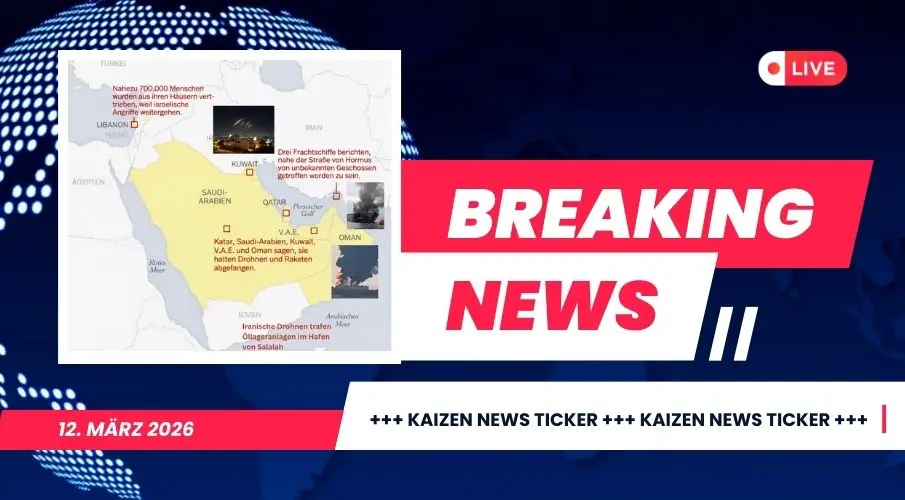
The Blocked Truth - How the Security Council Breaks Over the Origin of the War!
Iran’s UN ambassador Amir-Saeid Iravani said: “Some members of this Council are attempting to reverse the roles of victims and aggressors. They are attempting to reward the aggressor and punish the victims through a one sided and politically motivated resolution. Such a measure would, if adopted, severely damage and undermine the credibility and legitimacy of this Council. If adopted, it will be a stain on the credibility and reputation of the Security Council. If adopted, the aggressors - Israel and the United States - will be rewarded and encouraged to commit further acts of aggression. Today it is Iran. Tomorrow it could be any other sovereign state.”
Mr. Amir-Saeid Iravani, Iran’s ambassador to the United Nations, makes his public argument far too easily. Military actions attributable to Iran against third states - including attacks on the territory and infrastructure of Saudi Arabia, Bahrain, Kuwait, the United Arab Emirates, Qatar, Oman, Iraq, Azerbaijan, and Jordan - meet the criteria of the prohibition of the use of force under Art. 2 para. 4 of the UN Charter. The use of military force against sovereign states without their consent, without the right of self defense under Art. 51 of the UN Charter, and without a Security Council mandate under Chapter VII is to be qualified under customary international law as aggression within the meaning of UN Resolution 3314 (XXIX).
The attacks on commercial vessels in the Strait of Hormuz also constitute violations of the freedom of navigation codified in Art. 38 and Art. 87 of UNCLOS as well as of the SUA Convention of March 10, 1988. A justification through reprisal or collective self defense is excluded, since the affected third states did not conduct an armed attack against Iran that would meet the requirements of Art. 51 of the UN Charter.
A legally consistent short assessment of the conflict is that serious violations of peremptory international law exist on both sides, which belong to the area of ius cogens and from which no contractual deviation is permitted. The prohibition of the use of force under Art. 2 para. 4 of the UN Charter is considered a peremptory norm of general international law within the meaning of Art. 53 of the Vienna Convention on the Law of Treaties. Mr. Iravani would therefore be well advised not to limit himself to a selective international law argument that focuses exclusively on the actions of the opposing side while shielding his own state conduct from critical legal examination. International law applies universally or it does not apply at all.
In the United Nations Security Council a resolution on the situation in the Middle East has become the latest point of dispute. The text demanded an end to Iranian attacks on states in the Gulf. Russia and China, however, refused their approval. Both countries declared that the draft concealed the beginning of the war. The document did not mention that Israeli and American strikes on Iran on February 28 had triggered the conflict. Russia’s UN ambassador Vassily Nebenzia said during the meeting that the text blurred cause and effect. Anyone reading the draft without knowing the background could believe Iran had attacked Arab states on its own initiative and without provocation. That portrayal was incorrect, Nebenzia told the Council.
China’s UN ambassador Fu Cong also defended the abstention. Both delegations reported that they had tried, together with Bahrain and the United States, to find language that would also mention the initial attacks on Iranian territory. That passage ultimately did not enter the resolution. For Moscow and Beijing the text therefore remained unbalanced. At the same time a second attempt in the Council failed. Russia introduced its own short draft demanding an immediate halt to the fighting and condemning attacks on civilians and civilian infrastructure. The proposal did not receive the required nine votes. Only Russia, China, Pakistan, and Somalia supported it. Other states accused Moscow of lacking credibility in calling for an end to violence in light of the war in Ukraine.
The session was further shaped by sharp exchanges. Even before Iran’s representative could speak, the American UN ambassador Mike Waltz attacked Tehran. He declared that the Iranian diplomat would present untruths to the Council. Iran claimed it was striking only American military bases in the Gulf. That portrayal was false, Waltz said. The attacks had been brutal and carried out without clear targeting. According to the American ambassador it was precisely this conduct that had produced new alliances. Gulf states that had previously held differing interests had now moved closer together. The conflict has therefore not only created military fronts but has also redrawn political lines. Inside the Security Council itself, however, a different picture emerges: while a war is unfolding outside, the most important body of the United Nations remains deeply divided over its interpretation.
The President’s Shoes

Within Donald Trump’s circle a small but remarkable story is currently circulating. The president is said to have begun giving elegant shoes to men in his inner circle. They are classic dress shoes from the brand Florsheim, priced at about 145 dollars per pair. The unusual part lies less in the gift itself than in its effect. According to reports from Washington, some recipients apparently feel obliged to wear these shoes. Not out of enthusiasm, but because they believe it would be better not to leave them in the closet.
One photograph in particular drew attention. Secretary of State Marco Rubio was seen at a public appearance wearing exactly such shoes. Trump allegedly ordered them for him without asking for the size. He simply estimated it. The result was clearly visible. The shoes looked too large. In the images they extend slightly beyond the edge, as if they were half a size off. In Washington it is now said that these gifts are more than a fashion idea. They are understood as a quiet sign of closeness. Whoever wears them shows belonging. Whoever does not wear them could raise questions.
Thus a strange scene emerges: men in important offices walking around in shoes they might not have chosen for themselves. Not because of style or comfort. But because they come from the president. See also: The Leader’s Shoes - A Continuous Improvement in Black Leather
The Visit to the Weapons Hall

Kim Jong Un visited an ammunition factory on Wednesday. State media in North Korea released a series of photographs shortly afterward. They show the leader standing in a production hall and personally testing several weapons. In some images he fires rifles while officers and factory managers stand beside him watching. The photographs were distributed by the state news agency KCNA.
Such images are a regular component of political communication in North Korea. The head of state frequently appears in factories, on military grounds, or at weapons projects. The message is always similar: the leader is personally present, he inspects production, and he takes the weapons into his own hands. In this way the connection between political leadership and the military is demonstrated. The published photographs show long production lines with weapons and ammunition. Workers stand in the background while Kim Jong Un handles the rifles and fires several shots. Official information about the location, quantity, or specific weapon types was not provided.
Attack on the Open Sea
On Wednesday three tankers were attacked on the open sea by boats that, according to reports, were loaded with explosives. Several sources attribute the boats to Iranian forces. The explosions struck the ships in quick succession. The damage is significant, but both vessels remained afloat. Farhan al Fartousi, director general of the Iraqi Ports Company, later confirmed that the crews had been brought to safety. A total of 38 foreign crew members were evacuated from the damaged ships after the explosions. Rescue teams brought them ashore, and no injuries were initially reported. Smoke also rose from the tanker “Mayuree Naree, Bangkok.” The Royal Thai Navy released an image of the damaged vessel. Iran claimed responsibility for the attack. See also: 32 States Open 400 Million Barrels in Reserves - Trump’s Miscalculation Pushes the World Into Distress

The incident increases tension along one of the most important trade routes in the world. Tankers pass through these waters every day, and a significant portion of global oil trade moves along this corridor. Attacks on civilian vessels are considered a serious violation of the rules of maritime navigation under international law. The attack shows how quickly a regional conflict can affect international trade. Every incident in the Strait of Hormuz immediately sends a signal to markets, shipping companies, and insurers. The message of the attack is clear.
The Next Recommendation from Mar-a-Lago

Donald Trump has intervened in the primary race in Texas’s 23rd congressional district. The president publicly backed candidate Brandon Herrera. In a statement Trump praised him as a candidate supported by many “highly respected MAGA supporters in Texas” and as someone who also enjoys backing within the Republican camp in the House of Representatives. According to Trump, Herrera’s main task in Congress would be one thing above all: advancing the political line of the president’s movement. Trump put it briefly. Brandon Herrera would work “tirelessly” as a representative to push forward the political agenda “Make America Great Again.”
The 23rd district in Texas has for years been considered politically competitive. Republicans and Democrats regularly alternate there with narrow results. For that reason endorsements from the president’s circle carry particular weight in this region. With his support Trump is attempting to shape the outcome of the Republican primary early. For candidates in Texas a public word from his circle is often decisive. Whoever receives it gains attention, money, and volunteers. Whoever does not receive it has a harder path. Herrera therefore moves suddenly into the center of a campaign that in Texas is traditionally fought hard. The president has already made his choice.
The London File

For more than a decade there had been indications of events in London, yet a criminal investigation never began. Virginia Giuffre told the London police as early as 2015 that Jeffrey Epstein and Ghislaine Maxwell had brought her to London in 2001. There, she said, she had sex with Andrew Mountbatten-Windsor in Maxwell’s house, who at the time was known as Prince Andrew. The Metropolitan Police conducted three interviews with her, two in 2015 and another in 2016. After that the authority decided not to initiate an investigation.
A letter from the lawyer Paul G. Cassell to Scotland Yard described the course of events in detail. It states that Giuffre had been flown to London after two years of prior abuse. Epstein and Maxwell had deliberately prepared her to perform sexual acts for influential friends. The letter also included a photograph: Andrew Mountbatten-Windsor with his arm around the then seventeen year old Giuffre, with Ghislaine Maxwell standing beside them. Cassell explained that he had access to the original image.
Police later stated that during the interviews no specific criminal offense against a person in the United Kingdom had been identified. Giuffre had spoken of international human trafficking that had largely been organized outside Britain. Therefore the authorities had spoken with prosecutors and contacted American agencies that were already investigating Epstein. The final assessment was that an investigation would primarily have to be conducted abroad. In 2019, 2021, and 2022 authorities reviewed their decision again. Each time the conclusion remained not to open an investigation. Criticism of this came among others from Vera Baird, then victims’ commissioner for England and Wales. After Andrew Mountbatten-Windsor gave an interview to the BBC in 2019, she contacted the police and asked why the allegations had never been investigated. An officer explained to her that the main focus of the case lay outside the United Kingdom.
Lawyers also point to complex legal questions. In the United Kingdom the age of consent is 16 years, and not every sexual relationship involving payment is automatically a criminal offense. The decisive question would have been whether coercion or human trafficking could have been proven. After the death of Virginia Giuffre in 2025 a criminal examination is today considered almost impossible. Investigators are now again reviewing documents from the released Epstein files. This also concerns indications that London airports may have been used for transporting victims. The Metropolitan Police, however, currently sees no concrete new evidence for reopening the case.
Silence Over Taiwan

For years Chinese military aircraft had been part of everyday life around Taiwan. Almost daily the defense ministry in Taipei reported new flights near the island. Fighter jets of the People’s Liberation Army approached the air defense identification zone, sometimes in small groups, sometimes in larger formations. This presence was intended to exert pressure while also showing that Beijing continues to regard Taiwan as its own territory. Yet in recent days something unusual has happened. For twelve of the last thirteen days no Chinese military flights have been registered near the island. The only exception was two aircraft on Sunday. Observers speak of the longest interruption since 2021. At that time a tropical storm influenced the region. This time the weather was stable.
Last year Taiwan recorded on average about ten Chinese military flights per day, and on some days several dozen. The current pause therefore stands out clearly. Experts are trying to explain why the activity has suddenly declined. One possible explanation is the planned meeting between Xi Jinping and Donald Trump at the beginning of April in Beijing. A calmer military situation could help prepare this meeting without additional tensions. Other observers point to rising energy prices caused by the war between the United States, Israel, and Iran. Higher costs could limit military exercises. Others see internal reasons within the Chinese armed forces. In recent years numerous generals and senior figures have been removed from the military. Such changes can also influence training schedules.
It is striking, however, that the decline concerns only air activity. Chinese warships are still operating around Taiwan. Taiwan’s defense minister Wellington Koo therefore warned against interpreting the decline as a sign of relaxation. What matters is not only whether aircraft appear, but the overall picture of military movements in the region.
The coming weeks will show whether the flights increase again. For Taiwan the situation remains tense. The brief silence in the sky is not a sign of a fundamental shift in course. It is above all a puzzle that observers cannot yet fully explain.
The Strike in Bryansk

The Ukrainian armed forces have struck the Russian city of Bryansk. According to statements from Kyiv the target of the attack was a large electronics factory called Kremniy El. The facility produces components for Russian missiles. Control systems and microchips used in various weapon types are manufactured there. The factory lies around one hundred kilometers behind the border and for a long time was considered a secure production site. Russian authorities reported six civilian deaths and 42 injured after the attack. Several buildings in the surrounding area were damaged. Window panes shattered, residential houses and shops were struck. The governor of the region declared Wednesday a day of mourning and appeared at the scene beside destroyed facades and debris.
Moscow described the attack as an “inhumane act” and spoke of seven Storm Shadow missiles being used. These cruise missiles have a range of more than 150 miles and are produced by Britain and France. Kremlin spokesman Dmitry Peskov claimed the strike would not have been possible without British specialists. He did not provide evidence. The Ukrainian leadership presented the attack differently. President Volodymyr Zelensky said the factory produces control systems for Russian missiles that strike Ukrainian cities and villages. The Ukrainian general staff described it as an important component of Russia’s arms production and reported significant damage to the production facilities.
Images of the attack show explosions and dense clouds of smoke over the factory grounds. Even Russian military bloggers reacted unusually sharply. One of them spoke of “criminal negligence” and asked publicly how long it would take to replace production and specialized personnel. The strike shows one thing above all: even far behind the front the Russian defense industry remains vulnerable.


Bedauerlicherweise ist die UN schon lange zerrütet.
Unfähig menschen- und völkerrechtskonforme Resolutionen einheitlich zu verabschieden.
Und, die Resolutionen haben leider auch keine Auswirkungen.
Weder auf die Aggressoren, die Opfer, noch den Rest der Welt.
Der Iran wurde ohne UN Mandat, ohne Zustimmung des Kongress angegriffen.
Erst hat sich der Iran verteidigt und Militärbasen der USA angegriffen.
Nun aber bombardieren sie zivile Infrastrukturziele in Ländern, die den Iran nicht angegriffen haben. Dubai, Bahrain, Oman …
Auch das ist völkerrechtswidrig.
Mit all den machthungrigen Staaten, wie USA, Russland und China wird es nie eine Einigkeit in der UN geben.
Jeder will seine Macht erhalten und Stärke demonstrieren.
Zwar z.T auf unterschiedliche Art und Weise, aber dennoch gleich.
… ich kenne die un sehr, sehr gut, auch die abläufe … leider sind die guten leute weg, dass ist ein grosses problem
Die Schuhe 🙈🙈🙈 so mega peinlich.
Eigentlich kann sich Rubio ja noch freuen, dass sie zu groß und nicht zu klein sind.
Sonst müsste er es wie die böse Schwester bei Aschenputtel machen und sich die Zehen abhacken um in den Schuh zu passen …..
…ja, eine glückliche partei
Kim präsentiert sich immer gerne.
So läuft das in Diktaturen.
Der Machthaber zeigt „Stärke“ und das Volk hungert.
Waffen und Munition kann man nicht essen.
Aber darum müssen sich die Machthaber nicht sorgen.
Sie haben genug zu essen, schwelgen im Luxus.
In Anbetracht der Weltlage sicher kein Zufall, dass die Fotos jetzt gezeigt werden.
Ebenso wenig wie die Raketentests.
👍
Epstein und London
Was da vertuscht bzw erst gar nicht ermittelt wurde.
Sicher nur wegen Beteiligung von Andrew.
Guiffre hat klar ausgesagt, dass sie missbraucht wurde.
Das es sich um Menschenhandel gehandelt hat.
Aber nach nur 2 Gesprächen in einem Abstand von fast einem Jahr wurde beschlossen nicht zu ermitteln.
Nicht einmal mit all den neuen Beweisen will Scotland Yard die Ermittlungen wieder aufnehmen.
Es scheint, als ob mit der Degradierung von Andrew das „Epstein Problem“ aus der Öffentlichkeit verschwinden soll.
Eine der großen Fragen bleibt.
Wer wusste, wann, von was.
…da ist überall soviel mist gemacht worden, dass kannst du kaum noch alles nachholen
Danke auch für all die anderen Berichte.
So hat man einen hevorragenden und faktenbasierten überblick.
…ich danke dir
Es ist immer wieder „faszinierend“, wie Russland von einem „unmenschlichen Akt“ spricht, wenn die Ukraine Treffer landet.
Russland das seit 4 Jahren die Ukraine mit Bomben überzieht und Zivilisten zu hunderten ermordet.
…normal müsste man sie aus dem saal werfen