
Trump redet von Mission Accomplished. Iran feuert weiter Raketen. Wer verliert diesen Krieg, wird es als letzter merken.
Two weeks. That is how long the American Israeli war against Iran has been underway. And Donald Trump stands before Republican lawmakers in Florida and says: “We have already won in many ways.” At the same time, the Islamic Revolutionary Guard Corps launches new salvos at Tel Aviv and at the headquarters of the U.S. Navy in Bahrain.
The headquarters of the 5th U.S. Fleet in Bahrain, which was struck by an Iranian missile.
This is not irony. This is war. Through its spokesman Ali Mohammad Naini, the IRGC has made it unmistakably clear that Iran is capable of continuing this war for at least six more months at the same intensity. That is more than a threat: It is a description of the situation. Verifiable? Hardly. Naini also stated that in the first days of the war Iran had predominantly used missiles from the years 2010 to 2014. What has been produced over the past ten years has not yet been needed. How much of this is propaganda and how much is truth is difficult to verify. What we do see, however, is that the regime remains firmly in the saddle - unfortunately.
Trump, on the other hand, claimed to journalists that Iran’s missile capacity had been reduced to about ten percent, possibly less. Iranian Foreign Ministry spokesman Esmail Baghaei responded laconically from Tehran: “Let them remain in their illusions.”

This is not just rhetoric. It is an indication of something structural that should not be dismissed with arrogance. Iran did not improvise this war. That is the decisive point Washington apparently never truly took seriously. After the Twelve Day War of June 2025, Tehran played through its retaliation scenarios in detail. When the United States and Israel attacked on February 28, the Iranian counterstrategy functioned like a prepared system: command authority was delegated deep into the hierarchy so that commanders of the Revolutionary Guard’s aerospace division could launch rockets and drones at pre designated targets within hours - regardless of whether communication lines were disrupted or leadership figures eliminated.
When one speaks with locals, one hears this sentence again and again: “This is the war Iran has been working toward for a generation.”

Fear is present in every corner
The Trump administration treated Iran as if one could return every few months, devastate the country, and enforce regime change. Iran’s preparation is of another caliber. Distributed across the entire territory are autonomous units that continue operating when others fail. Iran’s underground infrastructure includes between 70 and 100 subterranean ballistic missile launch facilities, many embedded in mountains, with rail guided missile systems that function like automatic magazines. One missile moves into position, is fired, the next advances. Some of these facilities are equipped with bulldozers to clear debris at the entrance should it be blocked by airstrikes. The fact is, whether one likes it or not: So far no convincing evidence has been seen that these capacities have been seriously damaged.
On March 10 U.S. forces eliminated several Iranian naval vessels, including 16 minelayers near the Strait of Hormuz.
The greatest surprise of this war, however, does not lie in the missiles. It lies on the water, more precisely: at the Strait of Hormuz. Sheikh Nawaf Al Sabah, chief executive of the Kuwait Petroleum Corporation, stated in an interview in early March that he had not expected Kuwait to be targeted so consistently, nor had he expected Iran to be capable of effectively closing the Strait of Hormuz. Physically it is not blocked, but nothing is passing through because Iran threatens every vessel that attempts it. KPC had withdrawn tankers from the Gulf before the attack and stored oil near Japan and Korea. But these are stopgap measures, not a solution.

The consequences for health and the environment are not foreseeable at all - Black rain over Tehran
For more than 80 years, according to Al Sabah, oil traffic through the Strait of Hormuz had never stopped for a single day. Now there have been five or six days of virtually zero traffic. Twenty percent of the global oil supply flows through this strait. Anusar Farooqi, a geopolitics and defense analyst for the Policy Tensor newsletter, names the strategic problem: If the Strait of Hormuz cannot be reopened, the war cannot be ended. The vectors through which Iran can inflict economic damage would then be practically unlimited. The modeling for a three month closure is catastrophic.

What enables Iran to do this are essentially Shahed drones. Simple, cheap one way drones that can be produced for a few tens of thousands of dollars and operate from mobile launch platforms. They have altered the security architecture of the Gulf because they allow Iran to strike targets on a scale that effectively paralyzes a sea corridor vital to the global economy. The original U.S. strategy for securing the region, Farooqi explains, was based on the assumption that Iran could be denied the ability to close the strait. That assumption is false.
The costs of the war on the American side are accumulating quietly but steadily. Iran has damaged or destroyed radar installations that form the backbone of the American missile defense system - AN/TPY 2 and PAC 3 systems for THAAD and Patriot at U.S. bases in Bahrain, Kuwait, Qatar, the United Arab Emirates, Jordan, and Saudi Arabia. Reporting indicates that the United States has begun relocating THAAD components from South Korea to the Middle East. South Korea’s President Lee Jae myung stated that Seoul had objected but ultimately could not prevail.
At least eleven MQ 9 Reaper drones have been officially confirmed as shot down over Iran. Iran itself claims to have downed more than 80 drones. In our view this reflects more wishful thinking than reality. Each lost drone reduces the ability to detect and intercept Iranian missile launches at an early stage. One should also look at logistics: Interceptor missiles carried by destroyers are finite. Once expended, the ship must return to base to reload - a process that takes several days. Iran deliberately distributed its defensive potential among autonomous units so that the loss of one unit does not halt overall operations.
Iran’s Foreign Minister Abbas Araghchi summed up Trump’s position in one sentence: The United States believed it could achieve a clean victory in two or three days, possibly regime change. That failed, in his view. Plan A failed. All further plans as well. “I do not believe they have a realistic exit in mind. I believe they are aimless.” Mohammad Bagher Ghalibaf, speaker of Iran’s parliament, left no doubt: “We are absolutely not seeking a ceasefire. We believe the aggressor must be struck in such a way that he learns a lesson.”
Trump now speaks of a “short term excursion.” Whether he wants to end the war is one question. Whether Iran would agree on his terms is another. Iran has twice experienced Trump announcing negotiations and then launching massive attacks. A short term ceasefire modeled on the Twelve Day War, Iranian officials say, is out of the question.
The heaviest attacks on Tehran likely took place last night
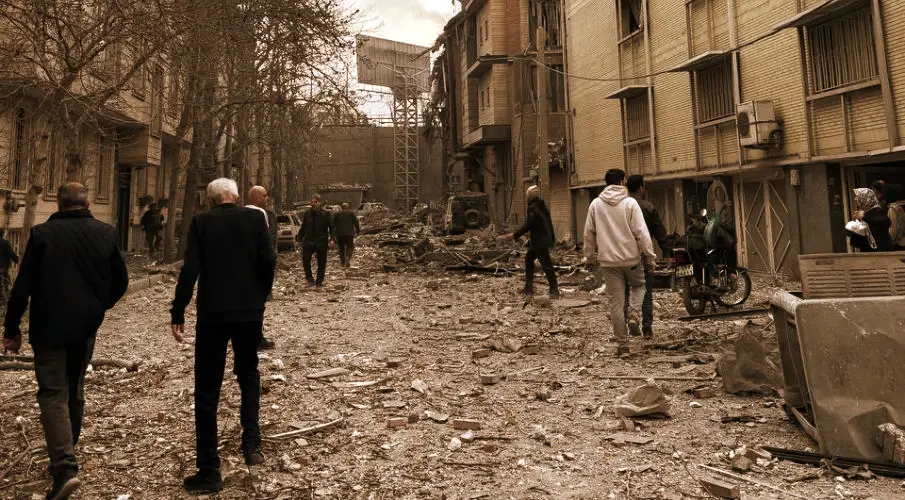
And while outside the rockets are counted and the strategists refine their models, inside people are living. And something else is felt: It is something smaller, more everyday, and therefore heavier: that one can hardly take a step without being observed. That the fear which once already knew hardly any boundaries has now long since lost those boundaries entirely. That is what is shocking. What was promised as liberation - by whomever, in whatever language - has turned into a new form of bondage. The regime of the mullahs has not been broken. Under external pressure it has hardened inwardly. And the civilian population bears what no satellite captures and no interceptor missile strikes: the daily growing burden of living in a country that does not trust its own people. The war continues. And those who first tried to explain it are now searching for an exit.
Updates – Kaizen News Brief
All current curated daily updates can be found in the Kaizen News Brief.
To the Kaizen News Brief In English


Die Macht im Iran fühlt sich seit 45 Jahren von Feinden umzingelt.
Wer um diese Tatsache weiß, kann sich schnell vorstellen wir sehr hier vorgesorgt wurde.
Nicht nur in Waffen wurde vorgesorgt, sondern auch in allen erdenklichen Angriff,- und Verteidigungsstrategien.
Ein Narr, wer diese Tatsache außen vor lässt – bzw. außen vor ließ!
Aber so sind die USA.
Die meinten in diesen Gebieten schon immer: Wir machen das…. und hatten noch nie einen Schimmer davon wie diese Menschen denken, fühlen und was sie wollen.
Folge: Das gesamte Gebiet wurde destabilisiert, Terrorgruppen bildeten sich, Fanatiker kamen/ kommen an die Macht und es nimmt kein Ende.
👍
👆
Das ist die Überheblichkeit von Trump.
Er weiß nichts über den Iran, seine Bevölkerung und schon gar nichts über das seit über 40 Jahre herrschende Mullahsystem.
Und das ist der große Fehler.
Trump dachte, mit ein „paar Bomben“ ist das fix erledigt.
Hegseth guilt sich scheinbar immer weiter an diesem Krieg auf. Aber sehr planlos.
Iran hat sich seit Jahrzehnten auf diesen Krieg vorbereitet.
Sie wussten, dass er kommt.
Je länger es dauerte, desto ausgeklügelter wurde das Verteidigungs/Angriffssystem.
Mit Unterstützung aus Russland wurden Waffen gebaut.
Im Ukrainekrieg revangierte man sich mit Drohnen.
Trump setzt weiter auf Russland.
Aber der Iran hat die Unterstützung Russlands.
Die Zivilisten leiden weiter.
Das Bild mit den 2 Katzen hat mich zum Weinen gebracht 💔
..ja die zwei, das foto mussten wir mitnehmen – trump hat sich komplett verrannt und jetzt muss er da irgendwie raus…wird spannend das zu betrachten