
In January 2026, Georgia allegedly exported its own petroleum products worth 56 million dollars. An increase of 3300 percent compared to the previous year. Petroleum products thus moved into second place in Georgia’s export statistics. A country with no significant domestic production, no established refining capacity - and suddenly a heavyweight in the oil business.
The official explanation is the new refinery project in Kulevi on the Black Sea. There, on the grounds of a terminal owned by the Azerbaijani SOCAR, a tanker loaded crude oil for the first time in October 2025. The operating company is called Black Sea Petroleum. Its owner is Maka Asatiani, known in the 2000s as a model and socialite, daughter of footballer Kacha Asatiani, former wife of Merab Shordania, later married to Russian-born businessman Kote Gogelia.

Maka Asatiani stands behind Black Sea Petroleum. Her son Kachi Shordania holds shares in SDO Logistics; the majority shareholder there is Sergei Alexeyev, son of Vladimir Alexeyev, First Deputy Head of Russia’s military intelligence service GRU since 2011, who was targeted in an assassination attempt in Moscow on February 6, 2026.
Gogelia is considered the real mastermind behind the project. In Russia he founded “Nefteresurs” and “Arctic Bunker,” companies in the fuel transport sector. And of all companies, “Russneft,” founded by Mikhail Gutseriev, delivered crude oil to Kulevi in October 2025 as the first supplier.

Kote Gogelia, Maka Asatiani (2016)
When Prime Minister Irakli Kobakhidze presented the refinery project in 2024, he promised stronger export capacity, an improved trade balance, and currency stabilization. That the venture did not come about without state support was admitted by Maka Asatiani herself. Investments for the first construction phase amounted to around 110 million dollars, the overall project was estimated at 700 million. Financing came in part through the “Georgian Development Fund” as well as commercial banks, including Cartu Bank, long within the sphere of influence of oligarch and founder of the ruling party “Georgian Dream,” Bidzina Ivanishvili. After U.S. sanctions against Ivanishvili in 2024, shares were redistributed, yet political influence is considered intact.

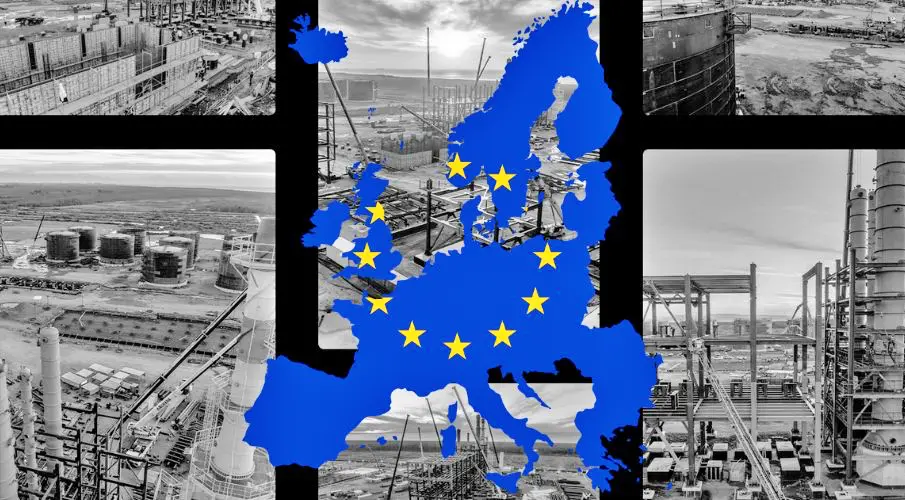
Steel frameworks, distillation towers, storage tanks, cranes operating nonstop. It is the construction of an oil refinery complex. According to the company’s own presentation, Black Sea Petroleum LLC was founded in 2022 with the goal of building and later operating the refinery in Kulevi, Georgia. The photographs document construction progress: foundation work, assembly of steel structures, installation of process units, large storage facilities, as well as maritime infrastructure. This suggests that the project includes not only a classic refinery but also storage and transshipment capacity - strategically significant on the Black Sea coast.

The company promotes a strategic claim: the facility is to contribute to the “energy independence of the country” and create a new industrial ecosystem. What is meant is refinery infrastructure capable of processing crude oil and producing fuels or petrochemical products domestically instead of relying entirely on imports. In its self-presentation, this is linked to economic growth, energy supply stability, and increased value creation. Georgia lies between Russia, Turkey, and the Black Sea - a refinery there is economically attractive, but also politically sensitive.
Personnel connections also raise questions. Levan Davitashvili, previously Minister of Economy and involved in approving the project, became CEO of Black Sea Petroleum in 2025. For anti-corruption researchers such as Besik Donadze, it is clear that a project of this magnitude would not be feasible without backing from within the government environment.
Parallel to the project’s development, imports of Russian energy rose dramatically. After the start of Russia’s attack on Ukraine, Georgia did not join Western sanctions. Russian products were price-attractive. In 2021, Georgia imported 225,000 tons of petroleum products from Russia. In 2022, it was already 658,000 tons, in 2023 around 771,000, in 2024 just under 700,000 tons. Russia’s share of Georgia’s energy imports temporarily rose to nearly 50 percent.
However, export figures became striking. International trade data show a multiplication of Georgian exports to Europe since the beginning of the war. According to Georgian statistics, no oil deliveries went to Spain in 2023 and 2024. International databases, however, registered 99,000 tons worth 49 million euros. Similar discrepancies were found with Greece, Italy, Belgium, and the Netherlands.

In 2021, Georgia imports 225,000 tons of oil products. 3.73 million inhabitants. That equals around 60 kilograms per capita. That is the reference value. One year later, imports shoot up to 658,000 tons. With the same per capita consumption, Georgia would suddenly have needed 10.9 million inhabitants. In reality, 3.69 million people lived in the country. In 2023 the number rises further - 771,000 tons. Mathematically, this would require 12.8 million inhabitants. Real figure: 3.74 million. In 2024 the value drops slightly to 699,000 tons. That would still correspond to 11.6 million people. Official population: 3.69 million.
In other words: Either Georgia tripled its population unnoticed - or the oil does not remain in the country.
At the same time, petroleum products appear in the EU with the origin label “Georgian.” Sanctions against Russian energy are intended to cut off the flow of money to Moscow. Yet the figures show something different. Our investigation reveals: The volumes moved by Georgia do not match the domestic consumption of a country of this size. They match a transshipment hub. And the EU? So far it finds no effective lever against it. The rigid regulatory framework does the rest.
Explanations range from triangular trade deals to document alterations to blending with other qualities. Also possible is minimal processing that allows a new origin label. With the commissioning of the refinery in Kulevi, a facility with a planned capacity of up to three million tons annually came into existence for the first time. Yet evidence of actual production on that scale is still lacking. In the municipality of Chobi, it was said in November 2025 that only test operations were running, the plant had not officially opened. The website still shows construction phase photos.
The timing is nevertheless striking. On October 6, 2025, the tanker “Kayseri” delivered 105,000 tons of crude oil from “Russneft” to Kulevi. A few weeks later, the vessel was sanctioned by the EU as part of the so-called shadow fleet, later also by the United Kingdom. At the beginning of 2026, a second ship followed, the 2003-built “Nostos,” from Novorossiysk. Ukrainian intelligence sources list it as an instrument of sanctions evasion. Georgian authorities emphasized that neither the ship nor the operator had been listed at the time of delivery. The use of vessels that correspond to the so-called shadow fleet pattern - older tankers with changing flags, opaque ownership structures, and conspicuous AIS manipulation - is not an isolated phenomenon. This logistics structure emerged deliberately as a response to Western sanctions. If such ships regularly call at a port, the question automatically arises whether that port has become part of a larger evasion network.
Shortly thereafter, export figures exploded. In January 2026, petroleum products reached 12.2 percent of total Georgian exports. 95 percent of that was considered domestic production. The increase compared to the previous year exceeded 3300 percent. Comparable refining capacities do not exist in the country. This development nearly brought the port of Kulevi onto the sanctions list of the twentieth EU package. Hungary and Slovakia have so far blocked corresponding steps. Italy is also said to have expressed reservations, as Azerbaijani gas is also handled via Kulevi. A sanctions decision would not only affect Georgia, but also SOCAR.
Former National Bank president Roman Gotsiridze sees several scenarios: import of already processed Russian products under false declaration, import of semi-finished products with minimal adjustment, or exchange of goods flows within the terminal. In any case, the allegation would be that customs declarations were manipulated and EU sanctions circumvented. At the same time, another sector shows how flexibly trade flows can be arranged: the re-export of passenger cars has for years been Georgia’s largest export item. The vehicles are predominantly exported to Kyrgyzstan, where only a fraction is registered. The rest allegedly disappears further toward Russia.
If Russian oil runs through Georgia, is re-declared there, further processed, or enters the European market as an allegedly “Georgian” product, then this is not just a trade problem. It is a political contradiction. A country cannot credibly claim the path toward Europe and at the same time become a possible hub for circumventing European sanctions.
That is why the Kulevi case is not merely about tankers, paperwork, and export figures. It is about how seriously Georgia means its EU course - and how seriously the EU itself takes its own sanctions.
If Kulevi is in fact reselling Russian products under a Georgian label, it would be more than a statistical outlier. It would mean that an EU candidate country has become a building block in the system of sanctions evasion. For the government in Tbilisi, not only an industrial project would be at stake, but the country’s foreign policy credibility.
Sanctions do not close all doors at once. They seal loopholes step by step. Kulevi could prove to be one of those loopholes. Whether the refinery is a real production center or merely a stopover in a larger diversion does not decide only trade statistics. It decides on which side Georgia stands in this conflict. For a country that officially holds the status of an EU candidate, such a development would be politically explosive. The European Union expects candidate states to align with its foreign and sanctions policy. A port suspected of being part of an evasion structure would undermine precisely that trust.
Updates – Kaizen News Brief
All current curated daily updates can be found in the Kaizen News Brief.
To the Kaizen News Brief In English


Was ich nicht begreife.
Georgian ist Beitrittskandidat.
Stellt sich aber seit Russlands Angriffskrieg aufdie Ukraine immer auf die Seite Russlands.
Unterstützt die Sanktionen nicht.
Wieso ist die EU nicht konsequent, nach nunmehr 4 Jahren, und entzieht den Status Beitrittskandidat komplett?
Nicht nur auf Eis legen.
Sondern kompletter Entzug.
Georgien ist auf keinem europäischen Weg.
Sie sind auf dem direkten Weg zurück unter russische Fittiche.
Daran ändert es auch rein gar nichts, wenn sie Beitragskandidat bleiben.
Das ist die typische Naivität und Blindheit der EU.
Bei der instabilen politischen situation sollten derzeit gar keine Beitrittsgespräche geführt werden.
Es reicht ein massiver Quertreiber wie Orban und einem ihm folgenden Fico.