
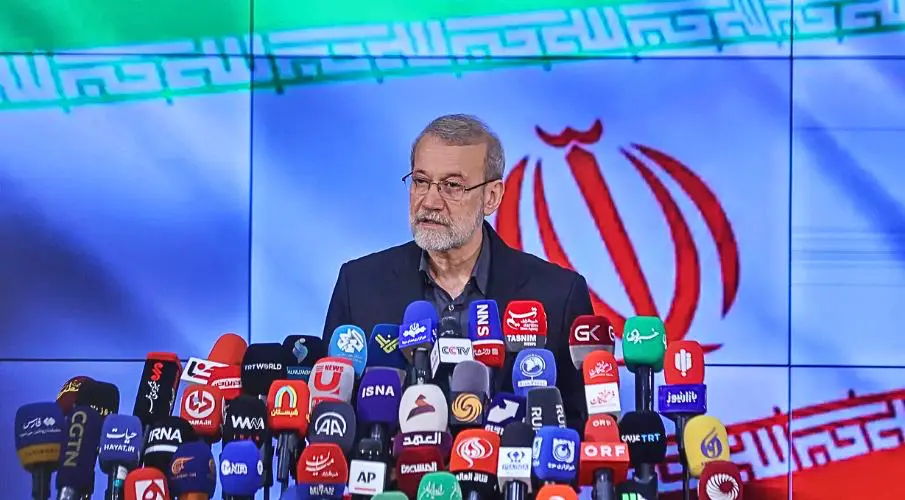
Tehran - Iran will neither surrender nor halt its attacks. That was the message Ali Larijani, Secretary of the Supreme National Security Council, delivered on state television as the war entered its second week. The United States must "pay the price" for the killing of Ayatollah Ali Khamenei, he said. "The Americans must know that we will not let them get away with it. Our people stand behind us, our leadership is united, there is no division in the fight against Israel and America." Ali Larijani is considered the closest confidant of the slain religious leader and effectively the highest authority on matters of national security and foreign policy. Under the constitution, a three person council consisting of President Masoud Pezeshkian, the head of the judiciary, and a cleric initially assumed leadership of the country. But in Tehran, Larijani is seen as the one who actually directs affairs. Ayatollah Khamenei had already granted him expanded powers at the beginning of the year during a phase of nationwide protests. The government crushed the unrest with lethal force; according to human rights groups, at least 7,000 people were killed.
Ali Larijani is not a moderate mediator and not an accidental crisis manager. He has been part of the center of power in Tehran for decades. As head of state broadcasting, he stood for a system of strict media control. Critical voices were filtered out, opposition figures defamed, public debate brought into line. Later, he rose to the top of the security apparatus and became a close confidant of Ayatollah Ali Khamenei. Under the security apparatus to which he is politically linked, nationwide protests were ended with deadly force. Human rights groups speak of thousands of deaths. This approach was not an aberration, but an expression of a system he helped sustain.
Larijani embodies the ruling structure of Revolutionary Guards, politics, and business. He stands for a hard line against internal opponents and for confrontation in foreign policy. Anyone portraying him today as a determined defender of the country ignores that he has long been one of the pillars of the very power structure that suppresses criticism and uses violence as a tool. A victim role does not belong to him. He is part of the apparatus, not its sufferer.
For a long time, the gaze was turned away from the situation in Iran, as if silence were a form of politeness. We had frequently investigated, again and again, had exposed structures, named connections - yet the texts found no place that wanted to publish them. The person of Ali Larijani and his role in particular were repeatedly the focus of our reporting.
See also: Who’s There?” – When AI Answers Where Family Once Was

Digital Repression Through Drones and Facial Recognition
Larijani visibly sought to demonstrate unity. Earlier, President Pezeshkian had apologized in a video message to the Arab Gulf states for Iranian retaliatory strikes and announced they would be halted. Hours later, he walked back his words after hardliners sharply criticized him. Donald Trump interpreted the episode as a sign of Iranian weakness and wrote that Tehran had "surrendered" to its neighbors. An end to the war, Trump added, would come only with "unconditional surrender." Larijani directly contradicted him. If American military bases in the region attack Iran, Iran will respond. That is the country’s right and policy. Iran does not seek destabilization, he said, but the nature of this war destabilizes the entire region. During his address, explosions shook Tehran and Karaj, fireballs were visible over the capital. Iran’s Oil Ministry reported attacks on several oil depots in both cities; the Israeli military confirmed the strikes.
"The Iraqi parliament breaks into chants: 'Death to the USA' and support for the Islamic Republic of Iran."
We face difficult times while Tehran remains under sustained attack. What matters now is the protection of civilians - and realistic preparation for possible refugee movements from multiple affected countries and regions - Editorial note
The Revolutionary Guards announced a new wave of attacks against Israel and stated that a refinery in Haifa had been targeted - in response to strikes on Iran’s oil industry. Earlier, Iran had launched drones at a hotel in the Dubai Marina, the airport, a Warner Brothers building, and a port in Bahrain. Tehran claims the American military uses these sites as logistical hubs. Larijani accused Washington of attempting to divide Iran and stir internal unrest. That attempt has failed. Addressing Trump, he said the president should accept that he made a mistake and was pushed into this war by Israel. In Tehran, the line is thus clear: no capitulation, no pause, no distancing from retaliatory strikes - and personal responsibility is seen in Washington.
Updates – Kaizen News Brief
All current curated daily updates can be found in the Kaizen News Brief.
To the Kaizen News Brief In English


Der Iran unter den Mullahs ist eine furchtbare Diktatur.
Ein Land, dass nach Gutdünken seine Bürger tötet.
Ein Land das jegliche Kritik nieder schlägt.
Ein Land das Frauenrechte faktisch eleminiert.
Der Westen hat sehr lange weg gesehen.
Sanktionen, ja.
Deutliche Kritik, eher nicht.
Aber dennoch.
Ein Angriff, ohne direkte „Provokation“, ohne UN-Mandat, ohne Legitimation des amerikanischen Kongresses ….
Das sind mir persönlich zu viele Völkerrechtsbrüche.
Auch wenn es einige Juristen anders sehen.
Aber spinnen wir das mal weiter:
Afghanistan, bis auf das es keine Atomwaffen hat, ist genau so eine furchtbare religiöse Diktatur.
Aber es gibt keine Ressourcen … daher für Trump uninteressant.
Kuba, Kuba steht auf Trumps Agenda. Nicht wegen Ressourcen, aber wegen der günstigen Lage.
Venezuela hat Ressourcen, also interessant für Trump.
Nordkorea eine Diktatur mit Atomwaffen.
Aber Trump bewundert Kim ja.
Grönland ist nicht aus dem Blickfeld von Trump.
Europa tut gut daran das nicht aus den Augen zu verlieren.
Die UN ist in meinen Augen „tot“
Diskussionen. Mahnungen, Warnungen.
Unausgegorene und uneinige Resolutionen, die nicht das Papier wert sind, auf dem sue stehen.
Der Internationale Strafgerichtshof, einst eine wirklich wichtige Institution.
Viele Länder erkennen ihn nicht an.
Gegen Richter, Staatsanwälte werden Sanktionen verhängt, wenn einem Land etwas nicht passt.
Wie soll der Gerichtshof da unabhängig handlungsfähig sein.
Larijani droht den USA,Israel und sogar Trump direkt.
Wenn Trump etwas gar nicht ab kann, ist es Kritik oder gar Drohungen.
Mal sehen, welche Rache sich Trumpelstilzchen einfallen lässt.
Wer weiß, wie lange die Staaten im Nahost noch „still halten“.
Sie sind aufgrund von US Militärbasen ein Ziel.
Wie lange werden sie die Sicherheit ihrer Bevölkerung riskieren?
Was Trump und Netanyahu ausgelöst haben, ist gar nicht vorhersehbar.
Es werden noch viele Menschen sterben 😞
👍