
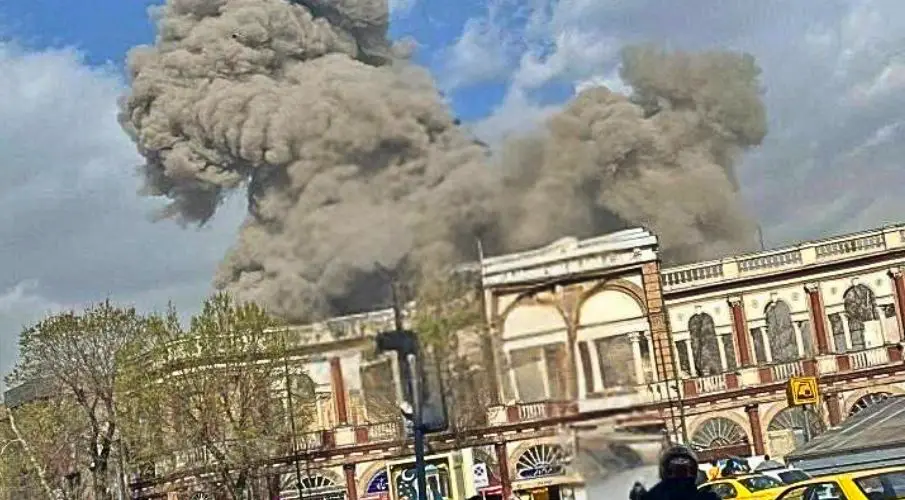
A dark plume of smoke rises over Tehran on Saturday. Several explosions shake the city center, near the zone where the office of Supreme Leader Ayatollah Ali Khamenei is located. Two residents report heavy detonations, windows were said to have trembled, in Vanak people spoke of “explosions and war.” Shortly thereafter, American and Israeli government officials confirm: The United States and Israel have attacked Iran. Defense Minister Israel Katz speaks of a strike and declares a state of emergency. Schools, workplaces and public gatherings in Israel are immediately closed, the airspace completely shut down. Incoming flights are diverted. Iran also closes its airspace. In Tehran, smoke rises from a district that houses not only the presidential palace but also the National Security Council.
The attacks follow a massive U.S. military buildup in the region. Two aircraft carriers, several Navy destroyers and more than fifty fighter jets were deployed. It is the largest American troop presence there in decades. The buildup was explicitly intended to protect American bases, facilities and diplomatic sites against a possible counterstrike. U.S. officials had stated in advance that they expected swift Iranian retaliation, likely also missile attacks on American bases and embassies. In addition, Tehran’s regional network of paramilitary forces is expected to target American interests in the region.
Already in June of the previous year, the United States had bombed Iranian nuclear facilities. President Donald Trump declared at the time that the program had been “obliterated,” later it became clear that it had merely been weakened. The current strikes therefore mark the second U.S. action against Iran in less than a year. They also come at a time when Washington had launched a military operation in Venezuela only about two months ago to detain Nicolás Maduro.
As recently as Thursday, American and Iranian representatives had held indirect talks in Switzerland. A breakthrough did not materialize. Trump demanded restrictions on the nuclear program, limits on the missile arsenal and an end to support for groups such as Hamas and Hezbollah. Tehran insisted on its right to uranium enrichment. Iran outwardly sought to avoid war but refused to negotiate over additional issues such as its long range missile program or support for allied militias. Explosions are now also being reported from other Iranian cities. The semi official news agency Fars reports detonations in Qom, Kermanshah, Isfahan and Karaj. The picture thus extends beyond the capital. The region is under maximum tension. Threats have turned into open violence.
While explosions are reported in Tehran, Israel moves to the highest level of alert. Several hospitals prepare to transfer patients to protected areas or underground shelters. The Health Ministry orders the discharge of all non acute patients to free up capacity. The government openly anticipates Iranian retaliatory strikes.
President Donald Trump meanwhile confirms that the U.S. military has begun “major combat operations” in Iran. He releases an eight minute video on Truth Social. With that, American involvement is official. According to a U.S. official, the initial focus of the American strikes is Iran’s military apparatus. In addition to nuclear facilities, the missile arsenal is considered a central factor: Iran is believed to possess more than 2,000 missiles, primarily short and medium range missiles, distributed across numerous launch sites throughout the country.
The current strikes occur only hours after Israel said it had targeted launch pads and underground facilities of Hezbollah in the south. In recent weeks, Israel had significantly intensified its operations against the Iran backed militia. An airstrike in the Bekaa Valley killed eight members, including a commander. The fronts are thus not confined to one country. Iranian media simultaneously report massive technical disruptions. Several news agencies, including the state outlet IRNA, were temporarily unreachable. Officials say they were the target of a cyberattack.
Security experts have warned for days that an attack on Iran could draw the United States into a prolonged conflict. Tehran possesses one of the largest and most diverse missile arsenals in the Middle East. Medium range missiles with ranges of more than 1,200 miles can reach American bases as far as western Turkey as well as targets in Israel and the Gulf states. The Gulf states in particular, where several U.S. bases are located, are watching potential counterstrikes with concern. Israeli cities are also considered potential targets. What is presented as a targeted strike against military infrastructure carries the risk of regional escalation. The military dynamic is open, and so is the political one.
Trump also addressed the Iranian people directly, urging them to “take control of their government.”
Updates – Kaizen News Brief
All current curated daily updates can be found in the Kaizen News Brief.
To the Kaizen News Brief In English


Was sagen denn seine Wähler dazu?
Trump wurde von denen doch auch gewählt weil er keinen Krieg anfängt und Kriege beenden wollte.
„Schöner“ Friedenspräsident.
Auch deutsche Rechte lobten Trump ständig wegen seiner friedvollen Regierungsarbeit.
👍
Der Aufschrei in der UN, den westlichen Ländern bleibt aus.
Eine nüchterne Schlagzeile, keine Kritik.
Warum?
Es ist der Iran.
Der Iran unterstützt Russland mit Drohnen.
Der Iran reichert Quran an
Der Iran hat eine islamistische Diktatur, in der Menschenrechte mit Füßen getreten werden.
Alles richtig.
Aber deswegen haben die USA und Israel, vor allem die USA paaar tausend Kilometer entfernt, nicht das Recht ohne Mandat der UN einen Krieg anzuzetteln.
Es ist, wie in Venezuela, Völkerrechtswidrig.
Und als „Krönung“, sollen die Iraner nun „am Boden“ weiter machen und die zregierung stürzen.
Glaubt Trump wirklich, dass einige Bomben dazu führen, dass ein Regime komplett gestürzt wird?
Wenn die Mullahs ihm einen guten Deal anbieten, dann wird er ihn machen und die Mullahs bleiben an der Macht.
Trump interessiert nur der persönliche Vorteil.
Israel, Urananreicherung… alles nur die Gründe für die Öffentlichkeit.
Seine MAGA werden ihn, obwohl er einen Krieg begonnen hat (ohne Kongress), dennoch feiern.
Für seine Stärke und Entschlossenheit.
Die Gehirnwäsche hat ihre Wirkung entfaltet.
Trump könnte die halbe Welt in einen Krieg bringen, MAGA würde bedauerlicherweise immer noch zu ihm halten.
Ich blicke mit großer Sorge auf die Zündschnur im Namen Osten.
BTW, wo ist da Trumps Board of Peace?
…genau das ist eben die frage, völkerrecht ja oder nein, auch wenn man natürlich die freude des iranischen volkes vollkommen versteht und gönnt, denn dieses regime ist die hölle