
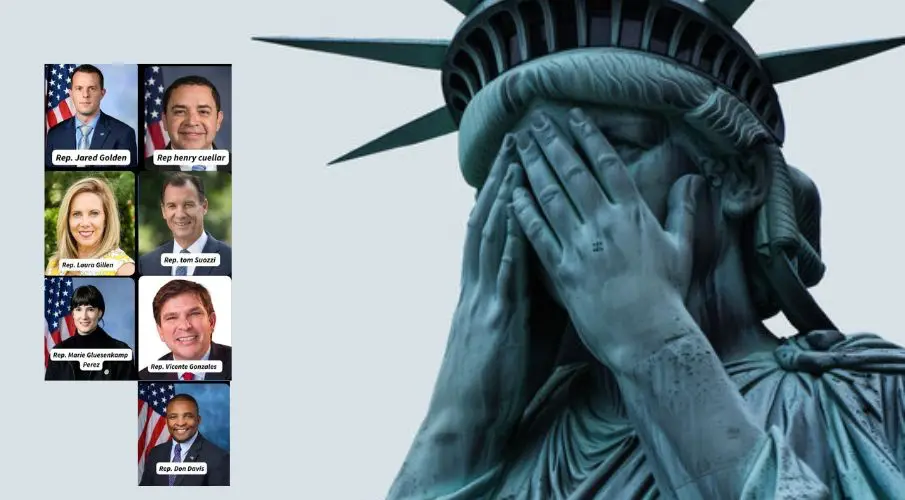
In the House of Representatives this week, a decision was made that says more about the state of American politics than any Sunday speech ever could. Seven Democratic lawmakers voted to continue funding the deportation agency ICE. Not by accident, but deliberately. At a moment when reports of raids, the arrest of children, dead civilians, and systematic abuses by federal authorities are long public, they chose the more comfortable path. The result is a political tragedy.

The names are on the record: Tom Suozzi, Henry Cuellar, Don Davis, Laura Gillen, Jared Golden, Vicente Gonzalez, and Marie Gluesenkamp Perez. All of them helped move a budget through committee that continues to fund ICE and thereby secures a practice that even fellow party members openly describe as brutal. Of all people, a Republican, Thomas Massie, voted against it.
The justifications sound familiar. One wanted to prevent worse outcomes. One did not want to endanger disaster relief or other agencies. One claimed to have no influence over majorities. It is the language of excuse. Because ICE would not have been incapacitated even without these votes. Billions from previous legislation remain available, deportations continue, detention centers are full. This vote was not about necessity. It was about principle. And that principle was absent.
Meanwhile, other Democrats spoke with unusual clarity. Hakeem Jeffries stated that taxpayer money is being misused to abuse U.S. citizens and explicitly referred to the death of Renee Good. Betty McCollum reported on racist stops and the detention of people lawfully present in the country. Jerrold Nadler openly spoke of methods he compared to a secret police. These words were in the room. They were known. And yet the vote turned out as it did. The bill officially freezes ICE funding, adds a few reporting requirements, and promises more oversight. At the same time, the apparatus remains untouched. More than that: it is politically legitimized. Anyone who votes yes under these circumstances signals that everything that has happened is acceptable. That deaths, traumatized children, and ignored court orders are not sufficient reasons to draw a line.
This voting behavior fits a political profile that is becoming increasingly clear. Polished appearances, avoidance of conflict, cowardice, securing one’s own seat. Courage is treated as a risk, clarity as a burden. That may seem tactically clever, but it is dangerous. Democracy does not live on polished résumés, but on resistance at the right moments. Those who refuse it become complicit in what follows. We are not speaking here out of impulse. We work in states where people sit in detention without guilt, where families are torn apart, where courts are ignored. We fight every day to get innocent people out of jails, while in Washington hands are raised that sustain exactly this system. That is the contradiction that can no longer be ignored.
America still calls itself a democracy. But decisions like this allow doubt to grow. When even those who should know better bow their heads, this is no longer a minor political cold. It is a pandemic. One that says: power prevails when no one is willing to pay the price. Long live America. And quietly, another piece of democracy slips away. But the fight, the exposure, and the help will continue. The bill comes due at the end, and it may hit harder than any bill before.
To be continued ...
Updates – Kaizen News Brief
All current curated daily updates can be found in the Kaizen News Brief.
To the Kaizen News Brief In English


Das Verhalten der 7 demokratischen Politiker ist feige, opportunistisch und unentschuldbar. 5 von ihnen fallen doch selbst ins Raster des Racial Profilings, das von ICE praktiziert wird.
Mit dem Verhalten der 7 wird das Wählervertrauen in die demokratische Partei weiter unterminiert. Wen also sollen die Leute wählen, die die Republikaner und ihre MAGA ablehnen?
…und genau das führte 2024 dazu, dass 89 Millionen der amerikaner, 36% nicht gewählt hatten
Unglaublich!
Können diese 7 noch in den Spiegel schauen?
Wie kann man, nach all dem was mit ICE passiert, für solch ein Gesetz stimmen?
Das ist rechtlich, demokratisch und moralisch absolut verwerflich.
Diese lächerliche Begründung „wir wollten schlimmeres verhindern“.
Wie kann man mit der Zustimmung zu diesem Gesetz schlimmeres verhindern?
Ich hoffe sehr, dass die Namen groß Publik gemacht werden.
Auch in deren Wahlkreisen
Und man sich jetzt auf andere Kandidaten konzentriert und die unterstützt, die nicht anti-demokratisch und rückgratlos abstimmen.
Noch ist Zeit bis zu den Mudterms!
Von den Demokraten erwarte ich, dass sie sich klar von diesen 7 distanzieren.
Das wäre das Einzig richtige Zeichen.
Aber wahrscheinlich schielen sie auf die Wahlergebnisse der 7 und haben Sorge Sitze an die Republikaner zu verlieren.
Aber rechtfertigt das, dass man ketztlich bei dieser ICE-SS mitspielt?
Nein, denn man erreicht damit nur, das die UCE-Ss noch Starker wird.
MAGA postet schon begeistert, dass auch Demokraten aufwachen und die Notwendigkeit von mehr ICE sehen.
Die 7 haben den Republikanern schön in die Hände gespielt.
Minnesota steht auf und die vote für mehr ICE….
Sind das vielleicht sogar die Gleichen, die gegen den Shutdown gevotet haben „um Schlimmeres“ zu verhindern?
So gemein es klingt, einige der 7 passen voll ins Racial Profiling.
Irgendwie wünsche ich mir, dass sie in die ICE Maschinerie geraten.
Aber vielleicht war das der „Deal“, Sicherheit für die eigene Familie …
Eine Schande für die Demokraten! Wie kann das sein? Bin so enttäuscht!!