
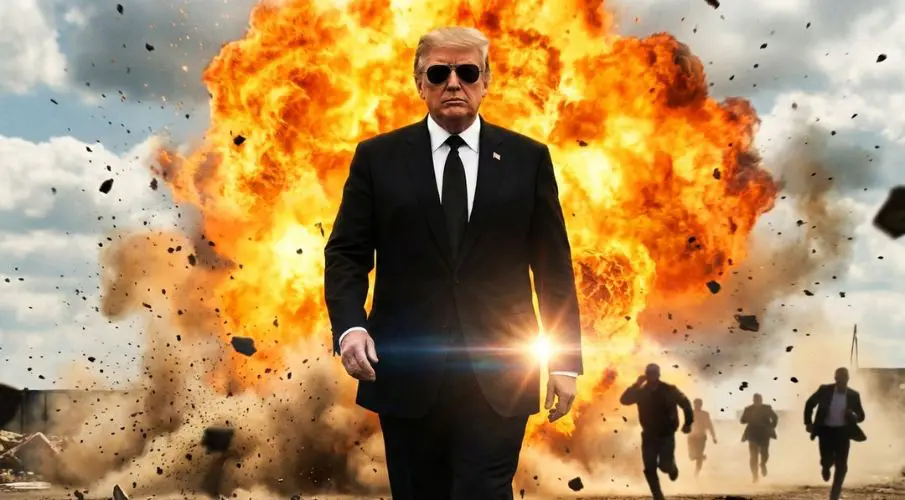
On Tuesday in the White House briefing room, Donald Trump delivered a rare, nearly two-hour display of power that sounded less like foreign policy than an improvised program for a new world order. It was the anniversary of his inauguration, and that symbolism framed the appearance. Trump listed the achievements of his administration, then shifted to attacks on the United Nations, and finally landed where he has caused the greatest damage in recent days - Greenland, which he no longer treats as a matter of partnership but as a matter of possession.
He repeated that the United States must control Greenland. Not as a diplomatic vision, but as a necessity he presents almost as a law of nature. When the decisive question came of how far he was prepared to go to achieve this, he answered briefly and coldly: You will find out. He then continued speaking as if he had just been discussing infrastructure. That single sentence contains the entire method. No limitation, no rejection of violence, no assurance of protection for allies - only the suggestion that escalation is part of the toolkit.
Asked whether NATO could be harmed if the United States were to take over Greenland, Donald Trump said: “I think we will work something out that will be very good for everyone.” He added that he had “done more for NATO than any other person since its founding” and justified this with the argument of security. At the same time, he suggested that a solution would be found “that NATO will be very happy with and we will be very happy with.”
He deliberately escalated the situation exactly one day before his appearance at the World Economic Forum in Davos. There he will speak before an audience of global political leaders, business executives, and financial elites - and he will not step into a neutral setting, but into a space where open resistance is forming. NATO partners have been pressing for days to reject this Greenland strategy, and at the same time concern is growing that Trump does not see confrontation as a risk, but as a goal.
Trump directly links territorial threats to punitive tariffs. According to his announcements over the weekend, eight European states are to be hit with an additional ten percent import tariff starting in February. And he doubled down: if these countries continue to oppose an American takeover of Greenland, the rate could rise to 25 percent in June. The purpose is clear. Not to negotiate, but to compel. Not to persuade, but to punish.
Financial markets reacted as markets do to political explosives. Stocks slid. The S&P 500 fell 2.1 percent, the steepest daily loss since October. The Dow dropped 1.8 percent, the Nasdaq 2.4 percent. Technology stocks led the decline. European markets also fell. Gold rose, as did nervousness. Long-term yields on US government bonds increased. Trump’s Greenland policy has thus shifted from a diplomatic provocation to an economic stress factor.
And then there is this second project he is inflating at the same time: a “peace council” led by him, which he markets as a “Board of Peace.” Originally, this body was supposed to monitor the Gaza ceasefire. Now Trump presented it on Tuesday as a structure that could soon mediate peace in global conflicts - and in the next step replace the United Nations. This is not only megalomania in its purest form, it is also a clear declaration of war on any international structure based on rules, procedures, and equality. Trump does not want more influence within existing institutions. He wants a new order led by him.
President Donald Trump said he believed that God was very proud of the work he had done for America. He expressed this as a personal conviction and explicitly placed his political record in a religious context.
In Davos, this attitude had already met with pushback before Trump even arrived. Canadian Prime Minister Mark Carney spoke in Switzerland of a rupture, not a transition - a sharp diagnosis that describes Trump as a danger to the entire structure. Emmanuel Macron said Europe had little patience for bullies and preferred the rule of law over brutality. He directly linked this to Trump’s approach: tariffs as leverage against territorial sovereignty were unacceptable. Ursula von der Leyen simultaneously signaled that the European Union would have to rethink its security architecture and cooperate more closely with partners such as the United Kingdom, Canada, Norway, and Iceland, because under Trump one could no longer rely on the old reliability of the United States.
What Gavin Newsom said in Davos touches a sore point many in Europe would prefer to avoid. His words cut so deeply not because they are polemical, but because they name something that has long been visible: the willingness of European top politicians to make themselves small out of fear of escalation. This behavior is not neutral, it is effective - and in favor of a regime that openly threatens tariffs, claims territories, and turns international law into a bargaining chip. Those who appease in this situation do not become mediators, but part of the problem.

For all those who oppose the Trump regime, this submissiveness is more than a diplomatic misstep. It also stabs us in the back. It devalues the daily efforts of all of us who fight for human rights, document deportations, help people, expose ICE violence, work against right-wing populism, and take real risks in doing so. Investigative work under this administration is no longer an academic project, but a confrontation that demands courage - for journalists as well as for sources who can lose everything. If Europe looks away or appeases at this moment, that is not a sign of wisdom, but a blow against all of us who make this work possible. Newsom’s anger is therefore not directed only at Trump, but at the spectacle around him: the kneeling, the flattery, the hope that adaptation might move one out of the line of fire. That is an illusion. Anyone who believes they can disarm a political extortionist by giving in has not understood the logic of power. The result is not peace, but encouragement. And it sends a devastating signal: that principles are negotiable as soon as the pressure becomes great enough.
From this perspective, the behavior of large parts of the EU is not only disappointing, but dangerous. It does not weaken Trump, but those who confront him. It damages the protective space for critical voices, for victims of state violence, for those who depend on law, dignity, and public scrutiny. What Newsom calls embarrassing is in truth a political betrayal of one’s own values. And that is precisely why his demand for backbone is not rhetorical exaggeration, but a sober diagnosis.

The response from Greenland to the image came swiftly.
Meanwhile, Trump continued to push escalation forward by the hour. He posted private text messages from foreign leaders who apparently tried to placate him. He published an artificially generated image in which he planted a flag on Greenland, accompanied by a sign: Greenland, US Territory, founded 2026. He also shared posts portraying the United Nations and NATO as the real threats while downplaying China and Russia. And he invited Vladimir Putin to this new “Board of Peace” while European governments are trying to isolate that very man politically. This is not a communication error. It is the public dismantling of the West’s sense of alliance.
Asked whether he had invited the Russian president, Trump answered: “Yes.” When told that French President Emmanuel Macron would not join his planned peace council, Trump said: “Did he say that? Well, nobody wants him anyway, because he will be out of office very soon.” He then added that he would impose a 200 percent tariff on French wine and champagne, after which France would “go along,” while also emphasizing: “He does not have to join.”
Trump also treated NATO itself like a commodity on Tuesday. He openly questioned whether the alliance would come to the aid of the United States in an emergency - even though the core collective defense article in NATO’s history has been invoked only once, after the attacks of September 11. At the same time, he wrote elsewhere in substance that he had done more for NATO than anyone else since its founding, and now NATO had to do something for the United States. In this thinking, the alliance is no longer a mutual promise, but a demand machine he can operate or shut down.
The military, meanwhile, is trying not to be dragged directly into Trump’s threat posture. From Pentagon circles it is said that so far there have been no instructions to draw up concrete plans for an invasion of Greenland. But the mere fact that this question has to be asked publicly shows how far Trump has pushed the unthinkable into the realm of the thinkable. Reports speak of internal disbelief, because Greenland is a territory of the Kingdom of Denmark - a NATO partner whose soldiers fought alongside the United States in Iraq and Afghanistan. An attack on Greenland would be an attack on an ally. The threat alone eats away at the substance of the alliance.
That Europe is now visibly reacting triggers Trump even further. Several European states have recently sent military personnel to Greenland, officially as a sign of solidarity and as part of Arctic security exercises. Named are France, Germany, Norway, Sweden, the Netherlands, Finland, and the United Kingdom. Trump pretended these troops or reconnaissance teams were there “for unknown reasons” - and immediately afterward announced his tariffs. Denmark, for its part, publicly reinforced its presence and reportedly sent around 100 soldiers to western Greenland, linked to an exercise described as Operation Arctic Endurance. Images were shown, capability demonstrated. Precisely this kind of visible counteraction seems to be perceived by Trump as provocation.
At the same time, he is playing with threats on other fronts as well. Asked about earlier statements on the Panama Canal, he said it was “kind of” still on the table. It is the same style as with Greenland: suggestion as a weapon, ambiguity as leverage. Even in trade policy, a legal breaking point hangs in the air. The Supreme Court continues to review the legality of his tariffs, while Trump wants to expand them to force Europe on the Greenland issue. Asked what he would do if the Court ruled against him, he replied in substance: then he would use something else. On our inquiry at the Supreme Court, we were told that a decision is expected around February 20, 2026. He praised his method as the strongest, fastest, simplest, and least complicated. At the same time, his administration pointed to aid packages for farmers suffering from the consequences of his tariff policy, and Trump claimed he had given this money because other states had taken advantage of the farmers. Once again: first create damage, then appear as savior.
Within the Republican Party, lines are shifting. There is resistance, but also accommodation. Mike Johnson spoke in the British Parliament about strategic strength and the Arctic region without explicitly naming Greenland, thereby supporting Trump’s argument. In a conversation with Nigel Farage, he said in substance that one should take Trump seriously, but not always literally. Other Republicans argue similarly. They claim the threats are a means to “start conversations.” Mike Lawler spoke of broad opposition to any violence regarding Greenland, but supported acquisition as a strategic goal against Russian and Chinese influence. Then there are the open supporters. Ted Cruz praised Trump’s focus on Greenland as a national interest. Eric Schmitt claimed Europe and Denmark could not protect Greenland, the United States would have to do so. And there are those who warn: Thom Tillis called the idea absurd, bad for America, bad for companies and allies - and good for Putin and Xi because it divides NATO. Don Bacon essentially called for ending the Greenland talk. And Blake Moore stated together with Steny Hoyer that the truth is the United States already has access to what it needs there, and that Denmark has always enabled additional military infrastructure - threats are unnecessary and destructive.
Davos is officially marketed under a different label. The White House had previously announced that Trump’s speech would focus on his agenda for affordable housing. But after this Tuesday, no one believes anymore that it will only be about rents and construction costs. Trump arrives with a package of conflicts: Greenland as a claim of possession, tariffs as punishment, the UN as an enemy image, a self-built peace council as a replacement structure, and the willingness to publicly humiliate allies. When he takes the stage there, he will not merely deliver a speech. He will test how far he is allowed to go.
Updates – Kaizen News Brief
All current curated daily updates can be found in the Kaizen News Brief.
To the Kaizen News Brief In English


Betr. Europa (und der Schweiz, wo ich lebe) meine Gedanken: „Wir müssen reden“ – dieser berühmte Satz, der in Partnerschaften meist ein Disaster auslösen kann, gilt auch bei diesem orangen Diktator. ER WILL NICHT REDEN! Nur seine Meinung, sein Wille zählen, schliesslich ist er die mächtigste Person der Welt, alle anderen sind seine Untertanen oder werden bis zum geht-nicht-mehr öffentlich erniedrigt. Also hat der Redepartner schon von Anfang an verloren – sogar dann, wenn Goldgeschenke und Stiefellecken ihn umstimmen sollten.
trump versteht nur eine sprache, die hat leider wenig mit reden zu tun ….
Er reist gar nicht an. Die Air Force One hat umgedreht….wegen eines „technischen Mängels“…wer es glaubt.
DT hat keine Lust auf einen Gipfel, der sich gegen ihn stellt.
Kann uns mal jemand aus dem bösen Traum holen?
…doch er kommt
Ich hoffe sehr, daß er damit auf die Schnauze fällt!
👍
Ende 2024 hatten meine Freunde mich noch als Pessimist bezeichnet, mittlerweile zeigt sich, dass ich leider in vielem Recht hatte. Man kann mit Trump nicht reden! Der will nur 100 Prozent Loyalität, und selbst dann ist man nicht sicher in seine Ungnade zu fallen…
Es braucht ein starkes Europa, eines das sich einig ist und sich nicht drohen lässt.
und es braucht ein viel engeres Bündnis mit Kanada, Mark Carney sprach schon vor Monaten von einem Bruch, nicht nur wirtschaftlich auch sicherheitspolitisch..
Trump und auch seine ganze Regierung sind höchst unzuverlässig und das wird sich nicht ändern. Gavin Newsom bringt es auf den Punkt! Man sollte ihn ernst nehmen! Hoffentlich kandidiert er für die nächsten Wahlen.
Und hoffentlich wird DJT sich richtig in den midterms abgestraft, und hoffentlich aus den eigenen Reihen, denn nicht alle Republikaner sind mit der Politik einverstanden, doch leider fehlt denen der Mut zum Widerstand.
Auf uns kommen harte Zeiten zu
ja, das stimmt leider, aber genau deswegen geben wir alle vollen Widerstand, die midterms sollte für Trump nicht gut enden, die Weichen dafür sind gestellt. man muss durchhalten und die erste „Frontreihe“ muss halten
Hoffentlich werden die Wahlmaschinen nicht manipuliert. Elon kennt sich da ja wohl aus 😔
….schon schlimm, an was man alles mittlerweile denken muss, oder einbeziehen muss
Das Verhalten einiger europäischer Länder (auch Deutschlands) gegenüber Trump zeigt meiner Meinung nach leider viele Parallelen zu der Apeacement Politik gegenüber Nazi-Deutschland in den 1930er Jahren. Und wie gut die funktioniert hat, kann man in jedem Geschichtsbuch nachlesen…
…da hast du nicht unrecht