
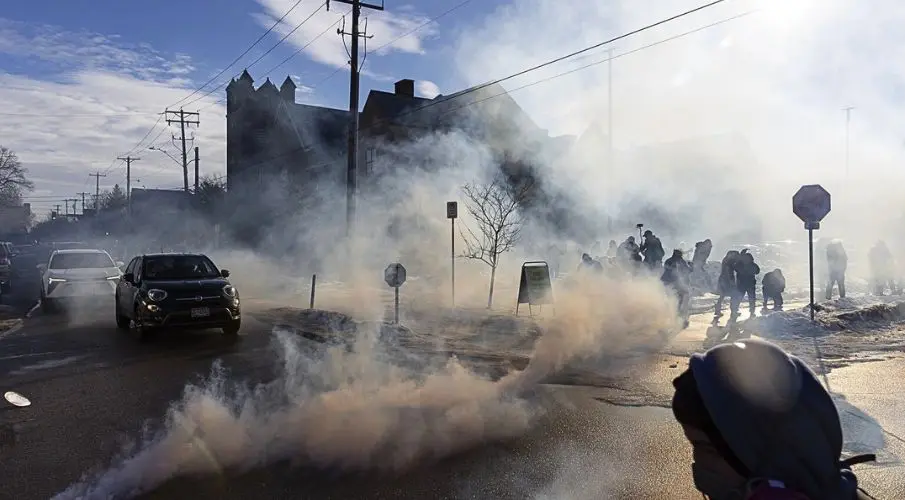
What investigations now reveal is a system that has expanded in secrecy over many years. Immigration and Customs Enforcement no longer acts merely as a deportation authority. Internal documents in our possession paint the picture of an organization that has declared itself a security power - with its own programs, its own levels of secrecy, and an operational reach that goes far beyond anything publicly discussed.

The names sound harmless, almost playful. Benchwarmer. Tidal Wave. Abracadabra. Dust Off. Fleur De Lis. But behind these code names lies not administrative action, but a sweeping enforcement apparatus. At least 21 so called large scale operations are listed in an internal document classified as law enforcement sensitive, 15 pages long. Since June, nearly seven thousand people are said to have been arrested in these operations. This is not a snapshot. It is a permanent deployment.

What stands out is not only the scale, but the purpose. It is not solely about immigration status. It is about information. People in custody are systematically approached, questioned, evaluated. One of the operations is explicitly designed to recruit informants in deportation detention. Not sporadically, but structurally. Another deploys around two thousand so called information resources nationwide - a term that says everything and nothing, but makes clear that people are being turned into tools.

This becomes particularly clear in Operation Abracadabra. It specifies that one hundred percent of all detained individuals must be questioned. Not to clarify their case, but to identify follow on targets. Apartments. Networks. Additional persons. The internal objective description goes even further. Every border crossing is to be linked, wherever possible, to terrorist organizations or transnational crime. Not because there is evidence, but because it is operationally useful.


Leaked operational materials: What becomes visible here and why this is politically highly dangerous
These materials do not show ordinary enforcement of immigration law, but a nationwide, interconnected operational architecture in which arrests are systematically used to gather intelligence. The documents name code names, locations, time frames, personnel strength, and arrest numbers, making visible how far this practice is removed from public representation and democratic oversight.
Nationwide operations list with concrete figures
The excerpts list numerous operations with exact arrest totals, including Operation At Large with deployments in 19 cities and 210 Border Patrol agents, Operation Tidal Wave with ongoing measures in the Miami area, Operation Fleur De Lis in the New Orleans area, Operation Los Angeles in support of immigration enforcement, as well as Operation Abracadabra with nationwide reach. These are supplemented by special unit series such as Zulu Shield with iterations in multiple states, as well as additional sector based operations from California to North Dakota.
Plainclothes officers deployed in transports and detention areas
Particularly explosive is the description of Operation Benchwarmer. Plainclothes officers are deliberately deployed in prisoner transport vehicles, processing corridors, intake zones, and detention cells in order to collect information that would not be obtained in formal interrogations. Detention and transport themselves are thus defined as intelligence spaces.
Mandatory questioning for all and systematic target linkage
Operation Abracadabra is described as a structured approach in which every detained person is to be questioned in order to identify follow on target locations such as clandestine housing or additional involved individuals. The documents explicitly formulate the aim of linking individuals without legal status to transnational criminal structures or foreign terrorist organizations, or of using the information obtained to develop new target persons.
Benchwarmer as a parallel investigative structure
For Operation Benchwarmer, more than two thousand deployed information sources are listed, thousands of direct contacts, hundreds of investigative leads, and the identification of numerous clandestine locations. This describes not a selective measure, but a broad based structure for intelligence collection and subsequent exploitation.
Tight interlinking of multiple federal agencies
The documents show close cooperation between Border Patrol, immigration authorities, federal police, central targeting units, and specialized units for combating organized crime. Jurisdictions blur, transitions are fluid. Anyone caught in this mechanism does not end up merely in an administrative process, but in a comprehensive network of registration, evaluation, and forwarding.
Why these documents are so explosive
The explosiveness does not lie in individual arrests, but in the structure revealed behind them. Code names, nationwide coordination, covert presence in detention areas, standardized questioning, and systematic target development show a state practice that is increasingly escaping public oversight. It is about the question of how far a state builds an internal infrastructure that is hardly reviewable.
Note: This summary is based exclusively on the visible excerpts of the documents marked as law enforcement sensitive. Terms, figures, and descriptions follow the wording of the documents.
In parallel, Operation Benchwarmer is underway. It shows how far the camouflage goes. Operatives appear in civilian clothing, blend in with others, sit in transport vehicles, in corridors, in detention areas. They listen, observe, collect information that would not be gathered in formal interrogations. This is not a marginal phenomenon. It is a nationwide program. None of this happens in isolation. ICE draws on an entire web. Border Patrol, investigative services, uniformed police, even the Secret Service are involved. The Department of Homeland Security has become the largest law enforcement agency in the country. Larger than the FBI. And that was before ICE’s budget was nearly tripled last year.

What makes this development so explosive is the lack of oversight. Many of these programs were previously unknown. Not because no one was looking, but because they are systematically sealed off. Even basic rules of engagement, such as the use of lethal force, are almost entirely redacted in internal guidelines. Public scrutiny is not intended here. Within the agencies, resistance is growing. The flow of information does not come from activists, but from officers who no longer want to go along with what they are seeing. The anger is directed at the secrecy, but also at the political mandate. Increasingly, there is open talk of a war. Not only against cartels, but against everything labeled as left, critical, or un-American. When even people like Renee Good or Alex Pretti are publicly described as terrorists, it is hardly surprising that the agency sees itself as operating under a state of emergency.

The consequences now reach into the Justice Department. In Minnesota, several senior federal prosecutors have resigned after pressure was applied not to examine the shooter, but the environment of the deceased. There are also fractures within the FBI. While one part of the agency follows political directives and investigates connections to activist groups, others warn internally that ICE’s conduct is destroying trust in law enforcement as a whole. An experienced FBI agent put it this way: Those who enforce the law must themselves abide by it. Masking, isolation, open hostility toward the public - all of this conveys the impression that one is placing oneself above the law. And that impression sticks.
What becomes visible here is not a single escalation, but a gradual shift in power. An agency assigning itself tasks that were once clearly separated. Deportation, intelligence gathering, policing, political monitoring. All in one hand. Without mandate. Without public debate. That is the larger context that is often missing. The images of raids, of shootings, of tear gas tell only part of the story. Behind them stands an apparatus that understands itself as a security state within the state. And that has learned to operate in the shadows.
That these documents are now surfacing is no coincidence. It is a sign that even within the structures, trust is eroding. Not outwardly, but inwardly. And that is precisely what makes the situation so dangerous. Because a system that no longer wants to explain itself and can no longer explain itself begins to seal itself off from everything - including its own society.
Updates – Kaizen News Brief
All current curated daily updates can be found in the Kaizen News Brief.
To the Kaizen News Brief In English


Erinnert mich irgendwie an Gestapo und Stasi… 😕
Trumps private Schattenarmee.
Loyalisten die für ihn alles tun würden.
In der Zwischenzeit so gut vernetzt, dass sie quasi Jedem gefährlich werden können.
Eine Mischung aus Geheimdienst, schneller Eingreiftruppe, Vertuschungsmeister und Gesetzesbrecher.
Das war die Gestapo, die Stasi, der KGB, jetzt FSB.
Spitzelei gegen die Bevölkerung.
Das Volk ist der Feind, so lange man nicht vollkommen unkritisch der Linie folgt
Die MAGA Hohlbirnen raffen das nicht.
Trump warb damit den Deepstate zu entfernen, den Sumpf in Washington auszutrocknen.
Weniger stastliche Bundeskontrolle, nehr Befugnisse für die Bundesstaaten.
Und was passiert?
Genau das Gegenteil.
Mit ihm und seiner Entourage ist Korruption und Klüngelei „gesellschaftsfähig“
Trump will immer mehr Kontrolle über die Bundesstaaten haben. Vor allem die Demokratischen. Denn die sind im Weg. Stören den Ablauf.
Außerdem ist das perfekt für MAGA. Trump räumt bei den korrupten und kriminellen Demokraten auf. 🙈🙈🙈
Da holt sich Trump seine Zustimmung.