
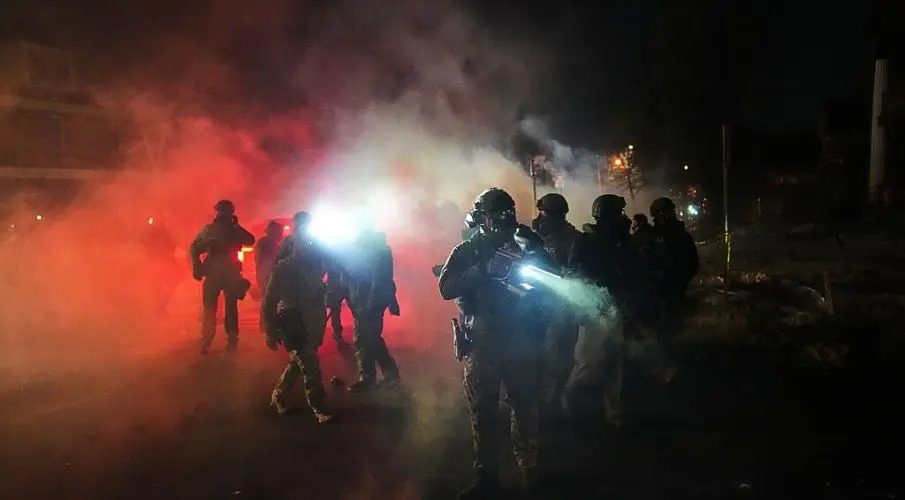
Minneapolis is under a strain that goes far beyond protest. In a city that for days has been shaped by tear gas, heavily armed federal forces, and nighttime confrontations, President Donald Trump has openly threatened to invoke the Insurrection Act to end the protests against Immigration and Customs Enforcement by military means. It is a threat that reaches far beyond Minnesota and marks a line at which civilian order risks tipping into military logic. The immediate trigger for the latest escalation was another gunshot. On Wednesday, a federal officer wounded a man with a targeted shot to the leg after, according to authorities, being attacked with a broom handle and a shovel. The scene unfolded only a few miles from the spot where a week earlier 37-year-old Renee Good was shot and killed by an ICE agent. Since then, a leaden heaviness has settled over the city. Fear, anger, and exhaustion interlock as federal forces appear in numbers Minneapolis has not previously experienced.

Trump responded not with de-escalation, but with escalation rhetoric. In a public statement he attacked Minnesota’s political leaders, spoke of so-called agitators, and portrayed ICE agents as patriots merely doing their jobs. If state politicians did not “enforce the law,” he said, he would invoke the Insurrection Act and put an end to what he described as a state of decay. It is a law that allows the president to deploy the military or a federalized National Guard domestically - historically rarely used and politically highly controversial.

On the streets of Minneapolis, the conflict meanwhile appeared in images reminiscent of wartime. Tear gas hung for hours over intersections in the northern part of the city, officers in gas masks and helmets advanced on small groups of demonstrators, while stones flew and fireworks were set off. Police Chief Brian O’Hara declared the assemblies unlawful and ordered people to leave the area. Only in the early morning hours around 5:00 a.m. did a fragile calm return. See also our report: Second shooting, same city – Minneapolis slips deeper into a state of emergency
The context of this escalation runs deeper. Since early December, the Department of Homeland Security says it has carried out more than 2,000 arrests in Minnesota. Thousands of additional federal agents have been sent to the Twin Cities. People are pulled from cars, apartments are forced open with battering rams, neighborhoods are combed through. Increasingly, residents confront the agents and demand that they leave the city. The protests are not isolated events, they are an expression of sustained overload. Mayor Jacob Frey describes the situation as unsustainable. A federal force that vastly outnumbers local police is imposing itself on the city, while municipal forces must still secure everyday life. The city has been pushed into a situation that undermines safety and order rather than protecting them.
According to the Department of Homeland Security, the most recent shooting began with an attempt to arrest a man from Venezuela who was allegedly in the United States without legal status. He reportedly fled by car, struck a parked vehicle, and continued on foot. When officers caught up with him, two additional individuals reportedly emerged from a nearby building and attacked the officer. Fearing for his life, the officer fired a shot. Two of those involved were arrested, and the injured man was taken to the hospital with non-life-threatening injuries.
Parallel to the violence on the streets, the confrontation in the courts is intensifying. The state of Minnesota and the cities of Minneapolis and St. Paul have filed suit to halt the federal government’s actions. A judge gave the Trump administration time to respond to the motion. The state’s deputy attorney general said openly that the situation must be de-escalated. This is no longer about immigration law, he said, but about fundamental rights and democracy. Governor Tim Walz used blunt words. What is happening in Minnesota defies comprehension. It is no longer the enforcement of laws, but an organized brutality of the federal government against its own population. Statements like these from a sitting governor mark a depth of institutional conflict that is rarely named so openly in the United States.

There is also another dimension: the involvement of the military at the legal level. According to reports that have also been indirectly confirmed by the Department of Defense, dozens of military lawyers are to be sent to Minneapolis on the orders of Defense Secretary Pete Hegseth to serve as additional prosecutors. Critics warn that this would divert already scarce resources from the military justice system, while more than a million service members depend on legal support.

Hovering over all of this is the death of Renee Good. According to a senior official, the ICE agent Jonathan Ross who shot her is said to have suffered internal bleeding. Details about the type, timing, and cause of these injuries remain unclear. Homeland Security Secretary Kristi Noem spoke of self-defense and claimed the car had been used as a weapon. This account is sharply disputed by local officials. Renee Good’s family has retained a law firm that previously represented the family of George Floyd. It announced it would conduct its own investigation and make its findings public.
Video footage from the scene shows Ross and other officers moving without any apparent impairment after the shots were fired.
Minneapolis is thus more than a site of protest. The city has become a point of no return for how far a federal government is willing to go when resistance does not fall silent. The threat of invoking the Insurrection Act, the massive deployment of federal force, and the legal standoff between federal, state, and local authorities show a country in which questions of power, law, and responsibility are being renegotiated anew and painfully - on the street, in court, and in the lives of the people caught between these fronts.
The fight goes on. Again today. Minneapolis is no longer just a place. It is what happens when people stop being silent. A city with this history - people standing openly in the streets. Journalists risking everything to carry what is happening out into the world. Into a world in which Minneapolis could be anywhere. This is about democracy. About fundamental rights. About the fight against right-wing populism in its most extreme form. The fight for democracy has only just truly begun. Not in the news. Not on the screens. But where people are. And as long as most just watch, as long as they settle for being informed, nothing will change. It concerns everyone.
Updates – Kaizen News Brief
All current curated daily updates can be found in the Kaizen News Brief.
To the Kaizen News Brief In English


Furchtbar 😟
Mir fehlen die Worte bei soviel Gesetzesbruch und Brutalität.
Dürfen Militärjuristen einfach in Minnesota als Staatsanwälte agieren?
Werden Staatsanwälte nicht gewählt und ernannt?
Das gilt doch auch für Fälle auf Bundesebene.
Auch da muss doch eine Ernennung erfolgen.
Dürfen Militärjuristen bicht nur für Militärische Strafverfahren tätig werden?
…die haben bald keine staatsanwälte mehr und diese lösung kommt natürlich trump entgegen