
Nobel Institute blocks Trump’s hopes of receiving someone else’s Peace Prize!
Trump said literally that no one deserved the Nobel Peace Prize more than he did – and ten minutes later he threatened Greenland
The Norwegian Nobel Institute has made clear that the Nobel Peace Prize cannot be revoked, transferred, or shared after it has been awarded. The statement followed remarks by Venezuelan opposition politician María Corina Machado, who had announced that she would like to give her prize to Donald Trump or share it with him. The institute stated unambiguously that the decision is final and applies permanently. The trigger was an interview Machado gave on Fox News, in which she said the prize belonged to the Venezuelan people and should honor Trump for his role in the capture of Nicolás Maduro. Maduro is facing drug trafficking charges in New York. Machado spoke of a historic step toward democracy. Shortly after the prize was announced, she dedicated the Nobel Peace Prize to Trump and to the people of Venezuela. Trump himself has openly campaigned for years to receive a Nobel Peace Prize. At the same time, for the political transition phase in Venezuela he is not supporting Machado, but the acting president Delcy Rodríguez, who previously served as Maduro’s vice president. Trump described Machado as a very nice woman but said she currently lacks sufficient support within the country. A possible visit by Machado to the United States is scheduled for next week. Her circle has not yet commented on the clarification from Oslo.
An answer without attribution
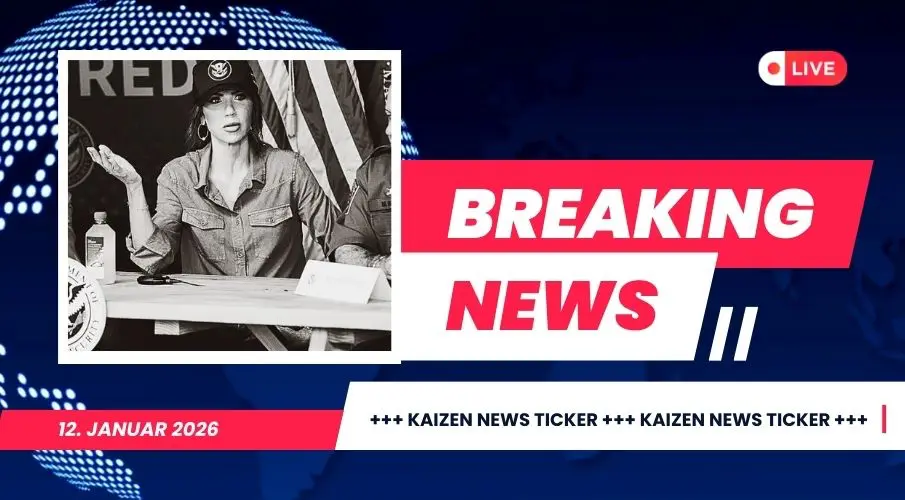
On CNN, Kristi Noem is asked whether the voice on the audio recording is that of Agent Ross, calling Renee Good a “damn bitch.” The question refers to the moment after the fatal shots and is clearly posed. Noem says she cannot say whose voice it is. In the same sentence, she adds that it could be his. As a result, no one is named, but no one is excluded either. For the public, an unresolved state remains. The word is not spoken somewhere at a party, but directly after a deadly operation. A clear answer would have provided clarity. Instead, there is a formulation that leaves everything open and yet everyone knows it was Ross. Responsibility is transformed into cowardice. That is the current state.
Call for external review after deadly ICE shooting in Minneapolis

After the shooting of Renee Good in Minneapolis, leading Democrats in Minnesota are calling for a much broader investigation of the incident. Minneapolis Mayor Jacob Frey and U.S. Senator Tina Smith agree that a purely federal internal review is insufficient. The federal government, they argue, publicly stated its assessment of the incident early on and thus committed itself. Tina Smith said on television that it is difficult to trust an unbiased investigation when the outcome has effectively been announced in advance. The Trump administration is defending the ICE agent who shot Renee Good, citing self-defense. Homeland Security Secretary Kristi Noem rejected criticism from Minnesota and said cooperation with local authorities only occurs when they support ICE operations. Frey counters that the videos show a federal agent abusing his power with a fatal outcome. Both sides rely on the same footage and draw opposing conclusions. Parallel to the Minneapolis incident, two more people were shot by federal agents in Portland. Nationwide protests took place over the weekend. In Minneapolis, tens of thousands marched after the Department of Homeland Security carried out the largest ICE operation in the city’s history.
Why this photo was taken on January 3

On January 3, Matias saw an armed woman riding on the back of a motorcycle in Caracas. The sight immediately reminded him of a well-known photograph from the 1990s by a Chilean photographer showing a woman with a submachine gun. This visual parallel made him pause, because an image from another time suddenly reappeared under new circumstances. Decades later, a different country, a different situation, but a familiar motif. After the U.S. strikes that ended with the capture of Nicolás Maduro, pro-government groups took to the streets in Caracas. Some of them were armed. The city felt tense, uncertain, full of unanswered questions. For Delacroix, it was clear that this scene had to be documented. The photo does not show a single person, but a moment of collective uncertainty. It stands for the days after the attack, when no one knew what would follow. Armed civilians in public spaces were not a marginal phenomenon, but a visible expression of this situation. Delacroix, raised in Chile and working as a photojournalist, acted not out of routine, but observation. The image was created because history repeats itself in pictures, even when the context is different.
A continent under pressure – Trump’s grip on Latin America

Since the capture of Nicolás Maduro by the United States, Latin America has been under political tension. Even before dawn on January 3, frantic conversations were taking place in the capitals, because it was clear that a barrier had been broken. Brazil, Mexico, and Colombia criticized the operation, each in its own way, cautiously or openly. Right-wing governments such as those in Argentina, El Salvador, and Ecuador welcomed the move. Other countries deliberately kept a low profile to avoid drawing Washington’s attention. The common denominator is not unity, but caution. Everyone wants to avoid being next. Donald Trump makes no secret of his intention to expand control over the continent. Mexico’s president Claudia Sheinbaum is navigating between rejecting military force and trying to avoid conflict with her country’s most important trading partner. Brazil can afford more resistance, supported by its size, distance, and close ties to China and the EU. Colombia’s president Gustavo Petro swung between sharp confrontation and rapid rapprochement after Trump openly issued threats. Argentina, by contrast, is moving closer to Washington, politically and economically. Trump’s intervention in Venezuela therefore reaches far beyond Caracas. It reshapes alliances, shifts political axes, and forces each country to make a decision. Not out of conviction, but out of self-preservation. The consequences cannot yet be fully assessed.
Removal of impeachment references from Trump’s Smithsonian portrait

At the National Portrait Gallery of the Smithsonian museums, references to Donald Trump’s two impeachments have been removed from the label accompanying his photographic portrait. The previous text summarized his first term, mentioned his 2024 election victory, and also listed the two impeachments. Now a different photo hangs without an explanatory text, while the earlier description is only available online. Trump is thus the only president in the gallery whose display no longer includes an extended wall label. The White House did not say whether it requested any changes. Earlier, Trump had ordered a review of all Smithsonian exhibits ahead of the 250th anniversary of the Declaration of Independence.
The administration said the goal was to present a depiction that emphasized American exceptionalism and removed content perceived as partisan. Trump’s earlier label cited his Supreme Court nominations and the development of Covid-19 vaccines and concluded with a reference to the two impeachments and his acquittals in the Senate. This passage has now been completely removed. The gallery refers to a planned overhaul of the presidents exhibition and is experimenting with shorter informational formats. References to the impeachments of Andrew Johnson and Bill Clinton, as well as the resignation of Richard Nixon, remain. The move fits into Trump’s stated intention to actively shape how history and his own presidency are portrayed.
ICE arrests people during an operation in the south of Minneapolis who simply wanted to warn the neighborhood
During an ICE operation in the south of Minneapolis, federal agents smash the window of a car. Inside are people who did nothing other than warn neighbors about the operation. The images show agents breaking the window, dragging the man out of the vehicle, and detaining him. Around them, residents look on in shock. The scene unfolds on an open street, in the middle of a residential area. Shouting can be heard, several people are filming. The woman and the man show no visible resistance as he is pulled from the car and as the woman gets out. Nevertheless, they are taken away. The operation is part of the current ICE actions in the city. For many on site, the approach appears more than merely disproportionate and they have long used other terms for it. The images reinforce the impression that warning others is already enough to trigger force and end up in jail. America 2026 – this must be confronted. Period.
Lawrence, Kansas – And Suddenly They Wake Up
It is not just any place. Lawrence is located in Kansas, a state where ICE until now hardly had to expect resistance. But over the weekend people gathered here on the streets, with signs, with anger, with determination. The shots from Minneapolis are still echoing. The fear runs deep. And yet: they shout, they stand their ground. In the midst of conservative suburban streets something is growing that ICE did not expect. What is routine in New York or Oakland is now breaking through right in the middle of Trump’s core territory. The protesters are calling for justice for Renee Good and for an end to arbitrary arrests. ICE has no idea what they have unleashed. But the country is beginning to burn, even in places where no one would have expected it.
Attack on the Independence of the Central Bank
For the first time in the history of the United States, a sitting chair of the Federal Reserve is at the center of criminal investigations. The Department of Justice is investigating alleged irregularities in the renovation of the headquarters in Washington. But Jerome Powell openly calls the investigations an act of political retaliation. In a written statement, he said: “The threat of criminal charges is a consequence of the Federal Reserve setting interest rates based on our best assessment of what serves the public interest, rather than following the preferences of the president.” The independence of the US central bank had until now been considered untouchable. That targeted investigations are now being directed at its chair marks a profound rupture.


Wird man einen politischen Gegner nicht mit Druck los und ist der rechtmäßige Weg zu lang, konstruiert man eben eine Straftat und ermittelt.
Das machen Autokraten/Diktatoren.
Auch Hit*** ließ so unliebsame Regierungsmitarbeiter entfernen.
…da hast du recht, und so etwas kommt häufiger vor, als man vermuten möchte
Es besteht noch ein wenig Hoffnung, wenn in einem roten Staat die Menschen aufstehen und soch gegen ICE stellen.
Aber MAGA flutet das Internet mit Falschbehauptungen, Diffamierung und schlicht der Aussage „selber Schuld, sie hat nicht den Anweisungen Folge geleistet“
Ganz furchtbar Alles😔
Das Nobelpreiskommitee hat gut reagiert.
sachlich und auf die Rochtlinien hingewiesen.
Dennoch werden sie sich hinter vorgehaltener Hand fragen, ob ihre Entscheidung für sie richtig war.
jemand, der in seiner Dankesrede einenAutokraten und Faschisten den Nobelpreis ihm widmet.
Trump schreibt die Geschichte um.
Kritik an ihm? Muss weg.
Geschichte der USA? Schön White washing zum 250 Geburtstag.
Ob er das Martin Luther King Memorial noch entfernen lässt? Und stattdessen eine Statue von sich errichten lässt? Dem besten Präsidenten ever?🤬
Renee Goods Tod darf nicht ungesühnt bleiben.
Ich hoffe, dass dieser Mord viele Konsequenzen hat.
Das die Menschen weiter auf die Strasse gehen.
Das die Menschen eine umfassende und unabhängige Untersuchung fordern und diese auch erfolgt.
Das der ICE Typ bis zur Klärung ohne Gehalt suspendiert wird und dann auch vor Gericht gestellt wird.
Das die Lügen der Trump Regierung entlarvt und deutlich öffentlich gemacht werden und sich daraus auch Konsequenzen gegen Noem ergeben.
Das so etwas nie wieder passiert.
Denn derzeit ist es nur eine Frage der Zeit, nicht des ob, wann es wieder ein Todesopfer geben wird
Venezuela ist erst der Anfang.
Davon muss man ausgehen.
Trump ist damit durchgekommen.
Das beflügelt seine Machtfantasien und seine Gier.
Europa eiert rum.
Wie gehabt.