
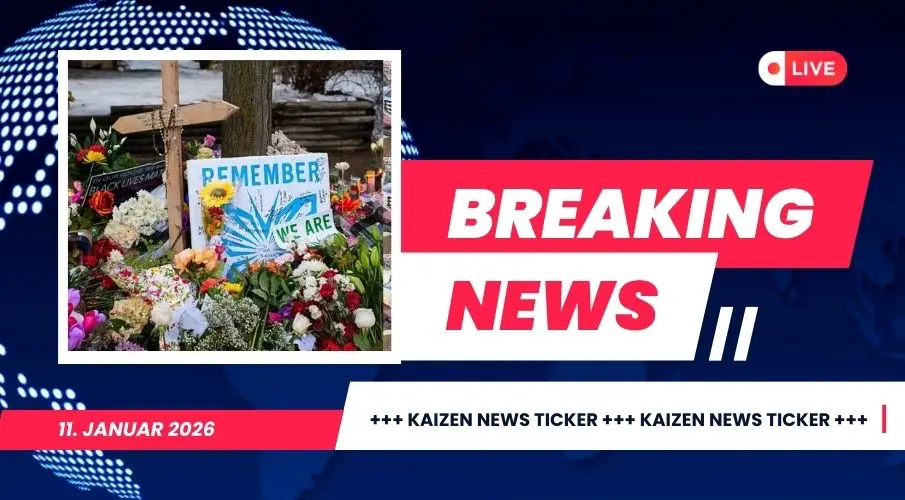
False Perpetrators, Real Victims – How Disinformation After the ICE Shooting Hits Innocent People!

Just hours after the fatal shooting of Renée Nicole Good in Minneapolis, a manhunt began online – not for the actual shooter, but for innocent people. On multiple platforms, the claim suddenly spread that the perpetrator was named Steve Grove, allegedly a man from Minneapolis. In reality, it hit the publisher of the Minnesota Star Tribune, who bears the same name and has nothing to do with the incident. Within a very short time, he received threats, insults, messages full of hatred. At the same time, a firearms dealer from Missouri was targeted, also named Steve Grove, who according to his own statements has never been to Minnesota and nevertheless received murder accusations and furious calls. The trigger was apparently an image generated with artificial image software that was falsely supposed to show the alleged shooter. Despite the lack of resemblance, the name was enough. More than six thousand posts circulated within two days. While authorities were still investigating, users sought their own justice. The case shows how quickly rumors take on a life of their own – and how real people pay the price when facts are replaced by speed.
Alex Karp and the Normalization of Killing in the Data State
The CEO of Palantir Technologies, Alex Karp, speaks publicly about considering killing as a possible option. The sentence does not appear in a war diary, but in the context of technology, security, and state power. When Karp says it may be necessary to intimidate opponents and occasionally kill them, we move beyond merely troubling rhetoric. It is an attitude articulated by someone whose controversial software has long been part of state decision making. Palantir systems are used to link data, create profiles, and assess risks. These systems operate not only in the United States, but also within European police forces and authorities. The separation between analysis and action is thin. Where data prepares decisions, it also shapes the framework for violence. Anyone who celebrates this power with words shifts boundaries. Not abstractly, but concretely, because decisions become faster, harsher, and more distant. Europe debates data protection while purchasing technology whose leadership openly factors in violence and at times offers insight into a mental disposition that leaves one astonished. This is not a distant problem, but a question of political responsibility.
Public Pressure on ICE Officer Grows
In Minneapolis, a vehicle is driving around with a clear appeal: “Arrest and prosecute Jonathan Ross.” The ICE officer had fatally shot Renee Nicole Good in early January – during an operation whose sequence continues to raise questions. Ross filmed with his phone while simultaneously carrying a weapon. His behavior is now being questioned not only by civil society groups, but also by legal experts. Demonstrators are demanding an independent investigation and, if appropriate, criminal proceedings. Public attention is growing, as is pressure on local authorities. Minneapolis is familiar with such situations – but this case concerns a woman who was unarmed and remained in her car. The question of disproportionality is becoming louder.
Trump Considers Next Military Strike Against Iran
US President Trump is currently being briefed on targeted military strikes against Iran. The trigger is the ongoing protests in the country, during which security forces are violently cracking down on demonstrators. According to insiders, Trump is considering air strikes on locations in Tehran, including civilian targets. Publicly he stated: “If they start killing people like in the past, we will strike – very hard, but without ground troops.” Already in June 2025, Trump had ordered the bombing of three Iranian nuclear facilities in Operation Midnight Hammer. Now he apparently wants to send another signal – under conditions designed to minimize risk to US soldiers. Iran is warning of escalation, while at the same time refusing to yield to the protests.
Trump Sanctions Block ICC Judges: No Amazon, No Gmail, No Credit Card

Since being sanctioned by the Trump administration, several judges of the International Criminal Court have been placed under a form of digital house arrest. Gmail accounts were suspended, Amazon access deactivated, credit cards canceled. Hotel bookings, online payments, or even booking a train ticket are no longer possible. The United States is officially classifying the judges like terrorists – because the court issued arrest warrants against Israel’s government and investigated US war crimes in Afghanistan. A total of eleven senior figures, including the chief prosecutor, are affected. While the court continues its work on Sudan, Venezuela, Ukraine, and Gaza, the United States is threatening further measures. At the same time, European states are attempting to keep the court independent through technical adjustments and legal safeguards. But the intimidation is having an effect: access to everyday services is cut off – without charges, entirely without a verdict.
ICE as a Power Instrument Without Oversight

Eight years ago, criticism of the immigration authority was still a debate, today it is a description of reality. Under Donald Trump and Stephen Miller, ICE has become an agency that operates with masks, weapons, and intimidation. Operations in cities such as Chicago, Los Angeles, or Minneapolis are directed not only at migrants, but at anyone who intervenes or documents. To grow faster, hiring standards were lowered, violence is openly promoted, the tone is that of an enemy image. Investigations found that since June, ICE officers have fired on people in at least sixteen operations. Three were hit while observing raids, others while driving away from checks. This week, Renee Nicole Good was shot dead in Minneapolis while sitting in her car. Video footage shows that she was moving away from the officer, not toward him. The government responded with blame shifting and portrayed her as a danger. Shortly thereafter, border agents in Portland again shot at civilians. A state needs immigration law, but not an agency whose first response is violence. ICE is no longer a normal authority. It is a power instrument without effective oversight, a modern Gestapo with smartphone and face covering.
Trump Wants to Go to Greenland – US Military Slows Him Down

Donald Trump has instructed his special operations commanders to draft concrete invasion plans for Greenland. But senior military leaders are internally pushing back against the idea. Sources within the Department of Defense say efforts are underway to occupy Trump with other options, such as intercepting Russian ghost ships – a secret tanker network Moscow uses to evade sanctions – or with a possible air strike against Iran. The idea of attacking Greenland is not new. During his first term, Trump had already tried to buy the island. The current escalation shows, however, that these fantasies are now turning into concrete military considerations. The Pentagon is apparently trying to buy time.
“I Love America, but ICE Shames Me”
Amid the outrage over the death of Renee Nicole Good, a resident of Minneapolis spoke out clearly: “I am a big patriot. I love America. My son serves in the military. I am proud of our country. But I am ashamed of what is happening right now. I am ashamed of ICE. This is extremely un-American.” The statement captures what many feel: love of country does not exclude criticism of authorities. On the contrary. When the use of deadly force against unarmed people becomes normal, the state loses moral authority. ICE is under increasing pressure after multiple deadly operations, yet the political leadership in Washington continues to defend the agency. In Minneapolis, it is clear that patriotic citizens do not want to remain silent when fundamental values are violated.
“I Am Free – But Belarus Is Not”

Ales Bialiatski, founder of the human rights center Viasna, was released after four and a half years in prison. His freedom was part of a deal: 123 political prisoners in exchange for the easing of US sanctions. But Bialiatski makes clear that the real struggle is only beginning. In Belarus, repression, torture, show trials, press censorship, and political imprisonment prevail. More than 1,000 people remain in prison – many of them young people, workers, or students. They wanted democracy and were criminalized for it. Bialiatski is calling for protection for activists in exile and concrete support for civil society. Belarus, he says, should not be equated with the Lukashenko regime, nor automatically considered part of Russia’s sphere of influence. The will for change is palpable – and it will not disappear.


Belarus, der Deal war sicher mit Putin besprochen.
Weniger Sanktionen für Belarus kommt Russland sehr gelegen. Denn der Weg nach Russland ist kurz und einfach.
Und kaum Jemand kann es prüfen.
Dennoch freue ich mich sehr für die Freigelassenen.
Wer weiß, wie lange das Militär sich „gegen“ Trump stellt.
Der Austausch von nicht 100% Loyalen läuft auf vollen Touren.
Der Angriff auf den Iran, vor allem auch auf zivile Ziele ist genau so ein Völkerrechtsbruch, wie der Angriff auf die Ukraine oder Venezuela.
Es gibt kein UN Mandat, nichts.
und da wird sich wieder die Scheinheiligkeit der westlichen Länder offenbaren.
Es geht ja um ein religiöses Terrorregime.
Ja, die alten extremistiscch-religiösen Säcke im Iran sind ein Terrorregime.
Aber dennoch ist der Iran ein souveräner Staat, den man bicht einfach bombardieren kann, weil einem bicht gefällt, was da passiert.
Ich bewundere das iranische Volk, insbesondere die iranischen Frauen, die sich trotz der drakonischen Strafen dem Regime immer wieder entgegen stellen.
Eine Bombardierung hilft nur Trumps Ego.
Nicht dem iranischen Volk.
Für MAGA ist man kein Patriot, sobald man an Trump und seinen Schergen Kritik übt.
Dann ist man einer von den woken, die lieber für das Recht Krimineller einstehen, als für die Sicherheit aufrechter Amerikaner 🤬🤬
Ich hoffe, dass der öffentliche Druck zunimmt und nicht endet.
Schlimm, dass Unschuldige durch Hetze ins Visier von gefährlichen Situationen geraten.
Drohungen sind schlimm. aber es kann auch in körperlicher Gewalt ausarten.
Alex Karp hatte sich vor einigen Jahren boch kritisch gegenüber Thiels Palantir Ausrichtung geäußert.
Was ist in der Zwischenzeit passiert, dass er offen vom Töten spricht?
Zuviel MAGA Gehirnwäsche?
Und hier in Deutschland will man immer noch mehr Palantir einsetzen.
Die sollten mal Deine Berichte über Palantir lesen, Rainer.
Wenn ich lese, welche Auswirkungen die US-Sanktionen auf die Mitarbeiter vom Internationalen Strafgerichtshof haben 🤬
Unglaublich.
Nur weil sie ihren Job machen und es Trumpeltier bicht gefällt.
Das sind für Eure Klage keine guten Voraussetzungen.
Eine Klage direkt gegen Trumps Regierung.
Wenn die Klage angenommen wird, werden umgehend Sanktionen folgen…. vielleicht gegen den ganzen Strafgerichtshof.
Ob es mutige Richter/Staatsanwälte gibt, die sich davon nicht beirren lassen?
Gerade auch weil die USA die Gerichtsbarkeit nicht anerkennt.
Lohnt sich das persönliche Risiko werden sich leider Viele fragen.