
The day in London could hardly have gone worse for Donald Trump. While he loudly claimed in Washington that the Ukrainian president had not read his “peace offer,” a coalition was forming on Downing Street that made it unmistakably clear that Europe is not prepared to serve as a backdrop for a deal written along Russian demands. Trump wanted speed. He wanted a quick solution. But the reality of the war, the political red lines of Ukraine, and the growing nervousness of European leaders now show him limits that he cannot set himself. Volodymyr Zelensky had already set the decisive sentence on his flight to Brussels. “We have no right - neither under Ukrainian law nor under international law - and also no moral right to give away our own land.” With that, he placed the question of territorial integrity on a level beyond political maneuvering. For Ukraine, it is non-negotiable. And this is precisely the point at which Trump’s plan falls apart: His proposal to hand the entire Donbas region over to Russia is, for Kyiv, nothing more than an externally dictated attempt to script the end of a war whose consequences the country itself would have to bear.
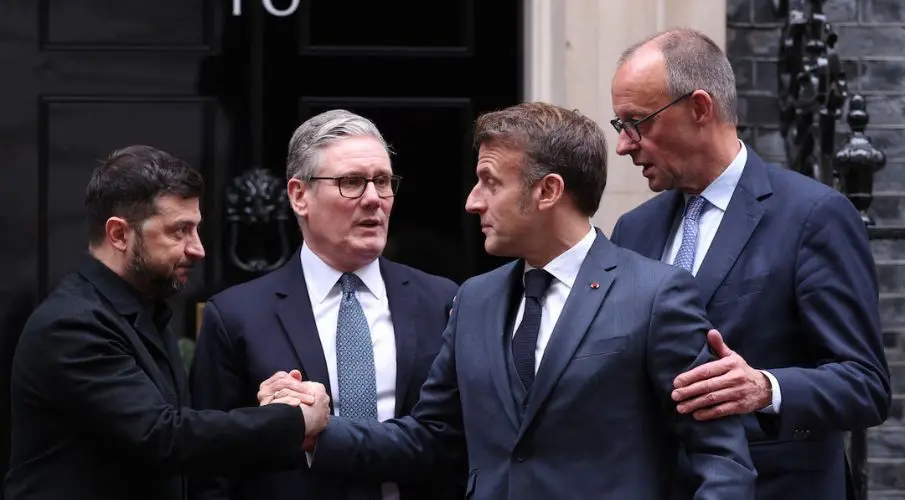
In London, Zelensky met with Keir Starmer, Emmanuel Macron, and Friedrich Merz - a group Trump would have gladly cast as extras who gratefully follow the American script. But the talks unfolded differently. Starmer spoke openly of a “critical phase,” Macron of the need for a “common position,” Merz of skepticism toward parts of the US proposals. All three made clear that Europe will not be a fig leaf that nods along to an agreement that would be celebrated in Moscow and felt in Kyiv as capitulation. While Trump increases the pressure, Europe grows more convinced that Ukraine must not be caught between the crossfire of transatlantic vanity.
Trump himself is trying to shift responsibility for the stalled talks. He claims Zelensky has not read the proposal and presents himself as a patient mediator whose offer needs only a signature. But behind the scenes a different picture emerges: The White House is pushing for rapid results, pushing for concessions, pushing for a conflict-ending arrangement that would be politically advantageous primarily for the United States. The imbalance this creates is obvious. Russia feels affirmed that the demand for the full surrender of the Donbas is not only sustainable but negotiable. This is an illusion shared by neither Europe nor Ukraine.
In Brussels, Zelensky is set to meet with NATO Secretary General Mark Rutte and European Commission President Ursula von der Leyen. Both know that Europe’s security architecture is at stake. Should Ukraine be forced to relinquish territory, the signal would reach far beyond Eastern Europe. It would be an invitation for Moscow to challenge any future agreement. It would also break with the core idea of European security: Borders cannot be changed by force. And this point was repeated multiple times during the London meeting. For Europe, the issue of territorial integrity is not just a political line - it is a red line.
American pressure stands in contrast to the reality the Ukrainian military is currently facing. Russian troops are regaining ground in parts of the East while Ukraine improves its training, mobilization, and recruitment in order to hold out in the long term. The situation is serious but not hopeless. A “freeze the front” deal would not bring peace, but a temporary ceasefire - and would likely grant Russia strategic advantages that could cost Europe dearly. The episode involving threatening drones over Zelensky’s plane during his visit to Ireland shows how strongly Moscow tries to disrupt the diplomatic spaces where the future of the war is negotiated. Irish authorities spoke of a “coordinated threat.” It was an attempt to project weakness and sow doubt. But London demonstrated the opposite: a unified European bloc that will not be intimidated.
Meanwhile, Trump is trying to flip the narrative. An article he shared spoke of “powerless Europeans.” But the day on Downing Street showed instead that Europe is ready to draw clear lines - not against America, but against the idea of a peace that does not amount to peace. Macron put it plainly: Europe has many cards in its hand. Economic strength, military support for Kyiv, sanctions against Russia - these are all elements that can cushion Washington’s rash moves. Meanwhile, impatience is growing in the United States. Trump Jr. suggested bluntly that his father could end support for Ukraine entirely if it does not comply. This is not only politically unstable but also a signal to Moscow that Washington might act against its own partners to force through an agreement. Zelensky knows this - and that is precisely why he sought support in Europe to counterbalance American pressure.
The day ends with a sober realization: Trump’s plan is faltering because it does not reflect the reality of the war but the political reality of a president who needs a quick success. Europe, on the other hand, understands that this is not about symbolism. It is about the future of a country whose struggle will determine whether military force once again becomes a legitimate tool to alter borders in Europe. In London, it became clear that Europe will not allow Washington to answer that question.
Investigative journalism requires courage – and your support.
Support our work against right-wing populism, disinformation, and violations of human and environmental rights. Every contribution goes directly into our daily reporting – we operate without advertising, without subscriptions, without corporations, without political parties. Our journalism is meant to remain freely accessible. For everyone.
Independent – Critical – For Everyone
Thank you for making our independent work possible.
Updates – Kaizen News Brief
All current curated daily updates can be found in the Kaizen News Brief.
To the Kaizen News Brief In English


Und es geht um die gesamteuropäische Zukunft, siehe Strategiepapier.
…das stimmt, auch wenn das ein traum von trump ist, der aber die motoviert, die die welt sowieso nicht braucht, siehe afd
Das wurde doch auch einmal Zeit.
👍