
First came the inflatable frog costumes. Dozens of them, wobbling through Times Square like a rush image of resistance, their oversized green limbs glittering in the October light. They were absurd, deliberately so - a direct mockery of the White House’s attempts to brand protesters as terrorists. Behind them came mothers pushing strollers, teachers in wizard hats, the grandmother from New Hampshire who carried a sign identifying herself as a “proud Antifa member” because her father had fought fascists in Belgium during World War II.


On Saturday, October 18, 2025, the carnival of American resistance had spread to more than 2,600 cities and towns. What had begun four months earlier as scattered demonstrations had grown into something that might have been larger than the protests after George Floyd’s death - a nationwide eruption of civic anger that even the organizers could hardly quantify anymore. Millions, they estimated. Maybe more. The exact number hardly mattered. What mattered was the density of bodies in places where they hadn’t been expected: in front of the courthouse in rural Madison County, Kentucky, where Trump had won clearly three times. On the streets of Birmingham, Alabama, where mothers invoked the legacy of the civil rights movement. In Little Village, Chicago, where an arch of Mexican-American pride framed hundreds of residents blowing whistles before signs reading “Big Man, Little Dignity” and a crossed-out cartoon Trump.


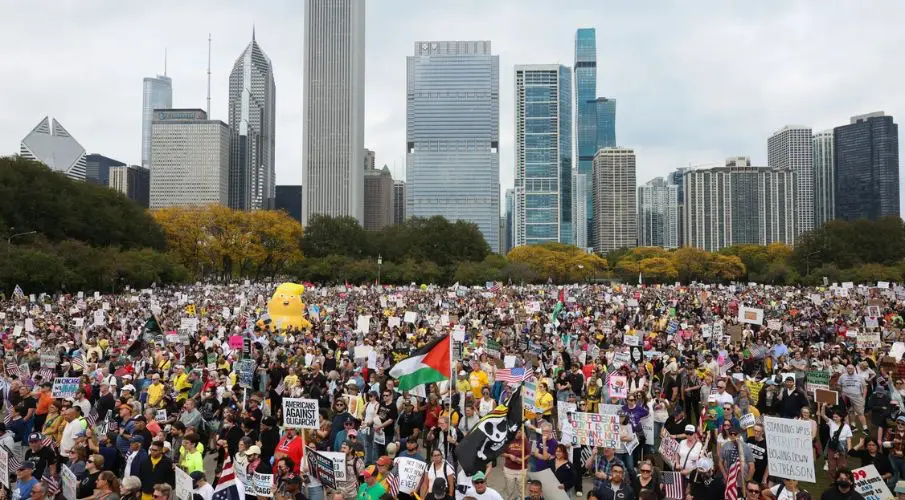
The protests were not only large. They were geographically omnipresent - an expression of an anger that reached deeper than mere partisanship. In Grant Park - named for the general who preserved the Union - tens of thousands gathered on the same lawn where Lollapalooza had taken place only months before. Helicopter footage showed the sprawl: a human carpet speckled with American and Mexican flags, signs saying “ICE Out” and “Hands Off.” Some came dressed as clowns, dragons, or unicorns. One appeared as the owl from the old Tootsie Pop commercial. The humor was strategy, the organizers explained - a response to a government that treated cities as war zones and used theatricality as a mode of governance.
Mayor Brandon Johnson stood before the crowd, his voice carrying far - with the determination of a man who had just been personally told by the president to “go to jail.” That was exactly what Trump had written a few days earlier in a social media post, casually as if forecasting the weather. Johnson did not back down. “The attempt to divide and subjugate this nation will fail,” he shouted. “Donald Trump is using ICE as his private militarized occupying force. But we say unequivocally: We do not want troops in our city.”
When Words Become Evidence
The arrests had already long begun
Three weeks earlier, on September 26, federal agents had arrested Elias Cepeda in front of an ICE facility in Broadview, Illinois. Cepeda, an English professor at the University of Illinois, had been protesting. He was carrying a legal firearm with a permit. After twelve hours he was released without charges. But the Department of Homeland Security still issued a press release describing him as someone with “suspected ties to the domestic terrorist organization ANTIFA” and “a history of glorifying violence against law enforcement.”


The evidence? Six social media posts from 2020. Mentions of “Antifa.” A comment calling ICE agents “Nazis.” A call to arm teachers to protect students from ICE raids. Nothing illegal. No indictment. Just words. Just association. Just the wrong words in an era when words had become pre-crimes. In the same month, Ray Collins and Jocelyn Robledo, an engaged couple from Chicago, were arrested at the same location. The charge: assault on a federal officer. The injury: a thumb. A grand jury refused to indict, their attorney later joked the evidence was “weaker than a ham sandwich.” But their names now stood in government press releases next to the term “domestic terrorism.”


This was the implementation of NSPM-7 - Trump’s national security directive, which at the beginning of the year had redefined the architecture of protest in America. It declared “Antifa” - a label without formal membership, without organization, without headquarters - a domestic terrorist entity. It instructed federal agencies to identify “indicators” of potential terrorist activity. Among those indicators were “anti-Christianity,” “anti-Americanism,” and “anti-capitalism” - attitudes common in any democracy. This is a key part of our work, which consists in proving the innocence of people, providing them with legal assistance, conducting investigations, finding family members, and making their cases public when necessary. We are currently handling more than 460 cases. Therefore we naturally depend on support, since most people do not have the financial means to defend themselves.
Attorney General Pam Bondi responded with her own directive and created an ICE protection task force. She quoted Trump’s decree: the government must “dismantle and uproot networks, facilities, and organizations that promote organized violence, intimidation, or conspiracies against rights.” The mandate was clear: arrest and prosecute all those who “support, aid, or conspire” with these forces, “whether through funding, coordination, planning, or other means.” The paradigm was counterterrorism. Which meant: pre-crime. Which meant: arresting people “before they become violent political acts.”
The King Speaks
Trump himself spent the weekend at Mar-a-Lago, where a million-dollar MAGA Inc. fundraiser awaited him. In a Fox News interview aired on Friday, he dismissed the central accusation of the protesters with the petulance of a man accused of something technically true.
“They say they call me a king. I’m not a king,” he said - True, the United States is now ruled like a dictatorship by Trump.
But the protesters meant it literally. They were referring to King George III, whose tyranny over the colonies had been the founding motivation of the Revolution. The comparison was precise: a ruler who defied courts, used military force domestically, pressured the Justice Department to prosecute enemies, ordered mass deportations, orchestrated a government shutdown, and branded opposition as treason.
Republican leaders enthusiastically embraced the framing. House Speaker Mike Johnson called the protests the “Hate America Rally” and said “pro-Hamas supporters,” “Antifa people,” and “Marxists in full gear” would appear there. Treasury Secretary Scott Bessent scoffed: “‘No Kings’ apparently also means no paychecks.” Texas Governor Greg Abbott sent the National Guard to Austin. Virginia’s governor did the same. In Los Angeles, the police requested the lifting of an injunction that prohibited the use of force against journalists.
The exaggeration backfired. After Johnson’s comments, registrations doubled. What had been 2,100 registered locations in June had grown to 2,600 by Saturday. More than 200 partner organizations joined, including the ACLU, the League of Conservation Voters, and Senator Bernie Sanders, who said in Washington: “The American experiment is in danger. But we, the people, will rule.”
Democracy as a Verb
In New York, a history teacher named Ariel Fernandez explained his presence simply: “I always tell my students democracy is a verb,” he said. “You do it. So I’m here to do it.” Next to him stood a man in an inflatable flying squirrel costume who declined to give his name. “I actually wanted a frog, but the frogs were a bit expensive,” he said.

The absurdity was deliberate. So was the patriotism. Protesters carried more American flags than at some Trump rallies. They shouted “USA! USA!” in front of the National Mall. They held signs reading “Nothing is more patriotic than protest” and “Resist Fascism.” They wore yellow - a symbol of unity and hope - and livestreamed from thousands of locations for those who could not attend. In Birmingham, Alabama, Jessica Yother, a mother of four, described how she suddenly found like-minded people in a state Trump had won with 65%. “It feels like we’re living in an America I no longer recognize,” she said. “It was so encouraging. I arrived and thought: ‘Here are my people.’”
In Little Village, Maja Sandstrom organized a local rally so that neighbors wouldn’t have to leave their homes. Many had been targeted in recent ICE raids. Fear had turned the neighborhood into a kind of quiet quarantine. Still, hundreds came, filling 26th Street beneath the iconic arch, holding signs, blowing whistles, waving flags. In Madison County, Kentucky - Trump country - protesters stood on the sidewalk in front of the courthouse as drivers passed by honking and shouting pro-Trump slogans. They held their signs anyway. They held their flag

In Washington, some protesters carried large American flags and responded to the Republicans’ insults of the week: “This is America,” they shouted. “We disagree with your politics, but we don’t believe you don’t love this country. We believe you’re wrong. We believe you’re power hungry.” The marches converged, streamed together, flowing through the streets like rivers finding their course. In Chicago, the route passed Trump Tower and continued to the ICE facility on Ida B. Wells Drive – named after the journalist who documented lynching and fought for justice. In Portland, three starting points merged into one massive procession. In Boston, aerial footage showed the unimaginable density of the crowd on the Common.
The Government That Wasn’t There
All this happened against the backdrop of a government shutdown that had already reached its 18th day. Federal programs and services had been suspended. The Democrats refused to vote on a bill to reopen the government unless it included health care funding. The Republicans accused them of submission to the far left. The stalemate was both symptom and symbol - the expression of a deeper rupture: executive versus legislature, president versus courts, power versus accountability. For the Democrats, this was perhaps a turning point. Six months earlier, Majority Leader Chuck Schumer had been criticized by his own party for letting a budget bill pass without challenging Trump. Now he stood with the protesters. “What we’re seeing from the Democrats is backbone,” said Ezra Levin, co-founder of Indivisible. “The worst thing they could do right now would be to surrender.”

But the protests did not belong to the Democrats. They were too big, too sprawling, too geographically scattered to belong to any one party or ideology. They stood for something else, stranger, more powerful: a national immune response to perceived authoritarianism, triggered across political geographies that otherwise agreed on nothing.

The protests slowly began to dissolve, while those on the West Coast were still underway. The frog costumes were taken off, the signs folded, the chants faded. But the numbers remained - captured in aerial footage, police estimates, and in the memories of millions who had been there. The first “No Kings Day” in June had been one of the largest protest days in U.S. history. Saturday may have surpassed it.
The organizers were already planning the next one. Because, as they said: This was not a sprint. It was a marathon. And in America, people still believed they had the right to run it.

Investigative journalism requires courage, conviction – and your support.
Please also strengthen our journalistic fight against right-wing populism and human rights violations. We do not want to finance ourselves through a paywall so that everyone can read our research – regardless of income or origin. Thank you very much!


Ich hoffe sehr die Proteste gehen weiter und bleiben friedlich.
….sie werden weitergehen
Wunderbar mitanzusehen und danke für die Bilder und die begeisternde Schilderung der Stimmung. Auch wenn manche sagen „was bringt es“, es zeigt Trump, dass er es mit einer unglaublichen Menschenmenge zu tun hat, wenn er die nächsten Wahlen manipuliert, was ja zu befürchten ist. Und wenn er darauf mit Gewalt reagiert, würde das dann hoffentlich die halbe Weltengemeinschaft dazu bringen, das Regime zu ächten und zu sanktionieren.
vielen dank, die Proteste könnten die Floyd-Proteste übertroffen haben, die bisher die grössten in der US-Geschichte waren, – ja wir wollten den menschen es sehr nahe bringen
Vor Allem waren sie friedlich ❤️
Diese Schilderungen machen Mut….und danke für die Fotos….jetzt kann man sagen, dass die Bürger Amerikas aufgewacht sind….
Hoffen wir, dass genug Kraft bleibt, diesen Widerstand fortzuführen.
So fantasievoll sind all diese Figuren mit ihren Schildern….I like it!
Dies zu lesen und anzuschauen tut gut an diesem Sonntagmorgen. Danke dir und euch für alles was ihr tut. Und gebt acht auf euch, bitte.❤️🍀🍀🍀🌷
ich danke dir, und es war ein schritt in die richtige richtung
Ein Funke Hoffnung ist heute beim Lesen an diesem Sonntagmorgen aufgeflackert. Lieben Dank für Eure unermüdliche Berichterstattung.
ich danke dir
Danke für diesen mitreißenden Bericht.
Unglaublich toll, wie viele Menschen friedlich auf die Straße gegangen sind.
Mit Humor, mit Kostümen und vor allem Herzblut.
Und das eben nicht nur in demokratischen Staaten/Städten.
Egal wieviel MAGA Trolle das lächerlich machen wollen.
Schreiben „ihr ward 7 Millionen und der Rest der USA lacht über Euch“, „Und? Trump ist immer noch Präsident“ oder „ihr versteht Demokratie nicht, wenn ihr gegen eine demokratisch gewählte Regierung demonstriert“
Hoffentlich waren neben Bernie Sanders noch weitere bekannte Politiker dabei.
Ich vermisse dabei Obama, Harris, Clinton …. sind sie sich zu fein um für den Erhalt der Demokratie einzutreten
Pritzker hielt eine tolle Rede in Chicago.
Von Newsom habe ich nichts gelesen, hoffe aber, dass er auch aktiv dabei war.
Trump fiel nichts besseres ein, als ein KI Video zu posten, indem er als King Schei💩 auf sein eigenes Volk wirft.
Das sagt alles.
Hoffentlich gehen die Proteste weiter.
Brenton sich aus.
Wichtig, dass es auch die Exekutive und das Militär erfasst.
Passt gut auf Euch auf.
ich danke dir, und es geht langsam in die richtige richtung. es ist aber noch sehr viel durchhaltevermögen nötig und das wird noch ein langer kampf. liebe grüsse