
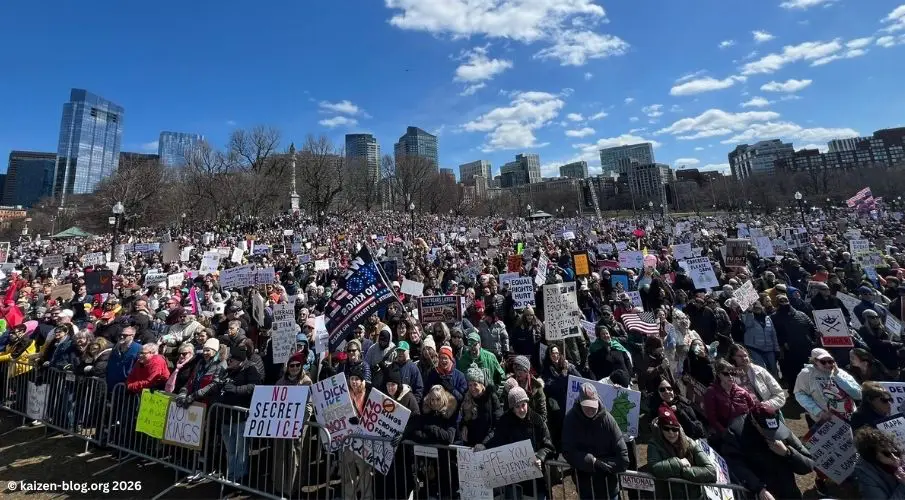
Donald Trump spent March 28 in Florida. Meanwhile, in more than 3,300 cities and communities across his country, millions of people took to the streets. From Alaska to Florida, from New York to a village in Idaho with fewer than 2,000 residents, from San Diego to a parking lot in Oshkosh, Wisconsin, where people stood in minus ten degrees with gloves and wool hats, holding signs that said what they think of their president.
It was the third No Kings protest day. And by all accounts - the largest.
Organizers spoke of at least 8 million participants, probably many more. In June, there had been several million, in October seven million. The numbers are growing, and so is the reason. You have to imagine what this day looked like to understand what it means.

In Reading, Pennsylvania, Jennifer and Jackie Arteaga stood at a busy intersection. Cousins, of Mexican origin, both raised in this country. Jennifer was 25, had brought her three year old son. “It feels like our country is a joke,” she said. “It is his future we are talking about.” Jackie, 20, lives twenty minutes from the planned ICE facility that is to be built in Reading in an empty warehouse - 1,500 beds, in the middle of their city. “It scares me to know that I might see them at the grocery store around the corner,” she said. “What am I supposed to do then?”

In Lander, Wyoming, Phyllis Roseberry raised an upside down American flag. A man stopped, shouted something obscene at her and drove on. She let it roll off her. “I am here because I love my country,” she said. In West Bloomfield, Michigan, people protested in temperatures below freezing. In Topeka, Kansas, someone stood dressed as a frog prince in front of the state capitol. In Oxford, Mississippi - an hour’s drive from Elvis Presley’s birthplace - Mitch Campbell, 72 years old, came with a sign: “No king except Elvis.” He said: “How can people ignore this? They are trampling on the Constitution. Whether it is gas prices, tariffs, cost of living - we just do not look.”
In Washington, hundreds marched past the Lincoln Memorial onto the National Mall. Signs: “Take off the crown, clown.” “Regime change begins at home.” Drums, bells, chants. Bill Jarcho from Seattle came with six people dressed as insects wearing tactical vests labeled “LICE” - a direct reference to ICE, Trump’s immigration authority. “We offer mockery for the king,” said Jarcho. “Making authoritarianism ridiculous - they hate that.”

Donna Lieberman, executive director of the New York Civil Liberties Union, said at a press conference in New York: “They want us to be afraid. They want us to believe there is nothing we can do to stop them. But they are wrong.”
In San Diego, police counted 40,000 people in the downtown area alone. Streets were closed - the Pacific Highway, North Harbor Drive, Ash Street, Broadway - all temporarily shut down, all reopened as the crowd moved through the city. Organizers had planned more than a dozen events across the county, from the South Bay to North County.
In Los Angeles, it was the only one of the major cities where the day escalated. Outside the Metropolitan Detention Center downtown, federal authorities used tear gas after protesters threw concrete blocks and bottles. Police arrested several individuals. It remained the only moment on an otherwise peaceful day.
In Atlanta, 36 year old veteran Marc McCaughey, who belongs to the veterans organization Common Defense, said: “No country can govern without the consent of the people. We are here because we believe the Constitution is threatened on many levels.” Naveed Shah of Common Defense said: “Since the last time we marched, this government has dragged us deeper into war. At home, we have seen citizens killed in the streets by militarized forces. Families have been torn apart.”

The center of the day was in Minnesota - and that was no coincidence.
In Minneapolis, Trump had ordered a wave of ICE operations in January. Two American citizens were shot and killed by federal agents. Renee Good, mother of three children. Alex Pretti, a nurse with the Veterans Administration, shot in the back and left lying in the street without the government ever launching an investigation. Minnesota fought back, loudly and persistently, until the border czar declared the raid over.

That is why the organizers designated St. Paul, the capital of Minnesota, as the national flagship of the third No Kings protests. And that is why Bruce Springsteen stood on stage in front of the capitol.
He sang “Streets of Minneapolis” - a song he had written in 24 hours after hearing about Renee Good and Alex Pretti. It was his third performance of the song, after a benefit concert in Minneapolis in January and an event in New York a few days earlier. Springsteen’s Land of Hope and Dreams Tour begins on Tuesday - in Minneapolis. It is set to end in Washington.
“This reactionary rule and these invasions of American cities will not endure,” he said. “Your strength has given courage to the whole country. You have given us hope.”
Before Springsteen took the stage, the organizers played a video of Robert De Niro, who said he wakes up depressed every morning because of Trump - but not on this Saturday. He congratulated the people of Minnesota.
Bernie Sanders spoke. Joan Baez was there. Jane Fonda. Randi Weingarten, president of the American Federation of Teachers, called out to the crowd: “Donald Trump may pretend he is not listening - but he cannot ignore the millions in the streets.” At the capitol, protesters held up a huge banner: “We had whistles, they had weapons. The revolution begins in Minneapolis.
The protests spread beyond the borders of the United States. In Rome, thousands marched, also against Israeli and American attacks on Iran. In London, demonstrators held banners reading “Stop the far right.” In Paris, hundreds gathered at the Bastille - mainly Americans living in France, together with French unions and human rights organizations. Ada Shen, one of the organizers, said: “I protest against all of Trump’s illegal, irresponsible and endless wars.”
Trump’s approval rating stands at 36 percent, according to a Reuters Ipsos poll from March 20 to 23 - the lowest level since his return to office. Only 35 percent of Americans support the attacks on Iran, down from 37 percent the previous week. Twenty five percent are satisfied with Trump’s handling of the cost of living. The White House had spokeswoman Abigail Jackson say the protests were the product of “left wing funding networks” without real support among the population. The only people interested in these “Trump derangement therapy sessions” were the journalists paid to report on them. The Republican congressional committee NRCC called the events “hate America rallies.”

Dana R. Fisher, professor at American University who researches civic engagement, says collective shock and reaching a certain number of participants alone are not enough. In her surveys, she found that participants in the No Kings protests are predominantly female, academically educated, middle aged and almost 90 percent white. More than two thirds said they had participated in a political boycott in the past year. “What we really need is the work of defending democracy in our communities,” said Fisher. “It is not about inflatable costumes.”

Donna Bailey from Reading, Pennsylvania, attended a No Kings protest for the third time. She said she comes because of her grandchildren. “And out of fear of losing democracy, of going backwards. Out of fear that my grandchildren will no longer be able to afford life. It is just getting worse. At some point, it has to stop or reach a turning point. But every time you think we have reached the bottom, that is not the case.”

In Chicago, Minneapolis, Boston and Philadelphia, the streets were flooded this Saturday. These four cities alone accounted for 400,000 to 500,000 people combined. The protests are growing - slowly, but steadily, round by round.

In the United States, there are many forms of resistance. This is one of them - loud, visible, and in its persistence perhaps the most honest. The road ahead is long, and no one knows whether it will be enough. But it is clear that it is decisive. Because what tips or holds here does not tip or hold only for America. A right wing populist regime that remains unchecked in Washington spreads - this is no longer theory, it is history being written in real time. Europe is only feeling a fraction of it so far. What will come if this resistance fails here will hit Europe with a force it is not prepared for.

Midterm elections are in November. Republicans risk losing both chambers of Congress. Whether more than 8 million people standing up on a Saturday in March will contribute to that - no one knows for certain.

But the fact that more than 8 million people stood up cannot be dismissed.
Not even from Florida.
Updates – Kaizen News Brief
All current curated daily updates can be found in the Kaizen News Brief.
To the Kaizen News Brief In English


