
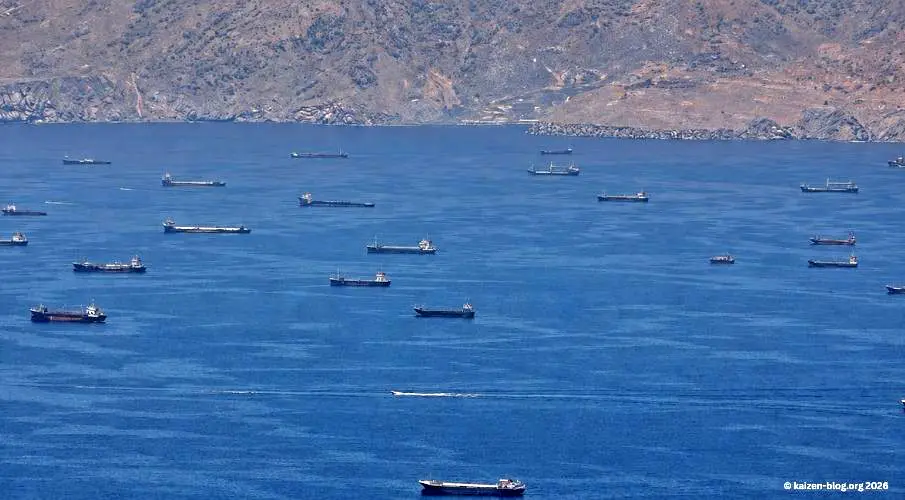
Wars do not change geography physically, but politically. The Strait of Hormuz is the same narrow passage it was before February 28 - 54 kilometers at its narrowest point, between Iran and the Arabian Peninsula, through which an average of 130 oil tankers pass each day, transporting twenty percent of global oil trade. What has changed is who is in charge. And this week Iran made clear what it intends to do with that.
Tehran estimates that fees for security, environmental, and navigation services in the strait could generate forty billion dollars annually - for all participating states combined, but with Iran as the driving force behind the model. The country's chief negotiator, Mohammad Bagher Ghalibaf, stated openly during a visit to Oman on Tuesday what Tehran's negotiating position is: “Everyone must understand that the administration of the strait will never again be what it was before the war.”

The graphic compares the estimated financial scope of two Iran agreements. On the Obama side, released assets, additional oil revenue, and a settlement add up to approximately 117 billion US dollars. On the Trump side, the significantly larger total of around 450 billion US dollars results from three illustrated components: more available assets, higher additional oil revenue, and above all an additional reconstruction fund of 300 billion dollars. That is what creates the large gap between the two “agreements.”
This Is Not a Negotiating Offer - It Is the Current Reality
The sixty day ceasefire agreement of June 14 provides for free passage without fees and obligates Iran to clear mines. At the same time, it grants Tehran a voice in the long term administration of the strait - even though Iran does not recognize the international law of the sea governing the Strait of Hormuz. Trump has therefore given a state that disputes the legal basis of the agreement a seat at the table of future design. What that means is already becoming visible: Iran has created its own insurance company which ships reportedly must use to pass through the strait. On Thursday, Tehran warned that transit outside the routes designated by Iran would be considered highly dangerous and prohibited.
New as well is the requirement to register two days in advance for passage
The model Iran refers to is the Dardanelles. Turkey charges transit fees there under a convention dating back to 1936 - currently 6.70 dollars per ton - for sanitation services, lighthouses, and maritime rescue. Ankara acquired this right through decades of geopolitical negotiation, and it is anchored in international law. The Turkish agreement is unique and cannot automatically be transferred to another country. Any service fee Iran would impose would require approval from all 176 members of the International Maritime Organization. Iran has signed international and regional agreements that prohibit unilateral payments for transiting ships.

That has not stopped Tehran from continuing to negotiate the concept. Talks with China and Egypt are ongoing. Iranian officials have privately stated that they would be open to the United States joining such a payment system - an idea Trump himself has occasionally hinted at publicly. At the same time, Secretary of State Marco Rubio stated in Bahrain this week that no country has the right to charge for the use of international waterways and that tolls would create a dangerous precedent that could spread like contagion. The Gulf states also rejected fees. Oman’s Foreign Minister Badr Albusaidi reaffirmed after talks with Rubio that future Hormuz arrangements would not include transit charges. However, the situation is more complicated than those rejections suggest. Oman announced that it would offer a safe, toll free temporary corridor along its coastline - coordinated with the International Maritime Organization. That sounds like a solution, but it is also an admission that the regular transit route is no longer being treated as a given. On Wednesday, around seventy ships crossed the strait - the highest number since the war began, but still well below the prewar average of 130 tankers per day. On Thursday, a cargo vessel near the Omani coast was struck by an unidentified projectile that damaged the bridge without causing casualties.
As another reference model, Iran and the Gulf states are examining the Strait of Malacca. There, Malaysia, Indonesia, Singapore, and other Asian countries coordinate a multinational naval patrol against piracy, jointly financed by the participating states and a Japanese foundation. For Hormuz, that would mean a combination of the naval forces of the Arab Gulf monarchies with Iran - an arrangement whose internal tension could hardly be greater. Tehran also justifies its claims to control of the strait by arguing that the United States used the Strait of Hormuz to transport military goods that were later used in attacks on Iran. Asked for comment, the White House referred to Trump’s social media post in which he rejected fees, without saying whether he would be willing to negotiate Iranian service charges.
What the war has shifted strategically is not geography but the basis of negotiation. Iran has demonstrated that with missiles and drones it possesses an on off switch over the world’s most important energy trade route. Trump’s agreement did not reverse that - it institutionalized it. Iran now sits at the table of Hormuz governance. Forty billion dollars is the asking price. How much of that is ultimately enforced will depend on how much the world is willing to pay to avoid seeing that switch activated again. Thank you, Mr. Trump.
Updates – Kaizen News Brief
All current curated daily updates can be found in the Kaizen News Brief.
To the Kaizen News Brief In English


Trumps und Netanyahus Krieg hat einiges bewirkt 🤬
Den Tod von unschuldigen Zivilisten
Den Tod von Soldaten
Die Schließung der Strasse von Hormus
Künftige Gebühren für die Strasse von Hormus, denn wenn Donny beteiligt wird, ist er dabei.
Der Iran bekommt eingefrorene Gelder und kann Öl verkaufen.
Die Umwelt hat massive Schaden genommen.
Das Ziel, dass der Iran „niemals Atomwaffen haben“ darf, ist in weiter Ferne
Hat Trump ja wirklich gut gemacht (Ironie) 🤬🤮