
Tehran - Shortly before 8 PM local time in Washington, Trump pulled his hand back.
Not because Iran had capitulated. Not because the bridges were standing and the power plants were running and the Strait of Hormuz was open. But because Pakistan’s Prime Minister Shehbaz Sharif and Army Chief General Asim Munir had called him, because the negotiations had taken a turn, because Iran had presented a 10 point plan that Trump described in a social media post as an acceptable basis for negotiations.
Iran’s Foreign Minister Seyed Abbas Araghchi released an official statement. He thanked Prime Minister Sharif and Field Marshal Munir for their tireless efforts. Then he clarified Iran’s position: Passage through the Strait of Hormuz would be possible for two weeks - under coordination with Iran’s armed forces and taking into account technical limitations. Trump had demanded a full, immediate and safe opening. Araghchi delivered coordinated passage with conditions. Both called it a ceasefire.
Israel has also agreed to the terms of the ceasefire, according to a representative of the White House who spoke anonymously - with reservations, as Israel had stated it wanted to achieve more. Iran’s nuclear fuel is still in the enrichment facilities. The nuclear program was one of the main reasons Israel and the United States cited for the start of the war in February. It no longer appears in Trump’s post from Tuesday evening.
As now confirmed, 04:45 a.m. CET: Benjamin Netanyahu says Israel supports the U.S. ceasefire with Iran, but the agreement does not cover fighting against Hezbollah in Lebanon. (We’ll see how this plays out – editorial note)

Trump declared, based on talks with Pakistan’s Prime Minister Shehbaz Sharif and Field Marshal Asim Munir, that the bombing of Iran would be suspended for two weeks - on the condition that Iran fully and immediately opens the Strait of Hormuz. He described an Iranian 10 point plan as a viable basis for negotiations and claimed that almost all disputed points had already been agreed. Iran’s Foreign Minister Seyed Abbas Araghchi accepted the ceasefire on behalf of the Supreme National Security Council, but formulated his own conditions: Passage through Hormuz would be possible for two weeks, but only in coordination with Iran’s armed forces and taking into account technical limitations. Both sides spoke of a mutual ceasefire, but clearly meant different things. Trump claimed in his post not only to act on behalf of the United States, but also on behalf of the countries of the Middle East - a self authorization no one had granted him. Pakistan, which had conducted the negotiations, invited both delegations to Islamabad for Friday, April 10.
Two weeks of ceasefire. Talks in Islamabad starting Friday. Trump wrote that almost all disputed points had already been agreed between the United States and Iran. What exactly was agreed, he did not explain. Iran’s Supreme National Security Council accepted the ceasefire and added in its statement: This does not mean the end of the war. Our hands remain on the trigger. If the enemy makes the smallest mistake, it will be answered with full force.
Two hours earlier, Trump had written that an entire civilization would die that night if no agreement were reached. Then he reaches an agreement. Then no civilizations die. Until the next post.
Since the beginning of the war, Trump has repeatedly set deadlines, extended them shortly before they expired or withdrawn them. The deadline from Monday. The threats against power plants and bridges. The announcement that four hours would be enough to reduce Iran to rubble. All withdrawn, postponed, repackaged. His critics have for months called this TACO - Trump always chickens out. It is not an accusation, it is an observation that repeats itself.
What had happened in the hours before the withdrawal cannot be argued away.
Israel had attacked bridges and railway lines that, according to its own statements, were used to transport Iranian weapons and military equipment. The United States had struck military facilities on Kharg Island as well as Iran’s two largest petrochemical centers in Mahshahr and Asaluyeh. A US government official said these attacks were a message to Tehran - a preview of what would come if Trump carried out his threats. Israel was skeptical whether the apparent breakthrough would hold.


In Abu Dhabi, the Habshan gas processing plant was in flames after Iranian fire was reported. Saudi Arabia intercepted seven ballistic missiles and four drones. Iran shelled Israel and Saudi Arabia. And even after the ceasefire announcement, rocket alarms sounded in Israel, the United Arab Emirates, Bahrain and Kuwait. The Revolutionary Guard has largely decided independently during this war what to attack and when. Whether they would immediately implement the political decision on the ceasefire was not clear in the early morning hours.
Tehran had experienced Tuesday differently than the announcements suggested.
People formed human chains, voluntarily or involuntarily, around power plants, to protect them with their bodies. Hundreds gathered at bridges and at a facility far outside the capital, Iranian flags in their hands. Iranian President Masoud Pezeshkian said 14 million people had allegedly registered as volunteers in case of a ground invasion. A teacher in Tehran said many opponents of the Islamic system had initially hoped Trump’s attacks would quickly bring down the regime. That hope has long faded. What remains is the fear of being left without electricity, without water, without gas. Back to the Stone Age, as Trump himself had put it.

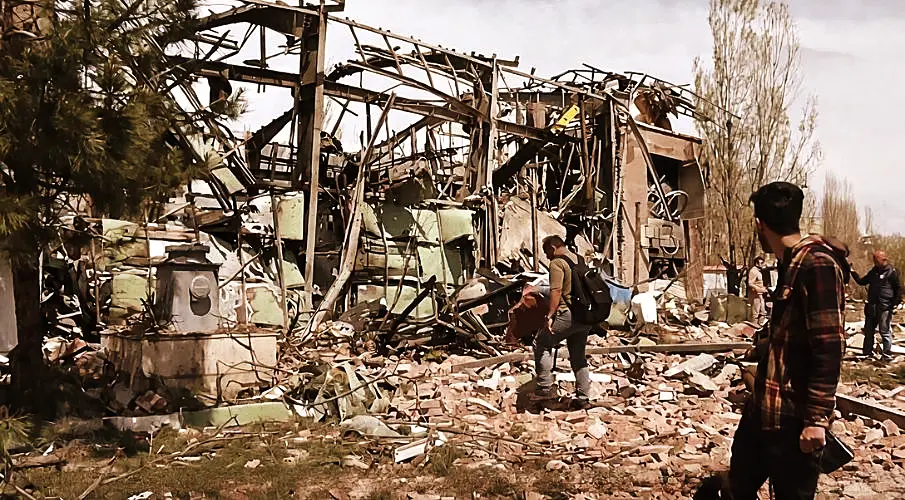
An attack had half destroyed the Khorasaniha synagogue in Tehran and damaged surrounding residential buildings. In Minab, people commemorated the schoolchildren who had been killed on the first day of the war, February 28, in an attack on a school. A girl stood next to a model of a spacecraft that had been set up as part of the memorial.
More than 1,900 people have died in Iran since the beginning of the war. The government has not updated the figures for days. In Lebanon, more than 1,500 people have been killed, more than one million displaced. In Israel, 23 people died from Iranian attacks, 13 American soldiers have fallen.
ran’s 10 point plan contains demands that go far beyond a ceasefire. Control over the Strait of Hormuz, described as regulated passage under coordination of the Iranian armed forces - which, according to Iran, would give it a unique economic and geopolitical position. Full lifting of sanctions. Release of frozen assets. Withdrawal of American combat troops from all bases and deployment locations in the region. If it were to happen, this would be a complete restructuring of the American presence in the Middle East that has existed since the Gulf War of 1991.
The White House did not answer questions about what Trump meant exactly by “acceptable basis.” Press Secretary Karoline Leavitt said Trump’s words speak for themselves. The negotiations would continue.
Pope Leo XIV called Trump’s threats completely unacceptable on Tuesday. French Foreign Minister Jean-Noel Barrot said attacks on civilian and energy infrastructure could constitute war crimes. UN Secretary General Antonio Guterres expressed deep concern. Trump said it does not concern him at all.
China, Iran’s largest trading partner, had exerted pressure behind the scenes on Tehran to find a path to a ceasefire. The spokesperson of the Chinese Foreign Ministry, Mao Ning, said publicly that all sides must show seriousness and quickly end this war, which should never have happened from the beginning.

The talks are scheduled to begin on Friday in Islamabad. Pakistan’s Prime Minister Shehbaz Sharif officially invited both delegations to come to Islamabad on April 10 to negotiate a final agreement to resolve all disputes. Neither the United States nor Iran have publicly confirmed the invitation.
Two weeks. Then we will see.
If at all.
Updates – Kaizen News Brief
All current curated daily updates can be found in the Kaizen News Brief.
To the Kaizen News Brief In English


