
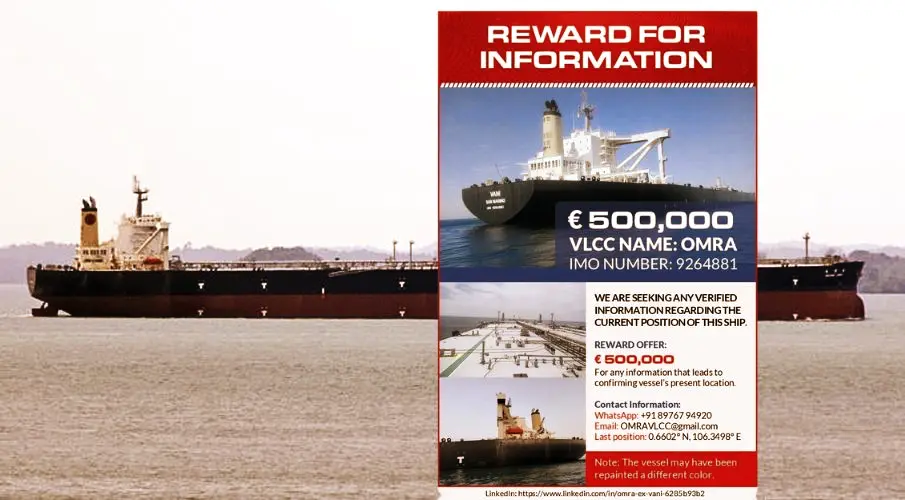
On LinkedIn, posts have recently appeared that sound more like a wanted notice than a business network update. An account named "Omra EX-VANI" is offering a 500,000 euro reward for "verified information" about the current position of an oil tanker. That detail alone, the promise of money in exchange for location data, makes the matter explosive: this is not about an ordinary vessel, but about a VLCC that appears in the environment of sanctioned oil transports and whose trail in relevant databases leads through multiple flag changes and inconsistencies.

In the posts, the tanker is described as "VLCC Name: OMRA," with IMO number 9264881. The notice is strikingly designed, with a large "REWARD FOR INFORMATION" headline and a clear amount: 500,000 euros. The wording is unambiguous. They are seeking "any verified information regarding the current location of this vessel." An Indian WhatsApp number and a Gmail address are listed as contact details. The account does not appear to be an official authority, but rather a profile presenting itself as "Master at vessel." It is precisely this mixture of professional appearance and questionable origin that makes the posts so unusual.

The notice also includes a specific "Last Position" entry: 0.6602° N, 106.3498° E. It adds that the vessel may have been "repainted in another color." That sentence is remarkable because it indirectly addresses what has repeatedly been reported about such tankers: visual changes, name changes, flag changes, all intended to make identity and movements more difficult to trace. In the images shown in the LinkedIn post itself, the vessel still carries the name "Vani." The bow reads "VANI," beneath it "SAN MARINO." The hull is painted black. That detail directly conflicts with what other registries and tracking data state about the flag.

VesselFinder is a public online platform for worldwide real-time vessel tracking based on AIS data. It displays positions, routes, technical data, ownership information, and historical movements of commercial ships.
The Equasis information system lists the tanker under a false flag from Guyana. The Equasis information system is a publicly accessible database operated by European authorities that consolidates information on vessels, their owners, flag states, and safety-related inspections in order to promote transparency in international shipping. At the same time, Pole Star Global’s PurpleTrac database for February 2026 shows a different flag: the Comoros, not Guyana. PurpleTrac by Pole Star Global is a maritime tracking and analysis system that evaluates vessel movements in real time, detects flag and identity changes, and highlights suspicious activities such as AIS manipulation or ship-to-ship transfers. The public impression from the LinkedIn photos presents yet a third version: San Marino. Three flag images, three levels that do not align cleanly. And these contradictions are precisely what, in the maritime shadow world, are not considered coincidence but pattern.

The tanker is not just any name in a database. Omra, formerly Vani, was sanctioned in the United States in July 2025, according to information from the U.S. sanctions environment, together with its owner. The company named is Avani Lines, a firm based in the Marshall Islands. Avani Lines is reportedly also on a U.S. list; in excerpts from the OFAC environment, "AVANI LINES INC" appears as an entity on the SDN list, with program code IRAN-EO13846. A registration in the Marshall Islands and an address in Majuro are also cited. What matters here is not the bureaucratic formula but the substance: the designation occurs in the context of Iran sanctions and is part of the U.S. approach to target trade, ownership structures, and logistical support along this oil route.

The U.S. agency OFAC lists AVANI LINES INC on its sanctions list of specially designated persons and entities. The company is assigned to the IRAN-EO13846 program, which provides for the blocking of property and assets. The listed seat is a Marshall Islands registration with number 125736, founded on May 3, 2024. AVANI LINES INC is therefore subject to comprehensive U.S. sanctions in connection with the Iran regime.
This case is highly unusual, because Omra is described there as a VLCC built in 2004 with 300,544 dwt, previously operating under the name Vani. A management company is also named: Sevana Shipping in Abu Dhabi. Research shows that Seavana Shipping Ltd, based in Abu Dhabi, is listed in international shipping registries as an ISM manager. The company does not appear as a classic large shipping line with a broad fleet but primarily as a safety and operational manager of a single very large crude oil tanker with a carrying capacity of around 300,000 tons. The address is given as Al Taweelah in Abu Dhabi; additional operational locations or an extensive fleet structure are not publicly documented. In publicly accessible maritime databases, Seavana Shipping appears in connection with exactly this VLCC, without a broader corporate presence, major chartering activities, or multiple managed vessels being traceable. Ownership structure, financial data, and executive leadership are publicly scarcely transparent, which in public representation reduces the company to a narrow, technical-administrative role around this single tanker, yet a tanker that appears in sensitive oil movements.
What are these movements specifically about. Omra is involved in the trade of Iranian oil. A stay in Iranian waters on January 23 is documented, where the vessel was seen bunkering. Such details are typically mentioned because they substantiate the connection between route, supply, and cargo. They also explain why a tanker that cannot easily be officially categorized nevertheless appears in tracking systems and sanctions lists.
The last known position cited by Pole Star Global is dated February 17. The region mentioned is off the Malaysian state of Johor. There are extensive anchorage areas outside regular port clearance zones, near heavily trafficked routes between the South China Sea and the Strait of Malacca, one of the world’s most important energy transit corridors. That location is precisely what makes the area attractive for ship-to-ship transfers, meaning the transfer of crude oil from one vessel to another. Such transfers are legal, but in gray-zone environments they are frequently used to obscure origin, ownership, or sanctions exposure.
The outer port limits off Johor have for years been considered a hotspot for this practice, because large tankers can be brought together with smaller units without being directly integrated into official port logistics. Analytical firms have repeatedly pointed to conspicuous AIS signal patterns - vessels that switch off their position data or appear to "stand still" for hours before continuing with altered cargo declarations. In multiple sanctions cases involving Iranian and Venezuelan oil exports, the region has appeared as an intermediate stop in route analyses.
Added to this is the proximity to Singapore, one of the world’s largest trade and bunkering hubs. While Singapore enforces strict controls, actors shift to adjacent international waters where jurisdiction is complex and fragmented. The combination of dense shipping traffic, complicated legal frameworks, and global energy demand makes Johor a strategic node - not only for legitimate transfers but also for actors who wish to operate in the shadows. Such transfers are central in this environment because they can obscure origin and supply chain when conducted outside clearly regulated port processes. Seatrade Maritime even located the last reported stay over several days in the East Outer Port Limits anchorage off Johor, an area associated with a high number of such transfers.
It becomes clear why a LinkedIn appeal offering 500,000 euros does not merely seem bizarre but like a signal. Someone wants the current position confirmed, not just a suspicion, not just a rumor, but "verified." And they are willing to pay for it. This is not the language of a traditional authority, but it is also not the language of standard shipping company communication. Added to this is the fact that the account itself does not appear as an official corporate profile but as a person or role, "Omra EX-VANI," with the note "Master at vessel." Anyone posting something like this online must at least factor in that third parties will respond, that data will circulate, that people may come forward who are not providing anything official but merely claim to know something. That is precisely why the word "verified" in the notice is so striking, because it suggests an intention to separate substance from noise, while simultaneously offering a structure that is not built for that purpose: WhatsApp and Gmail.
The notice itself looks like a digitally assembled wanted poster. At the top, a large photo of the tanker, beneath it a banner with the amount and the IMO number, then additional images of deck and side view. At the bottom, a note about possible repainting. And at the very bottom, a LinkedIn link leading directly to the profile. This format is not accidental. It is designed to be shared. It is designed to sit in feeds, to make a quick impact, to draw fast clicks. It is unsettling precisely because it does not come from a traditional investigative or law enforcement context, but from a network that normally distributes job postings, industry news, and career paths.
In the end, what remains is a situation that can only be stated soberly. A sanctioned VLCC with IMO 9264881, formerly Vani, now Omra, is moving in an environment associated with Iranian oil trade and the typical methods of concealment. Databases contradict each other regarding the flag. Photos show San Marino, Equasis refers to a false Guyana flag, Pole Star Global lists the Comoros. The last location cited is an area off Johor known for transfers. And into the middle of this, an unknown LinkedIn account places a reward of 500,000 euros for location information, including an Indian WhatsApp contact and a Gmail address.
If there is a common thread, it is not in the form of a grand thesis, but in the form of details that align: sanctions status since July 2025, owner Avani Lines on a U.S. list, the Iran connection, the route, the Johor location, the changing flag images, the note about repainting. And finally, the question that hangs over everything without anyone stating it openly: who is searching for whom here, and why is this search being made public through LinkedIn of all places.
Updates – Kaizen News Brief
All current curated daily updates can be found in the Kaizen News Brief.
To the Kaizen News Brief In English


