
The final seconds of Renee Nicole Macklin Good are now captured not only in shaky cellphone videos from bystanders, but also in footage from the perspective of the ICE officer who fired the shots. A 47-second clip, published by the right-wing outlet Alpha News and then redistributed by the Department of Homeland Security itself via social media, shows the encounter from the viewpoint of Jonathan Ross. Sirens wail in the background. Ross walks around the Honda Pilot, circles the vehicle, films with his phone as the situation escalates. And the more often one watches these seconds, the less the official narrative matches what can actually be seen and heard. We are currently analyzing the video, as one scene raises questions that could be significant. This review will be completed by Sunday.
If an officer truly believes that a car is an immediate weapon, he does not casually walk around it and document it, he does not stand there with a phone like someone who feels safe. Anyone who perceives the woman as an acute threat does not behave that way. It is precisely this discrepancy that burns itself into those 47 seconds.
Renee Good, 37 years old, a mother, a U.S. citizen from Colorado, sits behind the wheel. One hand on the steering wheel, the other at the open window. She does not look like someone trying to kill another human being. In the new video, she can be heard saying that she is not angry. Her wife Becca stands outside, holding up her phone, filming as well. She calls out to the officers that Renee is a U.S. citizen and a veteran. And in a moment that feels disturbingly casual, she throws them a line that sounds like bitter mockery: they should go get lunch first, “big boy.” This is not a heroic scene, not a charged ritual. It is that particular mixture of fear, defiance, and the attempt to maintain control over one’s dignity when armed men surround a car.
It is clearly visible that Becca Good gets out of the car, which explains the parking situation. Renee Good remained in the vehicle because Becca only wanted to hand out the whistles.
Then it tips. Other officers approach the driver’s side. One shouts that she should get out of the car. Ross now stands front left of the vehicle, near the hood. Renee briefly reverses, then turns the steering wheel toward the passenger side and drives forward. Ross opens fire. At least two shots. The camera jolts, shows sky, then street again. Someone shouts an insult, ugly, dehumanizing. The moment is over, but the impact only begins.
“The shots fired go far beyond a mere ‘misjudgment of the situation’ – the consequences can only point in one direction.”
From day one, the Trump administration has claimed that Ross acted in self-defense because Renee tried to run him over. Vice President JD Vance and a spokesperson for the Department of Homeland Security said after the clip’s release that the video supports the government’s account. Vance wrote, in substance, that the public had been lied to, that the officer had defended himself, that his life had been in danger. Minneapolis Mayor Jacob Frey called this justification garbage. And this is where the rupture lies: the federal government turns a woman in a car into a perpetrator, a gunshot into a duty. Yet even experts who do not speak for activists, but have analyzed police violence for years, say: the clip clarifies nothing, it raises new questions.
The video does not change the fundamental assessment of the use of force, but it calls the officer’s training into question. Ross holds a weapon in one hand and a phone in the other while filming. Who taught him that this is acceptable in a critical situation. Who allows an officer to occupy his own hands, narrow his focus, force his perception onto a screen while seconds decide between life and death. If an officer truly believes that a car is an immediate weapon, he does not casually walk around it and document it, he does not stand there with a phone like someone who feels safe. Anyone who perceives the woman as an acute threat does not behave that way. It is precisely this discrepancy that burns itself into the 47 seconds.
It becomes even more serious when one looks at the official rules that apply to ICE operations. According to an internal directive, officers are supposed to activate body cameras at the start of an operation and keep recording throughout the entire interaction. In serious cases, involving death or the use of firearms, the material must be secured. Yet the Department of Homeland Security has so far not answered the central question: did Ross or the other officers wear body cameras. Were they turned on. If so, where is the footage. If not, why not. Instead, a clip is circulated that does not come from a neutral system, but from the hand of the shooter, filmed with a device that has no place in the hand during an escalation. And then this very material is used by the federal government itself as evidence.
In the new clip, it is visible that the shooter is filming while simultaneously acting armed. This point alone does not automatically change the assessment, but it shifts the questions: what kind of training covers such behavior. Which service regulations are actually practiced. And why does the behavior not resemble that of an officer who fears for his life in those seconds.
In war, training prepares for an opponent conceived as an enemy force. Domestically, a different standard applies: control, de-escalation, protection of uninvolved persons, clean evidence preservation. Anyone who binds one hand with a phone in a civilian operation automatically narrows vision and attention, loses fine motor control and time reserves, and increases the risk of bad decisions. That is precisely why documentation and use of force are normally separated: fixed body cameras, fixed procedures, clear responsibilities.
We did not analyze the clip only after the shots were fired, but asked what training rules even allow such a “phone plus weapon” scenario. If a person is considered an immediate threat, one usually sees retreat, gaining distance, taking cover, clear commands, and focus on the threat object. An officer who walks around a vehicle while filming, by contrast, does not look like someone who at that same moment expects a deadly collision. This is not a side issue, but touches the core logic of threat perception.
In escalations, people resort to routines that give them a sense of control. Filming can function as self-assurance: I am recording what is happening. At the same time, it can increase stress because the gaze jumps between environment and screen. There is also a psychological effect: someone who is already “collecting evidence” can unconsciously slip into a mindset in which a threat is more likely to be confirmed than tested. In a situation with sirens, shouting, and multiple actors, this can make the situation tip faster.
For operations of this kind, ICE has rules on the use of body cameras precisely because serious incidents must be reviewable. When instead a short cellphone clip from the shooter’s hand becomes the central source, that is always problematic: it shows only a fragment, it is bound to a perspective, it can mislead through movement and angles. A thorough review requires complete, secured recordings and clear protocols, not just a piece of material that is politically exploited.
The pressure for transparency is also growing because Minnesota does not accept that Washington controls the review entirely. The Hennepin County Attorney, Mary Moriarty, called on the public to send all video and evidence material directly to her office. She openly said she was concerned because the Trump administration wants to keep state and local authorities away from the investigation and because it is unclear whether evidence is being fully shared. Moriarty also made clear that the shooter is not automatically shielded from any criminal review, even if Vance claims otherwise. Her sentence matters because it draws a red line: a federal badge is not a free pass. Not even in a country where the federal government currently acts as if it can cut off any oversight as soon as it becomes politically inconvenient.
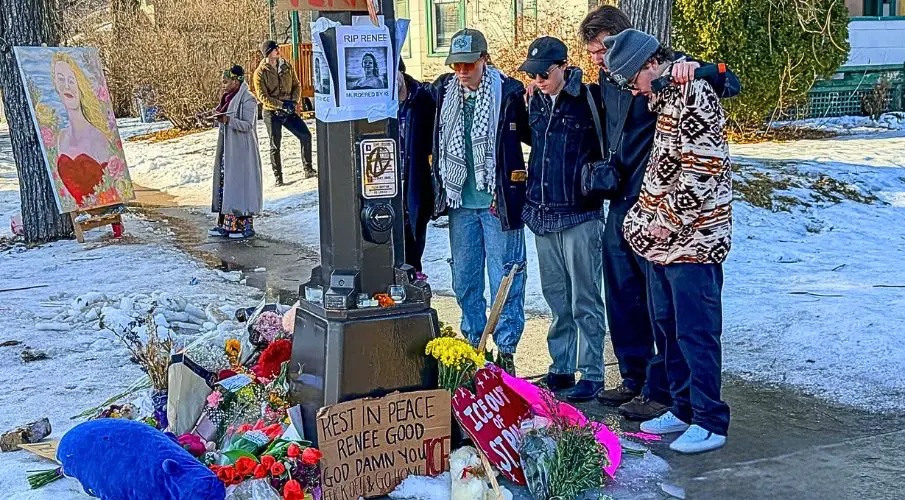
The reaction in Minneapolis was immediate and massive, also because this city cannot shake the memory of state violence. Where George Floyd died in 2020, another death caused by official action does not produce routine, but a wave. Hundreds marched to the site of the shooting, later into downtown, to the federal facility that serves as the hub of the current raids. Drums were beaten, pots were banged, “ICE out” was shouted, signs were raised carrying the simplest message one can formulate in such a situation: do not shoot. The school district responded by canceling classes for the rest of the week, out of caution, and offering an online option until February 12. One can argue about such decisions, but they show how deep the shock runs: a city reorganizes daily life because a federal officer shoots into a car in broad daylight and a mother dies.
Becca Good, wife of Renee Good, wrote a sentence this week that cuts through everything. She said that on January 7 they had stopped to help neighbors. That is why she got out. They had whistles they wanted to distribute. The others had weapons. This phrasing is not rhetorical decoration, but a factual description. There were people who could make noise, draw attention, at best call for help. And opposite them stood men who could decide over life and death, in seconds, with a pull of the trigger. Becca also wrote that kindness radiated from Renee, that she now has to raise their son alone and wants to teach him that there are people who build a better world. And that those who did this carry fear and anger within themselves. That is the opposite of hatred. It is an attempt not to harden oneself.

But the case is no longer a local isolated incident. It stands in a chain of events that has been growing denser since the beginning of Trump’s new enforcement push. The death of Renee Good is, according to reporting, at least the fifth fatality linked to such raids and operations since Trump took office. And while Minneapolis is still mourning and protesting, the next incident happened in Portland the following day: outside a hospital, Border Patrol officers shot at a vehicle and injured two people. The Department of Homeland Security identified them as Venezuelan nationals, Luis David Nico Moncada and Yorlenys Betzabeth Zambrano-Contreras. Both were described as stable after surgeries, while the federal government claimed the driver had tried to use the vehicle as a weapon. No officer was injured. Portland Police Chief Bob Day confirmed there was some connection to the Tren de Aragua gang because the two had come up in an investigation related to a shooting in July, but they had not been named as suspects. And he explicitly said that even a possible connection to a gang does not automatically justify shooting. Oregon’s Justice Department also announced investigations. There, too, hundreds marched and protested outside the ICE building.
It is this parallelism that blows the frame apart. Two cities, two firearm uses, twice Washington claims self-defense, twice key questions remain open, twice the streets erupt. And above it all looms the scale of the ongoing operation. The Department of Homeland Security calls the operation in the Minneapolis and St. Paul area the largest enforcement action of its kind ever conducted. More than 2,000 officers are involved, more than 1,500 arrests have already been made, said Homeland Security Secretary Kristi Noem. At the same time, documents show that forces were pulled from a previously planned series of raids in Louisiana and redeployed to Minnesota. An operation that was supposed to run until February is reshuffled because the political focus suddenly shifts. This is not a normal administrative act. It is a power decision.

In this climate, the release of the Ross video appears as a calculated step. First, the material was spread by a far-right outlet, then elevated by the Department of Homeland Security as if it were official proof. Yet the question remains whether body camera footage exists at all, whether standards were followed, whether neutral documentation exists. And while the government tries to squeeze an acquittal out of 47 seconds, other experts also say: those very 47 seconds show how unprofessional, how risky, how contradictory the shooter’s actions appear, because no one who truly believes they are in immediate mortal danger films on the side.
The central question therefore remains the same, and the clip does not make it smaller, but larger: why was the shot fired. Not why there was a conflict, not why people are angry at ICE, not why protests are growing. But why, in a moment when a car rolls forward slowly, when no contact is visible, when the officer does not step aside because he is being run over, but jumps back after he has already fired, the trigger is pulled. And why a federal government that claims to be hunting only the worst offenders immediately politicizes this death, publicly vilifies the woman and defends the shooter before an independent review can even take place.

Renee Good was not a wanted violent offender. She was a mother, a wife, a woman who wanted to arrive in this city, who according to her wife believed that people must protect one another. And now her death becomes a building block in a campaign that sells itself as order while letting weapons speak more and more often. What remains is the sentence that is not refuted by the new video, but sounds even harsher: we had whistles. They had weapons. And since Friday we know: they also had the camera in their hand.
Updates – Kaizen News Brief
All current curated daily updates can be found in the Kaizen News Brief.
To the Kaizen News Brief In English


Ich kann gar nicht beschreiben, wieviel Abscheu ich empfinde.
Auch die Tatsache, dass, wenn ich rausgehe, einkaufen, oder Veranstaltungen besuche oder was auch immer, ich mit großer Wahrscheinlichkeit Menschen um mich herum habe, die das gut finden. Die „selber schuld“ in ihre Tastatur klopfen, oder „endlich zeigt’s euch mal jemand“.
Potenzielle Mörder, wenn wir den Kampf gegen Rechts verlieren.
So ist es. Googeln Sie mal „Mühlviertler Hasenjagd“…
Mir fehlen einfach nur noch die Worte, was in der Welt passiert.😢😢😢 Vielen Dank für diesen starken Artikel, der in jeder Form überzeugt. 👍👍👍
Und in MAGA Kreisen und auch hier wird getönt „sie hatte selber Schuld“.
Ross wird als Held gefeiert.
Ich sehe einen Mann, der mit seinem (privaten?) Handy filmt.
Ich sehe keine Bodycam.
Ich höre zwei widersprüchliche Anweisungen „Raus aus dem Auto“ und „fahren sie weg“
Ich sehe eine Frau, die versucht sich vorsichtig aus dieser bedrohlichen Situation zu entfernen.
Und dann fallen 3 Schüsse.