
The anger is palpable whenever Donald Trump’s name appears next to Jeffrey Epstein’s. Old photos, shared parties, friendly remarks from the nineties - the picture seems clear. But anyone who truly wants to bring Trump down over this connection has to dig deeper. Much deeper. What then comes to light is not a single scandalous relationship, but a lifetime filled with failed projects, questionable deals, and legal battles. The Epstein story is only one chapter in a book that already spans hundreds of pages documenting how this man was able to rise to the most powerful office in the world.
Research Shows: The Disappearing Trace – How Case Numbers, Redactions, and an Old Deal Raise Many Questions About Trump and Epstein

(See also our research in the article of February 16, 2026)
In our research, while working through the extensive data set of thousands of pages, we came across a case number that tells more than any press conference: 31E-HQ-C1461253. Anyone who works through the files labeled EFTA01683870 and EFTA01246277 encounters an internal FBI query that literally notes that a search was conducted for cases “involving Jeffrey E. Epstein and Donald J. Trump regarding exploitation of minors.” Not “or,” but “and.” That wording stands out, because investigative authorities generally choose their language precisely in internal queries.
Donald John Trump was born in 1946 in Queens, New York, the son of real estate developer Fred Trump. His father built housing complexes for the middle class in Brooklyn and Queens - solid business, but not glamorous. Donald was meant to become something else. In 1959 he was transferred to the New York Military Academy, a school whose disciplinary measures were later repeatedly described as formative for his character. In 1964 he began his studies at Fordham University, but in 1966 transferred to the University of Pennsylvania, specifically the Wharton School. After graduating in 1968, he entered his father’s real estate business while at the same time dealing with military service issues - Trump received several deferments and ultimately a medical disqualification.

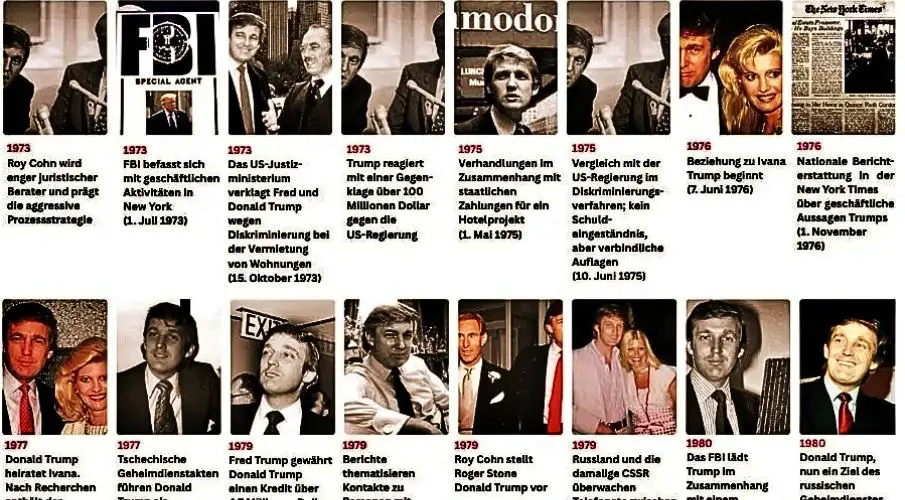
In 1971 Trump took over leadership of Trump Management and initiated a strategic shift toward larger projects in Manhattan. Yet as early as 1972 Fred Trump sold his Village through strategic financial maneuvers to Donald - substantial financial resources flowed to the son. In 1973 things escalated. Roy Cohn, the notorious attorney and former advisor to Senator Joseph McCarthy, became Trump’s legal counsel and shaped his aggressive litigation strategy. That same year the U.S. Department of Justice filed a discrimination lawsuit against Fred and Donald Trump over apartment rentals. Trump’s response: a countersuit for 100 million dollars against the U.S. government for discrimination in rental practices. On July 1, 1973, the FBI addressed alleged racist activities in New York.

In 1975 negotiations began in connection with this government payment obligation for a hotel project. On June 10, 1975, a settlement was reached with the U.S. civil rights authority regarding the discrimination allegations, but there were no binding enforcement provisions. No admission of guilt was made. In 1976 his relationship with Ivana Trump began on July 7, 1976, and in November 1976 the New York Times published the first polished accounts of his financial standing.

On October 16, 1973, the New York Times reported on a lawsuit filed by the US Department of Justice against the Trump Management Corporation. The allegation: systematic discrimination against Black rental applicants in housing complexes in Brooklyn, Queens and Staten Island. More than 14,000 apartments were part of the company’s portfolio at the time. The defendants were Donald Trump, then president of the company, and his father Fred C. Trump as principal responsible party. The government accused the company of denying apartments to Black applicants or imposing different conditions than on white tenants. The basis was the Fair Housing Act of 1968, which prohibits discrimination in the housing market. Trump rejected the allegations and spoke of unfounded accusations.
In 1975, the case ended with a settlement. There was no admission of guilt, but a commitment to refrain from future discrimination and to implement measures to ensure equal treatment. The date remains documented. The allegations as well. It is part of the early history of a man who later became president. Anyone who today speaks about rhetoric, about “Law and Order” and about alleged fairness cannot ignore these files.
In 1977 Donald Trump married Ivana. After their marriage, Czechoslovak intelligence files listed Trump as a monitoring subject. In documents of the Czechoslovak State Security service StB, which became accessible after 1989, Donald Trump appears in connection with family contacts in the former CSSR. The agency systematically documented Western businesspeople with Eastern European ties. In 1979 Fred Trump granted his son Donald a loan of 4.7 million dollars, in fact 4.3 million were redirected into complex trust-structured constructions. That same year Roy Cohn introduced Roger Stone to Donald Trump - an acquaintance that would endure for decades. In 1979 reports also began about contacts with individuals connected to organized crime.

In 1980 the fully modernized Commodore Hotel opened, later known as the Grand Hyatt New York. For Donald Trump it was the first major breakthrough in Manhattan. The mirrored glass facade became a visible symbol of his rise and marked the transition from residential development in Brooklyn and Queens to prestigious large-scale projects in the heart of the city. The renovation took place, however, in a New York construction environment that at the time was demonstrably heavily influenced by mafia-controlled unions and concrete supply chains. Investigations in the following years documented the dominance of so-called “Concrete Club” structures in which families such as the Gambino and Genovese organizations played central roles. A direct, documented business relationship between Trump and John Gotti is not established, but many questions remain open. What is certain: the project emerged in an industry that was deeply permeated by organized crime at the time - a context inseparable from the story of this ascent. And here as well: financing was largely secured through loans from his father and state tax incentives. In the same year Donald Trump is said, according to sources, to have been considered a target of Russian intelligence. We have not yet been able to document evidence for that claim.

In the summer of 1987, Donald Trump embarked on a conspicuous trip to the Soviet Union with his then-wife Ivana – embedded in a European tour that first took him to Paris and then on to Moscow and Leningrad. The visit was arranged and organized by the state-run travel agency Intourist, which hosted Western businessmen on behalf of the Soviet authorities. Officially it was about potential hotel projects in Moscow, but the trip was far more than a tourist venture: Trump and Ivana were received by officials, guided through representative sites, and also taken to the Catherine Palace near Leningrad, where the well-known photos of the couple in baroque halls glittering with gold were taken.
The background of this invitation raises questions to this day. At that time, Trump was an up-and-coming real estate developer from New York, whose name had become known above all in Manhattan with the construction of Trump Tower. That he was courted by Soviet authorities shows how carefully Moscow selected Western businessmen it could instrumentalize for its own interests. It was not only about hard currency and prestige projects, but also about the possibility of establishing ties to the American economic elite. Trump seemed a fitting candidate: ambitious, media-savvy, receptive to glamour and attention.
The trip took place in a time of upheaval. Mikhail Gorbachev had proclaimed glasnost and perestroika, and the relationship between East and West was beginning to change. For the Soviet leadership it was a balancing act: on the one hand signaling openness, on the other hand trying to influence influential personalities in the West. Trump and Ivana moved through a carefully staged backdrop that combined Russia’s old imperial heritage with the ambitions of a socialist great power.
After his return to the United States, Trump suddenly displayed a striking new foreign policy profile. As early as September 1987, he took out full-page ads in several major U.S. newspapers – including the New York Times, the Washington Post, and the Boston Globe – in which he criticized American foreign policy. He accused Washington of being too soft toward allies such as Japan and Saudi Arabia and called for a tougher international stance. For a real estate developer with no political experience, this was a remarkable step. Many observers see this as the beginning of Trump’s effort to cast himself as a foreign policy voice – an impulse possibly reinforced by his impressions in Moscow and Leningrad.
In retrospect, this trip looks like a harbinger. The fascination with Russia, the distrust of traditional alliances, the willingness to place national strength above diplomatic conventions – all these are themes that shaped Trump’s later political actions. In 1987 he was still at the beginning of his career, but the image of the young businessman posing with Ivana in gilded halls is more than a historical curiosity. It is an indication of how early he was willing to be impressed by the aura of authoritarian power – a red thread that would extend all the way into his presidency.

It is an unassuming sheet of paper, little more than a few lines, hastily noted, almost casual. Yet within these lines lies a political detonation. The United States Department of Justice could no longer avoid releasing a handwritten note by then-FBI Director James Comey, dated September 26, 2016 – six weeks before the election that brought Donald Trump into the White House. The document, now filed as “Government Exhibit 13” in an ongoing case on November 3, 2025, shows that U.S. authorities already had indications at that time of two explosive facts: possible financial ties between Trump and Moscow – and coordinated Russian attacks on American voter databases.

JB – We have CID (likely the Counterintelligence Division)
– Uncertainty about Hillary Clinton
– Contractors have access to the system
– Hillary Clinton plans to hit Trump
– Clinton’s healthKerry – Trump finances
– Debts to MoscowJB – Journalist(s) say they are working with Trump
I mentioned the New York Times – RussiaDurbin – The Department of Justice should examine a pattern in the intrusions and scans of state voter databases
The 1980s were Trump’s golden decade - at least outwardly. But behind the facade connections to questionable figures multiplied. Between telephone calls involving Ivana Trump and her father in the former CSSR a network developed that continues to raise questions to this day. In 1979 he had met Roger Stone, in 1987 the link to Russian intelligence followed. Russia and the former CSSR began to observe Trump and his circle more closely and to establish contacts.

What followed was an unprecedented series of failed ventures. In 1989 Trump purchased Eastern Air Shuttle for 365 million dollars - largely financed through debt. The luxury fittings with gold fixtures and carpets at Trump Airlines did not attract new customers. In 1992 the airline had to be relinquished to US Airways under pressure from banks. That same year, 1989, Trump: The Game was released, a board game that was quickly pulled from the market due to lack of interest. A 2004 reboot failed just as decisively.
The casino bankruptcies began in 1991 with the insolvency of the Trump Taj Mahal. In 1992 the Trump Plaza Hotel followed into insolvency. The Trump Taj Mahal, Trump Plaza, Trump Marina - all filed for bankruptcy. Between 1991 and 2009 Trump Entertainment Resorts filed for bankruptcy four times. In 2004 Trump Hotels & Casino Resorts entered bankruptcy, in 2009 Trump Entertainment Resorts followed. Investors lost hundreds of millions of dollars. Trump later claimed he had “only used the system.”


It truly was a spectacle - Michael Jackson was there, Elton John performed that week, and The Donald deployed his full show machinery to convince us it was the greatest thing ever built.
Behind the scenes there was complete chaos. He fired his own brother, who was president of the casino, on the second day… as always it was someone else’s fault.
Within six months the casino was bankrupt. 4,000 employees lost their jobs. Most contractors - especially in construction - were not paid for months… if at all. Those who were paid had to settle for pennies on the dollar. Trump and two of his financiers benefited from the disaster: one was Wilbur Ross, whom Trump later appointed as Secretary of Commerce in his first term. The other was Carl Icahn, another billionaire whom Trump wanted to bring into a cabinet position - but Icahn was such a ruthless businessman that he was not even willing to submit the required financial disclosures. He would not have received Senate confirmation anyway.
In 2006 a new wave of failed projects began. Trump Mortgage was founded - shortly before the financial crisis. The CEO was a former DJ with no banking experience whatsoever. In 2007 the company effectively shut down. Trump had claimed it would become “the largest mortgage company in the world,” despite having no expertise. That same year, 2006, Trump Vodka launched with heavy marketing under the slogan “Success Distilled,” but sales were disastrous. The Russian market Trump had hoped for showed no interest. Production ended in 2011. Also in 2006 Trump Magazine launched, a glossy luxury magazine bearing his name, which disappeared again by 2009 as advertisers stayed away. And GoTrump.com, a travel search engine founded in 2006, existed only briefly and attracted hardly any users.
In 2007 Trump Steaks were launched, sold exclusively through Sharper Image. The partnership ended after a very short time because sales were disastrous. Trump Water, often marketed as Trump Ice, was mainly offered in his own hotels and never achieved relevant market significance - a niche product without broader impact.
Trump University, a non-accredited seminar program, was sued for fraud. A judge described the conduct as “systematic fraud against retirees and low-income individuals.” In 2016 Trump paid 25 million dollars in damages to settle the lawsuits. In 2009 Trump Network launched, a multi-level marketing vitamin venture that was sold and discontinued in 2011. The Trump Tower Tampa, a planned luxury high-rise, was never built - investors sued Trump. Trump hotels in Baku, Toronto, and Panama - all projects were abandoned or sold, often accompanied by lawsuits or political scandals, particularly involving corruption allegations.
The Trump Foundation was dissolved by the New York Attorney General. Trump had used foundation funds for personal expenses. A court ordered him to pay two million dollars for illegal self-dealing. Despite his harsh rhetoric against China, Trump maintained bank accounts there and actively sought trademark rights. Thirty-eight Chinese trademarks were granted to him during his presidency - a remarkable fact for someone who publicly railed against Chinese economic practices.
In total, at least six bankruptcies are documented: 1991 the Trump Taj Mahal, 1992 the Trump Plaza Hotel, 2004 Trump Hotels & Casino Resorts, 2009 Trump Entertainment Resorts and additional casino bankruptcies in between. Trump still claims he “only used the system.”
In 2023 Trump was criminally indicted on multiple counts, including election interference and mishandling of classified information. A conviction for falsifying business records stands. He was impeached twice and remains entangled in numerous legal disputes. This overview reveals which qualifications Donald Trump does not possess - and yet he is President of the United States. 45th president from 2017 to 2021, then returning in 2025 after an unprecedented election cycle as the 47th president. His political career is marked by populism, racism, nationalism, and legal conflicts. His positions: America First, isolationism, rejection of institutions such as NATO and the UN, radical migration and economic policies. An opponent of diversity programs and climate protection.

Anyone who seeks to bring Trump down over Epstein must therefore be prepared to turn his entire life upside down. What emerges is not a single compromising relationship, but a system of failed ventures, questionable business practices, criminal entanglements, and connections to dubious figures from Roy Cohn to Russian intelligence to Chinese business partners, from organized crime structures to failed airlines to fraudulent universities. The question is not whether material exists. The question is whether the public will see it - and whether politics will draw consequences from it. Many people are likely already aware of some of this. But what about what becomes visible behind the political biography? At that point the alarm bells should be ringing.
Updates – Kaizen News Brief
All current curated daily updates can be found in the Kaizen News Brief.
To the Kaizen News Brief In English


Danke für diese tief gehende Recherche.
Trumps Timeline der gescheiterten Projekte. Der Selbstbereicherung. Betrug und kriminelle Machenschaften.
Verbindungen die sichtbar werden ind wahrscheinlich noch tiefer gehen.
Trump war immer schon korrupt und manipulativ.
Im „Dunstkreis“ der Rechtspopulisten, Faschisten und Rassisten hat er sich etabliert.
Die Evangelikalen sahen mit Trump ihre Chance auf mehr politische Macht. Was macht es da, dass Trump sich einen Schmutz für christliche Werte interessiert.
In der Zwischenzeit ist es bei den Evangelikalen ohnehin nur Scheinheiligkeit. Glaube da, wo es nutzt.
Erst Ivana.
Dann Melania. Sicher kein Zufall, dass sie auch aus einem Land stammt, das hinter dem Eisernen Vorhang war.
Ich bin gespannt, was noch ans Licht kommt.
Fürchte aber, dass es Trump erstmal nichts anhaben wird.
Kurzform: Trump, ein Versager auf ganzer Linie – oder wie ein Loser zum Präsident der USA wurde.
Oder, je Verkommener, desto höher das Ansehen.
Und wer wählt solche Menschen?
Wer vergöttert so einen Mann?
Antwort: Der normale Bürger gab Trump diese Macht! Vielleicht weil immer noch viele den Amerikanischen Traum träumen: Vom Tellerwäscher zum…….