
The Department of Homeland Security is warning. An internal paper in our possession carries the title: “Iranian Religious Leaders Issue Fatwas and Call on Muslims to Avenge the Death of the Supreme Leader.” The fatwas describe the United States and Israel as “the worst enemies of humanity” and call for worldwide retaliation. The Islamic Revolutionary Guard Corps followed up on March 2: The enemy will “no longer have security anywhere in the world, not even in their own home.” That is one side.

On the other side stands Pete Hegseth, Secretary of Defense of the United States, who in an interview with CBS correspondent Major Garrett explains that the providence of Almighty God protects American troops in Iran. When asked whether he understands the war in religious terms, he says yes, essentially. He speaks of his Christian faith, of prayer on combat missions, of the fact that there are no atheists in foxholes. He explains that the connection to the Creator must be restored because self help and self esteem are not what soldiers need. Hegseth has “Deus Vult,” the battle cry of the Crusades, tattooed on his arm. His 2020 book is titled “American Crusade.” He announces that he will make the military chaplain corps large and active again.

Senator Lindsey Graham, one of the most vocal advocates of military action against Iran, said last week: “This is a religious war, and we will determine the course of the Middle East for a thousand years.” Mike Huckabee, former governor of Arkansas, pastor and now U.S. ambassador to Israel, states in an interview with Tucker Carlson that Israel has a religious right to large parts of the Middle East. Asked how far that right extends, he says: “It would be fine if they took all of it.”

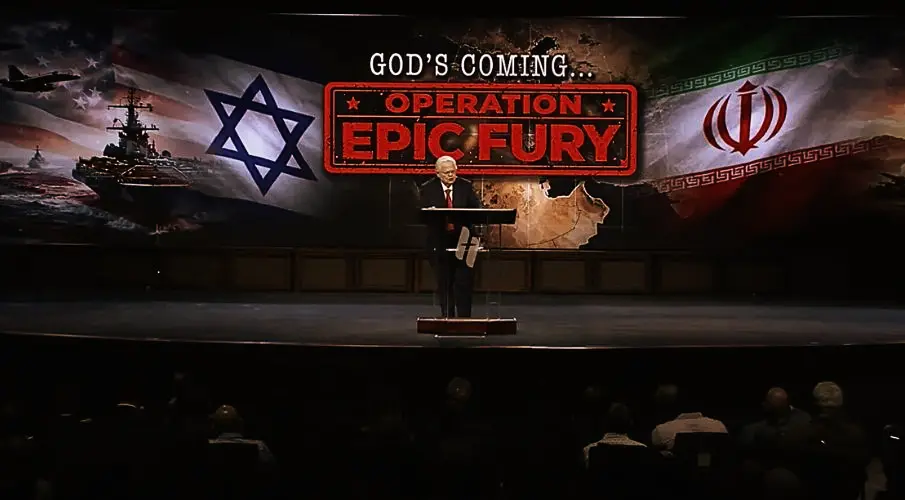
Televangelist John Hagee, chairman of Christians United for Israel, preaches in his Cornerstone Church in San Antonio in front of a banner reading “God Is Coming… Operation Epic Fury.” He thanks Trump for crushing the enemies of Zion and declares that the attack on Iran will trigger biblically prophesied events - the invasion of Israel by a Russian led army and the defeat of the Antichrist in the battle of Armageddon.
The nonprofit organization Military Religious Freedom Foundation reports on March 3 that it is being inundated with complaints. More than 200 calls from over 50 military bases, all with the same content: Commanders are telling their soldiers that the Iran war is part of God’s divine plan to initiate the return of Jesus Christ. One is said to have declared that Trump was anointed by Jesus to ignite the signal fire in Iran and trigger Armageddon. Marco Rubio, Secretary of State, says about Iran: “The entire regime is led by radical clerics who do not make geopolitical decisions. They make decisions based on their theology, an apocalyptic one that must be taken very seriously.” The sentence is correct. It also describes what is currently happening on the other side of the ocean. Rubio does not seem to notice. Or he notices and says it anyway.


The U.S. Department of Homeland Security issued an internal “Critical Incident Note” on March 2, 2026, warning of potential security related consequences of recent developments connected to the Iran war. The document, marked “unclassified / for official use only,” summarizes preliminary findings and emphasizes that it does not constitute a final assessment.
At the center are two fatwas published on March 1 by senior Iranian clerics. They call on Muslims worldwide to avenge the death of Iranian Supreme Leader Ali Khamenei. One of the religious declarations describes revenge as a religious duty of all Muslims, another labels the United States and Israel the “most malicious enemies of humanity.” Previously, Iranian clerics had already issued fatwas during the 12 day war in 2025 against the U.S. president and the Israeli prime minister.
The DHS also refers to a shooting on March 1 in Austin, Texas, in which a naturalized U.S. citizen killed two people and injured 14 others before being shot by police. According to the agency, indications from the attacker’s clothing and vehicle suggested a possible extremist background, but a clear motive has not yet been confirmed.
In an analytical assessment, the department warns that the fatwas, the rhetoric of the Iranian government, and online messages from regime loyal actors could increase the risk of violent acts by supporters of the Iranian regime. As an example, it cites a statement by the Revolutionary Guards declaring that “the enemy” will henceforth be “nowhere in the world safe.” Although fatwas have rarely led directly to attacks in the United States in the past, the document references the 2022 stabbing attack on Salman Rushdie, which was traced back to an earlier fatwa.
In February 1989, Ayatollah Khomeini issued a fatwa against writer Salman Rushdie over his book “The Satanic Verses.” Iran subsequently severed diplomatic relations with the United Kingdom. In August 1996, Osama Bin Laden issued his first fatwa, more than 11,500 words long, declaring holy war against American forces on the Arabian Peninsula. Shortly thereafter he was interviewed and asked why there had been no attacks after the declaration. His answer: “If we wanted to carry out small operations, that would have been easy. But the nature of the struggle requires qualitative operations that strike the enemy - and that obviously requires good preparation.” Two years later, in February 1998, the second fatwa followed. This time the call was to kill Americans everywhere in the world. It inspired a new generation. Three years later it was September 11.
Two sides are now invoking the name of God. Both are convinced they stand on the right one. Both describe the other as an apocalyptic threat. Both are preparing. What Bin Laden said back then about preparation was not an empty threat. It was an announcement. The current fatwas sound similar. And the response to them, in parts of the American leadership, does not sound like geopolitics. It sounds like the same book, just a different edition.
This is not an analysis. It is an observation. And it is heavy enough.
Updates – Kaizen News Brief
All current curated daily updates can be found in the Kaizen News Brief.
To the Kaizen News Brief In English


Da muß man sich schämen Christ zu sein. Ich sage nur noch das ich an Jesus glaube. Wo bleibt der Aufschrei der restlichen Welt. Und wo der Aufschrei der katholischen und evangelischen Kirche.
Unfassbar.