
The new Human Rights Watch report reads not like a warning, but like an accounting. What was considered secure for decades – human rights, democratic institutions, rule-of-law boundaries – is under pressure that no longer creeps, but strikes openly. The United States, Germany, large parts of the world: everywhere the same mechanism. Governments no longer treat fundamental rights as a foundation, but as an inconvenient obstacle. And the response to this determines whether democracy is more than a replaceable classification.

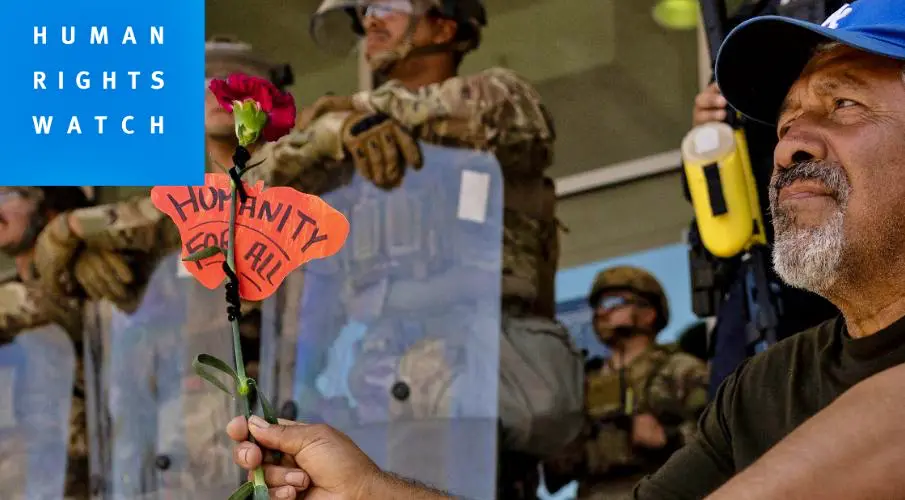
The United States under Donald Trump has damaged democratic standards in the first year of his second term in a breadth that is exceptional even in recent American history. Migration policy, health care, environmental and labor protections, rights of people with disabilities, equality, criminal justice, freedom of expression – nearly every area has been attacked. The report does not speak of misjudgments, but of a political program that aims to systematically destroy protective mechanisms. This is particularly brutal in the treatment of migration and protest. ICE operations, heavily armed, often masked agents, raids in schools and churches, places that previously were considered untouchable. Protests against this are not treated as a legitimate expression of democratic participation, but criminalized. The harshness is not collateral damage, but political intent. Fear is deliberately created and used to suppress resistance.
At the same time, political counterforces are failing. The erosion of democratic rights is not only the result of executive decisions, but also of silent tolerance by parts of Congress. Separation of powers is not spectacularly suspended, but gradually devalued. What remains are individual judges, individual states, individual institutions that still resist. But they are increasingly acting defensively. Nevertheless, American democracy is not dead. Not because of the government, but despite it. Millions of people have taken to the streets, at the No-Kings marches, at protests against the deployment of the National Guard, against ICE abuses. In Chicago, Minneapolis, Los Angeles, broad segments of society have opposed government enforcement. Students continue to organize, under massive pressure, despite police operations, visa revocations, repression. Democracy exists here not through institutions alone, but through active resistance. But this force is also under attack. Freedom of the press, independent courts, political opposition still function, but are increasingly targeted. How long they will hold remains open.
The United States is not alone. Human Rights Watch places it in a global context that is increasingly shaped by authoritarianism. Around three quarters of the world’s population now lives in states that are no longer considered democratic. Russia and China play a central role in this, not only through military aggression or economic pressure, but through the deliberate weakening of international human rights structures. But the United States also bears responsibility for this power vacuum. The withdrawal from a rules-based international order has given authoritarian regimes additional room for maneuver. Against this background, Human Rights Watch calls for a reorganization of international responsibility. Democratic states of medium size must cooperate more closely, form long-term alliances, and combine their political and economic power. Named are the European Union, but also South Africa, Brazil, Japan, South Korea, Australia, the United Kingdom. The goal is not symbolic politics, but concrete counterpower against authoritarian pressure, economic coercion, and the destruction of international rules.
How fragile state order has become even in democratic systems is shown by Minnesota as an example. After weeks of tensions, protests, and fatal shootings, the federal government is withdrawing around 700 officers – about one quarter of the deployed forces. Two U.S. citizens were killed during operations. Masked, heavily armed agents carried out raids, blocked streets, and spread fear across entire neighborhoods. But the withdrawal does not mark a change of course. Around 2,000 officers remain deployed. The operation is not ending, it is merely being adjusted. The withdrawal is not based on reflection, but after increased cooperation by local authorities. The mass deportation strategy remains in place. Protests continue to be treated as disruption, not as democratic correction.
Even within the Republican Party, isolated resistance is emerging. A senator from Mississippi openly opposes the construction of a massive deportation center with more than 8,500 places. Not for human rights reasons, but because of economic consequences and missing infrastructure. This is also part of reality: even where resistance emerges, it often follows pragmatic limits, not moral ones. At the same time, school districts and teachers’ unions are going to court to stop ICE operations at schools. They report disrupted classes, frightened children, families avoiding schools. Government violence has already reached areas that were previously considered untouchable.
Germany in Reverse
Germany appears in the current human rights report not as an exception, but as part of the same troubling trend. After an election campaign in which right-wing rhetoric increasingly became socially acceptable, especially against minorities and migrants, the political climate has noticeably shifted. The federal election in February 2025 brought massive gains for the AfD and led to a coalition between CDU/CSU and SPD. What followed was not a break, but an acceleration of developments already underway. The report draws the picture of a state that does not abruptly abandon its rule-of-law safeguards, but systematically narrows them. Freedom of expression, freedom of assembly, and civil society space are particularly affected. Authorities increasingly acted against protests, especially demonstrations in solidarity with Palestine. International observers expressed serious concern about blanket restrictions on assemblies, about harsh police operations in Berlin, and about interference in academic freedom. Criticism of Israel’s conduct in Gaza was often broadly classified as antisemitic, with noticeable consequences for art, culture, and science.
That this line is legally unsustainable became evident in May when a court stopped a deportation attempt against four foreign students. They had been accused of spreading antisemitic hate during a university occupation. The judiciary set clear limits on the actions of the Berlin migration authority. Such correctives still exist, but they are increasingly defensive. At the same time, the handling of climate activism intensified. The criminalization of peaceful forms of protest was further advanced. In March, the Munich public prosecutor again filed charges against members of the group Last Generation and classified them as a criminal organization. The report assesses this as a dangerous shift in which political protest is increasingly placed under criminal law.
Civil society also came into the political crosshairs. Immediately after the election, CDU and CSU submitted a massive parliamentary inquiry into 14 civil society organizations. Financing and alleged political neutrality were questioned. The affected groups had previously protested against right-wing extremism and criticized the rapprochement of the Union with the AfD. The organizations saw this as an attempt at intimidation. The government rejected this, but the incident marks a clear boundary shift in the handling of civic engagement.
Freedom of the press also did not remain untouched. In 2024, nearly 90 attacks on journalists and media outlets were recorded, more than twice as many as in the previous year. This is not a marginal phenomenon, but an expression of a rougher political climate in which reporting is increasingly perceived as a threat. In the area of discrimination, the report describes a clear breach. The decision by CDU/CSU to push through stricter migration policy in parliament with votes from the AfD broke a long-standing taboo. The chancellor himself contributed to further escalation by publicly linking migration to declining security, especially for women. Political opponents accused him of racist rhetoric. Shortly afterward, the domestic intelligence service officially classified the AfD as right-wing extremist, citing racist statements, ethnic-nationalist ideology, and anti-constitutional positions. The party is fighting this legally, but the numbers speak clearly.
Politically motivated hate crime reached a historic high in 2024. Nearly half of the more than 84,000 recorded offenses were attributed to the far-right spectrum. Anti-Muslim crimes increased significantly, as did antisemitic offenses. Civil society surveys suggest that the actual numbers are even higher than the official statistics. At the same time, fatal police shootings of a young Black man triggered a renewed debate about structural racism within law enforcement agencies. Calls for transparent accountability grew louder but largely remained without political consequences.
The assessment of migration and asylum policy is particularly drastic. The new government further tightened the course: restricted access to asylum, suspension of family reunification for subsidiary protection beneficiaries, tightened border controls despite judicial concerns, simplified classification of so-called safe countries of origin without parliamentary control. Humanitarian admission programs, for example for Afghan women and men, were effectively ended. Even refugees from Ukraine were partially removed from existing protection regulations and referred to a lower level of benefits.
Setbacks are also recorded in the area of gender diversity and sexual orientation. Hate crimes increased significantly. At the same time, the Interior Ministry planned a register for trans, inter, and non-binary people, which human rights organizations consider unnecessary and dangerous. Symbolically, the break with previous traditions was also evident when parliament no longer displayed the rainbow flag during Pride weeks and members of parliament were asked to remove corresponding symbols. The social situation remains tense. Nearly one in five people in Germany lives at the threshold of poverty or social exclusion. Particularly affected are people living alone, older women, and people with low incomes. At the same time, the government is planning cuts to basic social security and a restructuring of social security systems that effectively makes access more difficult.
Economically, the protection of human rights is also moving into the background. The government is pushing forward changes to the supply chain law that would reduce reporting obligations and weaken sanctions. Protection against exploitation along global supply chains therefore risks being further weakened. In foreign policy, the report describes a clear change of course. Human rights hardly play a role in official speeches anymore. Security, migration, and economic interests dominate. Germany assumes a leading role in supporting Ukraine and supports for the first time the seizure of frozen Russian assets, but at the same time shows a contradictory line in dealing with Israel’s war in Gaza. After massive pressure from civil society, arms deliveries were briefly restricted, but later resumed. The government thereby risked not only political credibility, but also legal responsibility. Additionally, Germany played a major role in weakening European rules on corporate due diligence. An instrument that had only recently been created to curb human rights violations by companies was politically weakened.
What Remains
The report leaves no doubt: Germany remains a rule-of-law state, but one under pressure. The development does not follow coincidence, but political decisions. The space for criticism, protest, and protection of minorities is becoming narrower. Human rights are not a stable condition. They exist only where they are defended – against governments, against political convenience, and against an international order that is increasingly willing to confuse looking away with stability.
In the United States as in Germany, their survival is not decided at conference tables, but in the resistance of those who do not want to get used to injustice becoming normality. The question is not whether democracy still exists. The question is how long democratic substance can endure when order is increasingly placed above rights – and human rights are more administered, neglected than defended.
Updates – Kaizen News Brief
All current curated daily updates can be found in the Kaizen News Brief.
To the Kaizen News Brief In English


Der Bericht ist erschrdckend, aber nicht überraschend.
Die USA haben den Boden der Rechtstaatlichkeit bereits verlassen.
Derzeit sehe ich da keinen Weg zurück.
Ohne den Umsturz von innen, mit der Hilfe von Demokraten und paar aufgewachten Republikanern wird das nichts.
Walz ist eingeknickt, seine Behörden kooperieren nun vermehrt mit ICE.
Etwas, was er ausgeschlossen hatte.
So gewinnt man kein Vertrauen und ändert nichts zum Positiven.
Deutschland ist nur ein paar Schritte hinter den USA.
Die Pressefreiheit ist ein hohes Gut.
Ebenso das Recht auf friedliche Demonstrationen.
Das macht eine Demokratie aus.
Für mich persönlich beeinhaltet das aber nicht das Festkleben auf Strassen (Nötigung sehr vieler anderer Menschen, die nicht oder sehr unpünktlich zur Arbeit oder wichtigen Terminen kamen. Starke Behinderung von Ersthelfern), stürmen von sicherheitsrelevanten Flughafenbereichen, Sachbeschädigung an Kunstwerken oder Privateigentum, Hassreden gegen „Andere“.
Ein Register für Trans-, inter, non binary Personen?
Was soll denn das?
Diese Personen gehören in kein Register.
Da interessiert mich die Begründung.
Register heißt immer auch, schneller Zugriff auf eine bestimmte Gruppe Menschen.
Da kommt mir gleich das 3. Reich in den Sinn.
In der Ukraine tobt seit Jahren ein grausamer Krieg.
Wie kann man Menschen dann den Schutz nicht gewähren?
Wir werden, da Putin bekommt was er will, eine riesige Flüchtlingswelle erleben, wie es sie nach dem 2. Weltkrieg nicht gab.
Danke, dass Ihr trotz aller Widrigkeiten und Bedrohung Eurer Sicherheit weiter macht.
Guter Text…so sehe ich die Situation auch
👍
…vielen dank, ich denke, das human Rights watch das sehr gut auf den Punkt gebracht hat …
…du, man muss dagegenhalten, wegschauen war noch nie mein/unser ding