
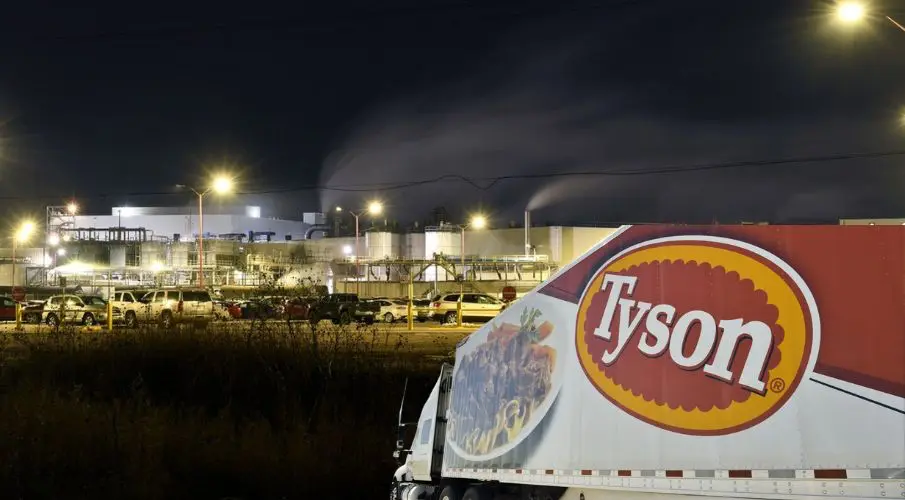
The cold hanging over Lexington, Nebraska, this winter does not come from the weather. It comes from the certainty that on January 20, 2026, something will end that carried this town for decades. Tyson Foods’ beef plant is closing. 3,200 people are losing their jobs. In a town of around 11,000 residents, this is not an ordinary reduction in staff, but a rupture that reaches everything: families, schools, small businesses, churches, the future.
About the history of Tyson Foods
Tyson Foods was founded in 1935 by John W. Tyson in the U.S. state of Arkansas. The company began as a small regional operation transporting poultry and gradually grew after the Second World War into a major processor of chicken meat. In the decades that followed, Tyson expanded strongly through acquisitions and built up its business in beef and pork. A decisive boost came with the acquisition of IBP in 2001, at the time the largest beef processor in the United States, which made Tyson the country’s largest meat producer. Today, Tyson Foods is one of the world’s largest food companies, supplying supermarkets, the hospitality sector, and large buyers, and employing hundreds of thousands of people, primarily in the United States.
At the Lexington site in the state of Nebraska, this history ends on January 20, 2026: On that day, Tyson Foods will permanently close the beef plant there after more than three decades.
After Mass at St. Ann’s Church, people sit on folding chairs in the parish hall. You can see the tension on their faces before anyone speaks. Alejandra Gutierrez says what many feel. Suddenly the work is gone, and with it life begins to contract. She is one of the plant’s employees, and for thousands of families it meant security. Homes were bought, children raised, plans for college made. Now bills are looming for which there will soon be no income. Shortly before Thanksgiving, Gutierrez visited a college campus with her daughter. There she learned about the closure. Her daughter said she no longer wanted to study. Where would the money come from.
The consequences reach far beyond the factory gates. Economists estimate that up to 7,000 jobs could be lost in total, in Lexington and the surrounding counties. Restaurants, hair salons, grocery stores, gas stations - they all live off the plant’s shifts. Tyson employees alone lose around 241 million dollars a year in wages and benefits. For a small town, this is a shock usually seen only in old industrial regions.

Tyson justifies the closure with a shrinking cattle herd in the United States and heavy losses in the beef business. That sounds like market logic and corporate accounting. In reality, this situation is also politically driven. Agricultural and trade policy under Donald Trump relied on tariffs, trade conflicts, and short term effects instead of stable framework conditions. Export markets became uncertain, costs rose, long term planning became more difficult. For corporations, this may be a calculation. For Lexington, it is a break in everyday life. See our investigative report from October 21, 2025: “How Trump turns America’s cattle ranchers against him – An investigative and disturbing report”

Here, the plant was more than an employer. It was the reason people came and stayed. The reason a town in the heart of the Great Plains grew, became diverse, alive. Lexington lies almost exactly in the middle of the United States, easy to miss from Interstate 80. But the plant was impossible to miss. Clouds of steam, shift changes, a rhythm that set the day. Those who came here found work. Many came from California, from Mexico, from Africa, from Central America. At first they spoke little English, often had no school diploma, and yet they built a life.

Convicted Democrat and voter: Lizeth Yanes
Lizeth Yanes was one of them. At first she called Lexington a ghost town. Later it became home. Now she has to leave, just now, she says, when she truly loves this place. Inside the plant, the mood feels like a funeral. Up to 5,000 cattle a day are processed there, and yet everything is marked by farewell. Arab Adan, an immigrant from Kenya, sits in the car with his sons and does not know which state they will move to next. The children are supposed to finish the school year here. After that, everything is open. Nearly half of the students in Lexington have a parent who works at Tyson. The schools are proud of their graduation rates, their diversity, their large marching band. When families leave, seats remain empty. Fewer children mean fewer teaching positions, fewer programs, less stability. What is being lost here cannot be replaced quickly.

After Mass, the congregation collects money for families in need, even though they themselves will soon be without work. Francisco Antonio says it is not only about the job. It is about home. If there is no new work here, Lexington will disappear. In the city’s restaurants, Tyson workers still sit together, filling tables, laughing quietly. Armando Martinez, owner of a Mexican restaurant near the plant, has known the faces for years. His grandson once said he wanted to work at Tyson when he grew up. Now children at school talk about where their families will move. Many cry.

Martinez knows his restaurant will have to close if customers stay away. He is ill, needs dialysis, has an amputated leg. Leaving is hardly possible for him. He hopes Tyson will change its mind. He knows it is unlikely. The city hopes the plant will be sold, that someone new will come. But that takes time, if it happens at all. Renovations, negotiations, uncertainty. No one can guarantee that thousands of jobs will be created again.

Maria Dolores Perez, left, and her husband Armando Martinez, right, are devastated
At the fairgrounds, state agencies advise people. Retraining, job applications, unemployment benefits. Faces are serious, like after a bad diagnosis. Many of the older workers speak little English, are not familiar with computers. They have worked here their entire lives. Now they are supposed to start over. “They only want young people now,” says one man who has worked at the plant for 25 years. Others have saved a little, some are considering returning to Mexico temporarily. Hardly anyone has a clear plan.

State agencies advise people on retraining, applications, unemployment benefits
In the end, a simple truth remains. Lexington was a place where the American promise became tangible for many: work, security, advancement. With the closure of the plant, this promise is at stake, in homes, schools, families. When a plant closes, not only a production line ends. A life built over decades comes to an end - and the price is not paid in balance sheets, but by an entire city. And the reason for it is called: Donald Trump.
Updates – Kaizen News Brief
All current curated daily updates can be found in the Kaizen News Brief.
To the Kaizen News Brief In English


Es ist eschütternd wie ein ungesunder Mann ein ganzes Land wirtschaftlich vernichten kann, seine Heimat!
schockierend, es ist einfach schockierend
Es ist natürlich immer schlecht, wenn eine Region nur von einem Arbeitgeber lebt, ist er weg, egal warum, dann stirbt der Ort.
Man bekommt ja kaum was mit hier in D, was so alles, vorallem eher im kleinem, übers Land verstreut, alles durch Trump kaputt geht. Aber das viele Kleine, wird halt wohl immer schneller zu etwas großem und wird das Land und die Menschen kaputt machen. Da werden dann auch keine neuen, riesigen Kriegsschiffe was nutzen.
Es wird der Tag kommen, da wird man auf Trump und seine Bagage spucken.