
Tehran - In Tehran, heavy attacks took place again today that no longer have anything to do with a limited military exchange. Air defense could be heard in several parts of the capital, and in some districts the power went out. The United Nations warns of a global shock to food supply and development. The OECD expects significantly higher inflation. Spain is intervening with billions to cushion the impact on consumers. Israel is expanding its war in Lebanon. France is consulting with 35 states on a future military safeguarding of shipping through the Strait of Hormuz. In Washington, the US government continues to speak of success and options, even though key objectives have not been achieved and the economic damage is already spreading.

Today’s attacks on Tehran are difficult to explain militarily and are hitting civil society. We will continue to document the attacks, and after a day full of fire this is not yet possible. One is glad to have electricity and some internet.
The warning from Máximo Torero, the chief economist of the United Nations Food and Agriculture Organization, was particularly clear. If the war ends within the next two weeks, the markets could still absorb the shock, he said. But if it lasts three to six months, it will not only affect energy and food, but also many other sectors, because prices overall would rise. In addition, there would be a decline in remittances from abroad, which in many countries are an important support for families and entire economies. That would weigh on growth and development worldwide. Torero added that an El Niño is also emerging. If it turns out strong, the economic situation could worsen again significantly. His message was clear: this war must end as quickly as possible. Otherwise, the consequences could become even more dramatic than after the start of the war in Ukraine.
The OECD also paints a picture that leaves little room for reassurance. For the United States, average inflation is now expected to reach 4.2 percent this year, after about 2.6 percent in 2025. This jump is driven primarily by sharply rising energy prices. But the chain does not end there. Fertilizer deliveries have also been disrupted, which could increase food prices in the coming months. At the same time, growth in the United States is expected to decline from 2.1 percent to 2 percent and fall further to 1.7 percent next year. In the G20 countries, inflation is expected to rise from 3.4 to 4 percent. This shows how directly this war translates into everyday costs. It does not only hit refineries, tankers and ports, but households, food prices and investment.
Spain is already reacting to this impact. Although the country generates more than half of its electricity from renewable sources, the government assumes that the shortage of oil and natural gas from the Middle East will still hit consumers hard. Parliament has therefore passed an emergency package. The value added tax on gas and electricity bills will be reduced from 21 to 10 percent. According to the government, drivers are to save around 30 cents per euro per liter, which corresponds to about 20 euros per tank. Truck drivers, farmers, livestock producers and fishermen can be reimbursed 20 cents per liter of diesel. This also applies to fertilizers. In addition, prices for butane and propane are being frozen. In total, the package amounts to 5 billion euros and is intended to benefit 20 million people. These steps alone show how far the economic shock wave of this war has already reached.
On the military front in Lebanon, the situation has also intensified significantly. Israel has moved another division, the 162nd Division, into the south of the country and expanded its ground offensive against Hezbollah. Previously, Defense Minister Israel Katz had stated that Israel wanted to expand its control area to the Litani River and create a security zone there. He openly drew parallels to Gaza, where entire areas have been depopulated. Israel describes this as a defensive measure to protect northern border regions. The consequences on the Lebanese side are already massive. According to Lebanese figures, more than one million people have been displaced and over 1,000 killed. On Thursday, the Ministry of Health in Beirut reported that in the past 24 hours another 22 people were killed and 110 injured. Among those killed so far are 121 children and 83 women.
The fear of a new, long lasting occupation is therefore growing with each passing day. Elias Konsol, who had to flee together with neighbors from the Christian border town of Alma al-Shaab, said openly that no one knows what will become of their homes and the village. There are neither weapons nor Hezbollah fighters there, and yet the place had to be evacuated. Mohanad Hage Ali of the Carnegie Middle East Center in Beirut now describes the first border line as a no man’s land, essentially a large empty area without movement. Further north, restrictions are also severe. Even during last year’s olive harvest, farmers could only reach their groves under escort by the Lebanese army and UN peacekeepers, who coordinated with Israel. Sarit Zehavi, a former Israeli officer and head of the Alma Institute, assumes that Israel could establish an even larger control area. She also acknowledges that Israel will likely not be able to defeat Hezbollah and risks being tied down militarily in southern Lebanon for the long term. Her justification for this logic is brutally simple. The alternative is the risk of being slaughtered.
This escalation is already having domestic political consequences in Lebanon. A senior Hezbollah official, Mahmoud Qamati, condemned on Thursday the decision of the Lebanese government to expel the Iranian ambassador. At a rally next to the Iranian embassy in the southern suburbs of Beirut, he said Ambassador Mohammad Reza Sheibani would remain in Lebanon no matter how much the government tried to change that. Foreign Minister Youssef Rajji, a sharp opponent of Hezbollah, was directly attacked by Qamati. His threat was unmistakable. One should not play with fire, because in the end that fire would burn those who had ignited it. This also shows how hardened the fronts in Lebanon have become.
On Israeli territory itself, the shelling continues. In Nahariya, a man in his thirties was killed by shrapnel from a projectile fired from Lebanon. Another man in his fifties was seriously to moderately injured, and three others were lightly injured. At the same time, sirens sounded again in central Israel and in Jerusalem after a reported rocket launch from Iran. The war is therefore not only spreading geographically, it remains highly dangerous and deadly on the immediate front lines.
While Lebanon is being drawn ever deeper into the war, the Strait of Hormuz remains the economic pressure point. France announced that 35 states have participated in talks among chiefs of staff about a future reopening of shipping. The considerations aim at a strictly defensive mission that would escort commercial vessels and restore freedom of navigation once the intensity of fighting has sufficiently decreased. This condition alone shows how far away that currently is. The discussion is not about free passage, but about a later state after a phase of extreme violence.
In Washington, reality and political staging are increasingly colliding. Donald Trump stated at his cabinet meeting that the United States does not really need the Strait of Hormuz because the country has so much of its own oil and is not affected. That is misleading. The United States may be less directly dependent on imports through Hormuz than many Asian countries. But oil prices are set on the global market. If Hormuz is blocked or threatened, prices rise worldwide. That has already happened. The average gasoline price in the United States is more than one dollar higher than a month ago, according to government figures. Scott Bessent, the US Treasury Secretary, also tried to downplay the importance of the strait. Iran is trying to control the global economy through a bottleneck that does not actually exist, he said. That also did not match reality. The Strait of Hormuz remains a central route for oil and gas supplies, especially for Asia. The fact that Bessent also assured that more and more tankers are passing does not change that.
Trump himself added to the confusion. As recently as Monday, he had threatened Iran with attacks on power plants if the strait was not fully opened. On Thursday, when asked, he would not even say whether his five day deadline still applied. “I don’t know,” he said. It would depend on whether his team told him that talks were going well. Then came his typical line, that in “Trump time” a day is an eternity. At the same time, he said Iran was allowing some oil tankers to pass as a sign of goodwill. He spoke of eight “boats with oil” that would be allowed to sail under Pakistani flags. Shortly afterward, this statement was also officially circulated as an important signal for possible talks.
At the same time, Steve Witkoff confirmed for the first time that the US government had transmitted a 15 point plan to Iran via Pakistan. He spoke of a possible framework for a deal and said there were indications that Iran could be convinced it had no other option. Trump had instructed him to keep the negotiations confidential. Almost simultaneously, Jared Kushner said at an investor meeting in Florida that public statements by Iranian representatives should largely be ignored, because they are often aimed primarily at domestic audiences and do not reflect what is said behind closed doors. Taken together, this creates a politically sensitive picture. Publicly, maximum toughness is displayed, while in the background channels, messages and exchanges are already underway.
The cabinet meeting at the White House was notable in itself. It lasted one hour and forty minutes and focused almost entirely on the war against Iran. This time, Trump did not let every cabinet member speak, but only a small circle: himself, J.D. Vance, Marco Rubio, Pete Hegseth, Scott Bessent, Energy Secretary Chris Wright and Interior Secretary Doug Burgum. Nevertheless, Trump also drifted into side topics, talking about his writing instruments, a construction project at the Federal Reserve he considered too expensive, and legal proceedings related to his plans around the Kennedy Center. The war was the main topic, but even in this situation, the staging never fully disappeared.
In substance, the US government continued to rely on triumphant language. J.D. Vance claimed that Iran’s conventional military had effectively been destroyed. Iran no longer had a navy and could no longer strike the United States as it had just weeks ago. This now gave Washington “options.” What those options actually are, he did not say. Pete Hegseth called the war material for the history books and for Trump’s legacy. He claimed that never before in history had a country’s military been neutralized so quickly and so effectively. At the same time, he said this was different from Iraq, not a stalemate, not chaos, but pure American success. Marco Rubio spoke in similarly aggressive terms and said the war department was now essentially striking every part of Iran with military capability. All of these statements sound like confidence in victory. At the same time, Hormuz is not secured, attacks on Israel and US targets have not disappeared, and the war continues to expand.
Thank you Mr. Steinmeier - respect

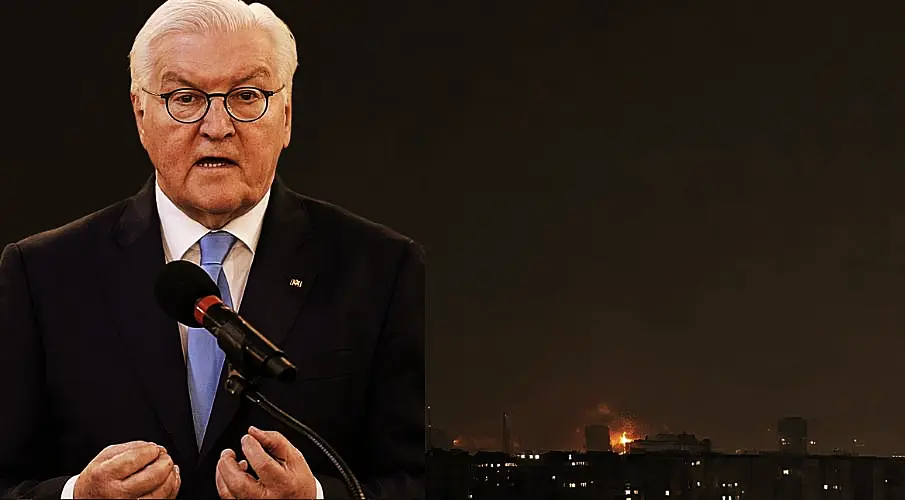
The conflict also remained an issue on the German side. Trump called the criticism by Federal President Frank Walter Steinmeier inappropriate after he described the US approach against Iran as a dangerous mistake and a violation of international law. Trump deflected, referred to Ukraine and again said that if he could resolve the war there, it would be a great honor. He only wished it had happened faster. This also fits a president who wants to present toughness, greatness and openness to deals at the same time, without resolving the contradictions of these positions.
Ali Bahreini, Iran’s representative to UN institutions in Geneva, at the same time stated that Iran is prepared for any scenario. An invasion by the United States or Israel would be a major mistake. He claimed that Iran is in the process of winning the war and has already pushed back the original goals of its opponents. The opponent is now only trying to keep the Strait of Hormuz open. Bahreini also said that Ayatollah Mojtaba Khamenei is safe and is leading the country. The fact that he has not been seen or heard publicly since his appointment as successor to his killed father was explained by Bahreini as necessary security measures.
How deeply this war has already seeped into everyday life is shown by the account of a young designer from Tehran. Her fashion business is on the verge of collapse because of internet restrictions. Sales have almost completely stopped. A nearby explosion damaged her apartment in the city center. She now lives with her parents because she feels safer there. She rarely leaves the house, except to buy essentials. Checkpoints remain in place, and at night there are rallies by regime supporters in the city. Her sentence about the past months is a look into the reality of this country: they have now experienced everything bad, from the brutal atmosphere in January with killings and arrests to the war. This continuity matters. Iran is not being bombed in a stable phase. The war is hitting a society already marked by violence, repression, economic crisis and isolation.
And then the fake news as well

An image is currently circulating, supposedly from Tehran, supposedly showing the war. It is real - but it comes from the Turkey Syria earthquake of 2023. Not a war image, not Tehran, not 2026. What drives people to amplify real suffering with false images is a question without a satisfying answer. Only one observation remains: it happens every day, and most people keep scrolling.
An environmental devastation is also building that will extend far beyond the duration of the fighting. Experts warn of a mixture of chemicals, heavy metals and other pollutants that could burden agriculture, drinking water and health for many years. Burning oil and gas fields, damaged depots, sunken ships, shattered infrastructure and debris in the Persian Gulf are releasing substances that cannot simply be removed with a ceasefire. Kaveh Madani of the UN University Institute for Water, Environment and Health said that for someone who has worked on sustainability and environmental protection in this region, this is like a setback of many years. Doug Weir of the Conflict and Environment Observatory stated that the full extent cannot yet be assessed because the war is ongoing and many areas are inaccessible. But this very uncertainty does not make the situation smaller, it makes it more dangerous.

At the same time, the war in Ukraine is being pushed further out of focus by Iran. Russia is taking advantage of this. This week, Moscow launched nearly 1,000 drones and 34 missiles at Ukraine. A day later, Kyiv responded with nearly 400 drones against Russian regions and Crimea. Meanwhile, Volodymyr Zelenskyy travels unexpectedly to Saudi Arabia, just days after he made public that Ukraine is supporting five countries in the Middle East in defending against drone attacks - Saudi Arabia, the United Arab Emirates, Qatar, Kuwait and Jordan. This is one of the most bitter lines of this war. A country that has spent years learning to live with drones, missiles and airstrikes is now becoming a trainer for other states in the same situation.
Economically, the markets have long given their answer. Brent rose on Thursday to 100.93 dollars per barrel, US oil to 93.05 dollars. Stock markets fluctuated. The S&P 500 fell by 0.4 percent, the Nasdaq by 0.6 percent, the Dow remained almost unchanged. Energy companies are benefiting, other sectors are coming under pressure because higher energy costs could slow demand for steel, industrial products and consumer goods. Trump said they are considering steps against rising gasoline prices, but for now do not want to suspend the federal gasoline tax. That option is something they have in reserve. Instead, he suggested that states should lower their own taxes. For Friday, he also announced measures to support American farmers, as fertilizer costs are rising during planting season.
Beyond the immediate participants in the war, rhetoric is also shifting. Houthi leader Abdul Malik al Houthi renewed his support for Iran in Yemen and called for solidarity protests. He spoke of an unjustified war by the United States and Israel and said that if developments required a military response, they would react. In Uganda, General Muhoozi Kainerugaba even threatened on social media that his country would enter the war on Israel’s side if asked. Such statements do not equate to immediate military involvement. But they show how far this war is already spreading into political spaces that initially seemed distant.
What remains at the end of this day is an overall picture that is more serious than many of the daily headlines. The war against Iran is not just an air war. It is not just a conflict over missiles, nuclear facilities or a waterway. It drives inflation, threatens food security, burdens poorer countries through remittances, turns power grids and cities into targets, pushes millions of people in Lebanon into uncertainty, forces governments in Europe into crisis measures, pollutes air, water and soil, and diverts attention and resources from other wars. The front lines are no longer only on maps. They now run through markets, fields, ports, homes, gas stations and refrigerators. That is the real scale of this escalation. Not in the victory rhetoric from Washington, but in the damage that already extends far beyond the battlefield.
At the end, what remains is what remains - Trump keeps writing and writing …

Trump threatened, then hesitated, then postponed the deadline to April 6 - because talks are supposedly going well. On Monday it sounded like war, on Thursday like patience. Iran had made it unmistakably clear that attacks on its energy infrastructure would hit the entire region - including desalination plants. What is being sold here as diplomacy is in reality what it has been all along: no plan, only pressure - and the hope that something will work.
Note: We ourselves are currently dealing with massive internet and power outages - which means there may be delays in reporting. We report whenever we can.
Updates – Kaizen News Brief
All current curated daily updates can be found in the Kaizen News Brief.
To the Kaizen News Brief In English


