
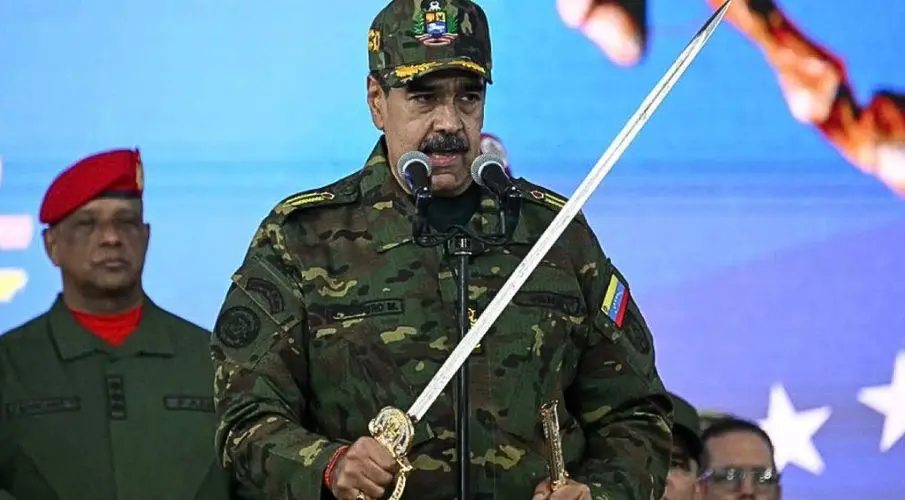
Venezuela seems in these weeks like a country that has already begun to prepare internally for an emergency. Behind closed doors, far from public press conferences, military officials and government advisers have drawn up two scenarios that are to be activated only in one case: if the United States launches military action. The plans are not officially confirmed, but they stem from documents and statements that have resurfaced over several years - and for that reason alone they are worth taking seriously.
Research shows that the first plan is as old as the history of asymmetric wars: the distribution of the armed forces into countless smaller units that sit in prepared positions scattered across the country. More than 280 such points are said to exist. From there, sabotage operations, ambushes and guerrilla-style attacks would be possible - not as a conventional war, but as an attempt to slow down a superior opponent. The political leadership knows it would hardly be able to withstand an open confrontation. That is why this part of the concept relies on attrition, surprise and the simple fact that a country like Venezuela is difficult to control when small, mobile groups are active everywhere.

The second plan carries a name within the government that leaves no doubt about its intent: anarchization. It refers to a scenario in which intelligence units and pro-government armed groups are activated to deliberately create chaos. The focal point would be Caracas, the capital, the political center. The goal would not be a military victory, but ungovernability. A country that is burning internally cannot easily be occupied or reorganized - that is precisely what this concept is built on. If the opponent cannot be stopped, he should at least be prevented from gaining control. That these plans are not publicly confirmed is no surprise. But the indications come from various directions: former officers, military reports, internal analyses that have surfaced repeatedly over the years. What is striking is how similar they are. And that is exactly what makes the situation volatile. When a country that has struggled for years with economic hardship, material shortages and emigration still works on such scenarios, it says a great deal about Maduro's fear of a possible attack - and about the confidence in its own ability to resist.
At the same time, many points remain unclear. The government avoids any confirmation. The exact number of positions, the operational capability of the units, the role of armed groups - all of this is based on sources that cannot be independently verified. Added to this is the condition of the army: outdated equipment, poorly paid soldiers, declining morale. Anyone who looks at the reality in the country quickly realizes that the success of such plans is unlikely. They seem more like the last moves of a system that knows how weak it has become but still relies on the idea of being able to defend itself.
And yet these considerations reveal a political constant. States that feel threatened do not only develop military responses, but scenarios designed to make the cost of an attack as high as possible - no matter how slim the chance of a conventional victory may be. Venezuela is playing for time. For uncertainty. For the fear of a conflict that could spiral out of control. Whether these plans will ever be activated is unknown. But their very existence - supported by repeated reports from credible sources - shows how tense the situation has become. A country that prepares so thoroughly for a state of exception no longer believes in political solutions. It prepares itself for the possibility that what seems unthinkable today could become reality tomorrow. And that is what makes the situation dangerous.
Investigative journalism requires courage – and your support.
Support our work against right-wing populism, disinformation, and violations of human and environmental rights. Every contribution goes directly into our daily reporting – we operate without advertising, without subscriptions, without corporations, without political parties. Our journalism is meant to remain freely accessible. For everyone.
Independent – Critical – For Everyone
Thank you for making our independent work possible.
Updates – Kaizen News Brief
All current curated daily updates can be found in the Kaizen News Brief.
To the Kaizen News Brief In English


Sehr interessante Recherche.
Ich verstehe, dass Venezuela sich nicht der Zangskolonialisierung der USA unterwerfen will.
Maduro ist ein Diktator, keine Frage.
Aber eine durch die jetzige US-Regierung gestützte neue venezulanische Regierung würde nichts für die Menschen vetbessetn.
Es ginge nur um den Schutz US-Deals. Kritik nicht gestattet, das Volk uninteressant.
Egal wie man es dreht, das Volk ist und bleibt der Verlierer in dieser ungleichen Auseinandersetzung
dankeschönm ja maduro gehört da natürlich weg, aber auf den wegen, wie es das gesetz vorsieht