
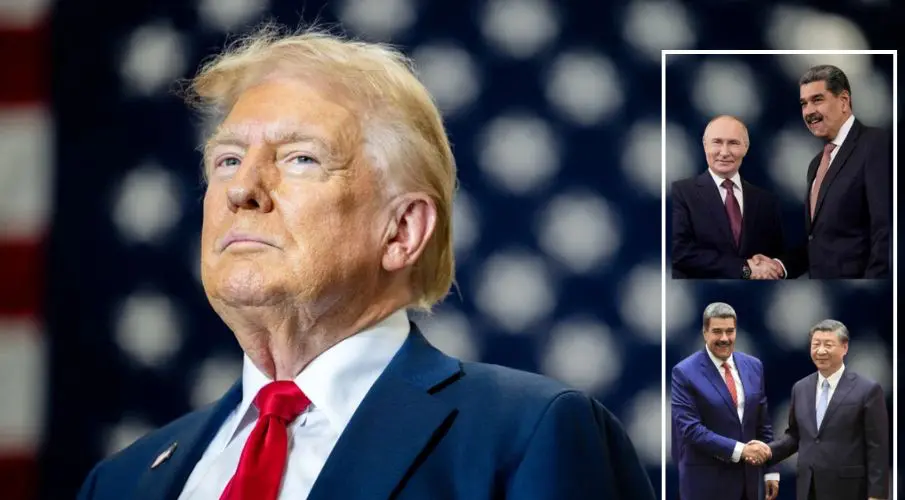
Donald Trump speaks as if Venezuela’s oil were already fully in American hands. But behind this demonstrative certainty lies a problem that cannot be solved by decree. A substantial portion of Venezuela’s oil reserves has for years been tied to China - through loans, supply contracts and strategic agreements concluded under previous governments. It is precisely these entanglements that now force Washington into a delicate balancing act. Over two decades, China has provided Venezuela with massive loans. Between 2000 and 2023, around 106 billion dollars flowed from Chinese state sources to Caracas, according to calculations by AidData. Repayment did not take place in the classic form of cash, but in oil. How much of this remains outstanding today, no one knows for sure. Estimates start at at least ten billion dollars, while others believe the true figure is significantly higher. For years, Venezuela has published no reliable debt data, and sanctions and delivery disruptions have further obscured the process.
Two Chinese state-owned corporations, China National Petroleum Corporation and Sinopec, have claims to around 4.4 billion barrels of Venezuelan oil reserves. No other foreign country holds larger formal access rights. At the same time, U.S. companies are also demanding compensation in the tens of billions for the nationalization of Venezuela’s oil industry. Who will ultimately be paid first and who will walk away empty-handed is completely unclear. The Trump administration has nevertheless drawn a clear line. This week, the United States seized two sanctioned oil tankers and openly declared that it intends to take control of Venezuelan oil exports in the future. Energy Secretary Chris Wright said the United States would organize the sale of the oil for an indefinite period. The proceeds are to be deposited in accounts controlled by the United States and later “benefit the Venezuelan people.” The initial phase is to involve 30 to 50 million barrels from existing stockpiles.
Internally, it is said that Washington wants to push back hostile influence in the Western Hemisphere. Above all, this means China. That the United States is focusing specifically on oil is no coincidence. In recent years, Beijing has demonstrated how effective economic leverage can be in the trade conflict - for example through restrictions on rare earths or targeted interventions in agricultural imports. Trump knows how sensitive such instruments are. At the same time, the White House is trying to prevent the conflict with Beijing from spiraling out of control. Trump plans to travel to China in April. The fragile truce in the trade dispute with President Xi Jinping is supposed to hold. Observers assume that Washington wants to avoid an open escalation in Venezuela so as not to jeopardize these talks. Behind the scenes, calculation prevails over bluster.
In Beijing itself, the arrest of Nicolás Maduro has stirred old memories. After the fall of Libyan leader Muammar al-Gaddafi in 2011, Chinese companies lost billions in investments there. In Venezuela, China’s engagement extends far beyond oil. Chinese firms are active in telecommunications, railway construction and port projects. All of this is now at stake. If a transitional government in Caracas were to declare contracts concluded under Maduro to be invalid, Chinese claims could also evaporate. Officially, Beijing reacted sharply. The Chinese government said it was “deeply shocked” by the use of force against a sovereign state and demanded the immediate release of Maduro and his wife. The Ministry of Commerce emphasized that no one had the right to interfere in economic cooperation between China and Venezuela. Regardless of political changes, China said it wanted to continue the cooperation.
Behind the rhetoric, however, the situation is more sober. Venezuelan oil accounts for only a small share of China’s imports. Beijing has diversified its energy supply and is investing heavily in electrification. The material damage would be limited. Politically, however, the loss of Venezuela is painful. It was the only country in Latin America with a strategic partnership at the highest level, comparable to close allies such as Pakistan. That status is now likely to end. Just hours before his arrest, Maduro had received a senior Chinese diplomat and invoked the shared history since Hugo Chávez. In hindsight, these images appear like a farewell. With Maduro’s fall, China’s influence in America’s backyard shrinks - an explicit goal of the Trump administration.
In the end, a contradictory picture remains. Trump is pursuing maximum control over Venezuela’s oil and using economic power as a geopolitical tool. At the same time, he must take into account a relationship with China that is already strained. Beijing can protest, warn and condemn. But if Washington increases the pressure, China’s options are limited. Venezuela’s oil thus becomes a test case for how far the United States is willing to go - and how much China can actually counter.
Updates – Kaizen News Brief
All current curated daily updates can be found in the Kaizen News Brief.
To the Kaizen News Brief In English


Alleine, wenn ich lese, das Geld landet auf von den „USA kontrollierten Konten“ ….
Das sagt alles.
Trump will nichts aufbauen oder modernisieren.
Er will Venezuelas Õl. Bis zum letzten Tropfen.
Das Volk interessiert ihn nicht. Nur als billige Arbeitskräfte in seinen Firmen.
Aber der Rest der Welt schaut zu. spricht von Sirge und Bestürzung und geht wieder zur Tagesordnung über.😟
Danke für diesen Bericht.
Die genauen Zusammenhänge waren mir so nicht bewusst.
Trump wir Xi freie Hand mit Taiwan lassen und China wird sich nicht mehr in Venezuela einmischen.
Und Trump kann es als Erfolg mit Macht und Stärke verkaufen.😟