
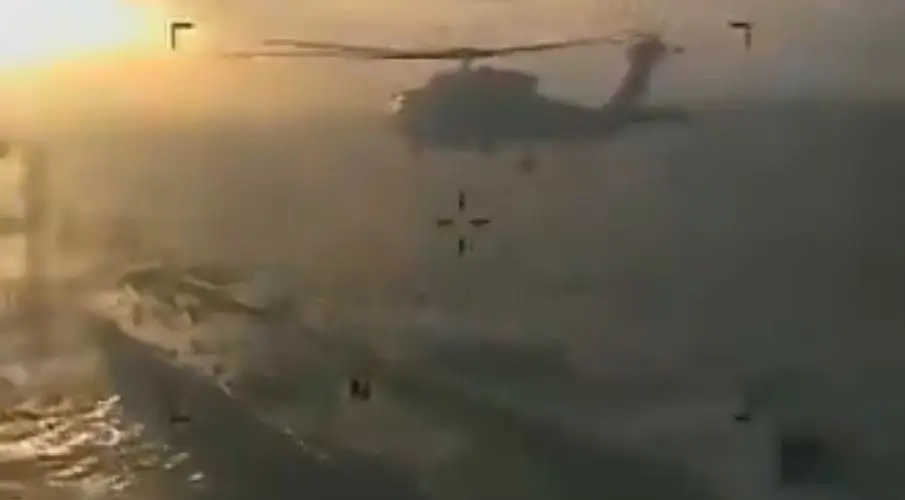
Trump likely enjoyed the images. Armed U.S. units, a helicopter hovering over an oil tanker, soldiers on the deck. The impression the Trump regime wants to project to the world, that of a lawful seizure, is false. At the time of the operation, the United States had neither a judicial mandate nor a sanctions-based legal foundation to detain the tanker. President Trump was not permitted under international law to order this intervention. What occurred was a militarily enforced boarding without a solid legal basis.
In fact, the U.S. Coast Guard boarded the tanker Centuries over the weekend while it was sailing under a Panamanian flag in international waters. The vessel was carrying Venezuelan crude oil and was en route to Asia. Homeland Security Secretary Kristi Noem publicly referred to a “detention.” What she did not say: There was no judicial seizure order for this operation. The tanker does not appear on the publicly maintained sanctions list of the U.S. Treasury Department. A connection to Iran, which was cited in the case of the first seized tanker earlier this month, has not been established.
This sets the decisive point. Boarding is not seizure. Entering a vessel is not a lawful confiscation. Terms like “apprehended” may sound politically forceful, but they do not replace a mandate. That U.S. authorities are now only after the boarding examining whether the tanker’s Panamanian registration is valid shows the direction of this operation. Law follows action, not the other way around.
Under the United Nations Convention on the Law of the Sea UNCLOS, a vessel on the high seas is generally subject to the exclusive jurisdiction of its flag state Article 92 UNCLOS. A foreign boarding is permitted only in exceptional cases, such as suspicion of piracy, slave trading, unauthorized broadcasting, or when there is a well-founded suspicion that the vessel has no valid nationality or is flying an improper flag Article 110 UNCLOS.
Selbst wenn ein Boarding zur Flaggen- oder Registrierungsprüfung zulässig ist, folgt daraus kein automatisches Recht zur Beschlagnahme oder dauerhaften Festsetzung eines Schiffes. Für eine Seizure braucht es eine eigenständige rechtliche Grundlage, völkerrechtlich wie national, etwa ein Mandat, die Zustimmung des Flaggenstaats oder eine gerichtliche Anordnung.
U.S. sanctions are implemented through the Treasury Department and OFAC. The decisive question is whether a vessel, owner, trader, or cargo is specifically listed or clearly falls within a sanctioned category. If a tanker is not listed and there is no documented connection to Iran or terrorist financing, the legal basis for a lawful seizure is absent. Political terms like “blockade” or “detention” do not create law.
Under U.S. law as well, a lasting seizure generally requires a judicial order. The president may direct military presence or searches, but cannot retroactively legitimize a missing legal foundation. Where no mandate exists, power does not create law. A seizure without judicial backing remains legally vulnerable.
U.S. courts grant protection to state authorities and federal officers only insofar as actions are objectively necessary and appropriate. As an operation moves away from clear legal foundations such as a mandate, flag verification, or court order, the legal risk increases significantly, domestically and internationally.
Venezuela speaks of abduction and theft. This language is politically charged, but it points to a real gray zone. Under international maritime law, a vessel in international waters may only be boarded under clearly defined conditions, such as suspicion of piracy, lack of registration, or demonstrably false flagging. None of these conditions had been conclusively established at the time of the operation. The United States acted first and examined later.
At the time of the operation, the United States had neither a judicial mandate nor a sanctions-based legal foundation to detain the tanker.
At the same time, the military situation is escalating. Satellite data and analyses by independent institutes show that both U.S. and Venezuelan forces are deliberately jamming GPS signals in the Caribbean. U.S. warships, including an aircraft carrier strike group, are employing electronic countermeasures, officially for counternarcotics operations. Venezuela is responding in kind, shielding military installations, refineries, and power plants. The result is not a balance of deterrence, but a growing risk to civilian air and maritime traffic.
n recent weeks, there have been extensive navigation failures. Commercial aircraft temporarily lost positional data, one flight reported a near collision with a military aircraft. Cruise ships and cargo vessels were forced to navigate for hours without GPS. The U.S. Federal Aviation Administration explicitly warned pilots about the region. The president went further and effectively declared Venezuelan airspace unusable, despite having no legal authority to do so. This escalation does not hit governments, but people. Flight connections were canceled, families were unable to see each other over the holidays, business trips collapsed, savings were rendered worthless. In a country where poverty is a daily reality, mobility becomes a luxury sacrificed to political power plays. The costs are borne not by decision-makers, but by those who have no influence over these decisions.
Another commercial pilot, whose aircraft was operated by Caribbean Airlines, told air traffic control that day with unusual bluntness that his navigation systems were being disrupted. He asked to be guided manually into Trinidad because reliable position determination was no longer possible. The hardest impact of these disruptions, however, is being felt by the population in Venezuela itself. At the end of November, the U.S. Federal Aviation Administration issued an unusually sharply worded warning regarding operations at Maiquetía Airport in Caracas. It cited a deteriorating security situation and increasing military activity, a sign that the state of exception has long since reached civilian life.
Gleichzeitig wird der wirtschaftliche Druck bewusst auf See verlagert. Venezuela lässt seine Tanker inzwischen militärisch eskortieren, zumindest bis an die Grenze der eigenen Wirtschaftszone. Dass Russland ähnlich vorgeht, ist bekannt. Nun wird dieses Muster in der Karibik reproduziert. Ein Öltanker braucht plötzlich Kriegsschiffe, um einen Hafen zu verlassen. Das ist kein Zeichen von Stärke, sondern von dauerhafter Belagerung. Die US-Regierung nennt ihr Vorgehen Durchsetzung von Recht. Tatsächlich wird Recht hier gedehnt, selektiv angewandt und durch militärische Präsenz ersetzt. Sanktionen werden nicht mehr nur administrativ vollzogen, sondern operativ erzwungen. Die Grenze zwischen Kontrolle und Konfrontation wird bewusst unscharf gehalten. Das erhöht den Druck, aber auch das Risiko eines Zwischenfalls, der sich nicht mehr einfangen lässt.
In the end, a clear picture emerges. What is officially sold as a fight against drug trafficking and illegal oil trade is an intervention without legal foundation, the risks and damage of which are borne not by states, but by people. The Caribbean is becoming a free-for-all for a policy that places power above procedure and treats escalation as law. For the people in the region, this is not a geopolitical chess game, but daily insecurity. And for international law, it is another moment in which its limits were not merely tested, but consciously and indefensibly crossed.
Updates – Kaizen News Brief
All current curated daily updates can be found in the Kaizen News Brief.
To the Kaizen News Brief In English


Ich nenne es Piraterie.
Anmaßende Kolonialpolitik.
GPS abschalten und damit hohe Risiken für Zivilisten herauf beschwören.
Ich kenne es eigentlich so, dass die US-Küstenwache nur innerhalb der eigenen 3 (?) Meilenzone tätig werden darf.
Nicht in internationalen Gewässern.
Deswegen sollen ja verdächtige Schiffe eben in diesem Radius abgefangen werden. Weil dahinter keine rechtliche Handhabe besteht.
Aber wie immer. Trump schafft Fakten, die rechtliche Seite interessiert ihn nicht.
Und bisher kommt er in den meisten Fällen auch damit durch.
ja piraterie trifft es sehr genau, doch wer den sicherheitsrat erlebt hat, kann nur noch mit dem kopf schütteln und ich war der UN Uni