
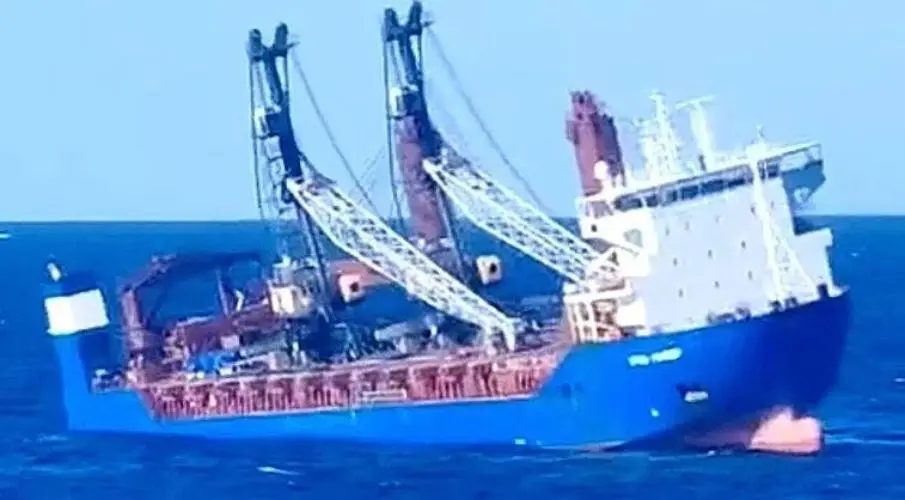
The trail was not the explosion, but an inconsistency. A Russian cargo vessel, traveling on a route that defied every principle of maritime logic, declared a harmless cargo – empty containers, harbor cranes, equipment. Yet the Ursa Major did not take the short route from Saint Petersburg to Vladivostok, but instead set course through the Mediterranean. When it ran into distress in late December 2024 about 60 nautical miles south of Cartagena, a chain of events began that today – after joint investigations with Spanish colleagues and a Russian activist network – leads to a disturbing conclusion: on board were two VM-4SG reactor housings, destined for North Korea.

The designation VM-4SG refers to a special class of Russian naval reactors originally developed for use in nuclear submarines. These are not complete reactor systems, but the outer housings of these reactors – meaning the multi-ton, highly specialized pressure vessels that are later fitted with nuclear fuel and control technology. They form the industrial backbone of a propulsion system that allows a submarine to remain submerged for months. Accordingly, their transfer is extremely sensitive. Anyone shipping such components is exporting strategic military technology.
This assessment comes from a Spanish investigation and further research. Investigators and researchers relied on aerial imagery, course data, and damage analyses. At the stern of the ship, heavy blue containers were mounted that did not appear in the cargo manifest. Their size and fixation did not match empty cargo. According to investigators and independent research, they were two VM-4SG reactors – a type developed for use in nuclear submarines. Destination port: Rason in North Korea, just a few kilometers from the Russian border.

The sequence of events can now be documented precisely. On December 22, 2024, authorities recorded an abrupt course change and a loss of propulsion. One day later, the Ursa Major sent a distress call. When Spanish rescue forces arrived, the ship was lying in the water with a heavy list to starboard. Photos taken by the rescue teams show a clear picture: a hole in the outer hull, metal pushed inward. No indication of an internal explosion, no fire, no typical signs of a machinery accident. The size and shape of the damage ruled out a conventional torpedo. They did, however, match a strike by a supercavitating, armor-piercing system with little or no explosive charge – a technology possessed by several states. Seismographs recorded an underwater shock at the moment the ship finally disappeared, equivalent to a detonation of 20 to 50 kilograms of TNT. Shortly thereafter, the Ursa Major sank to a depth of about 2,500 meters.

What followed escalated the situation further. The Russian landing ship Ivan Gren appeared in the operational area and demanded that Spanish units withdraw. Signal flares were fired, electronic interference reported. Rescue operations came under pressure. Although the Ursa Major was still afloat and the engine room remained sealed, two crew members could no longer be found. Fourteen were rescued.
The ship’s owner, the state company Oboronlogistika with direct ties to the Russian Ministry of Defense, spoke of a terrorist attack. But Spanish files include another possibility: that Russia itself accepted – or caused – the sinking in order to conceal the nuclear shipment. This assumption gains weight through further research. Shortly after the sinking, the Russian special vessel Yantar appeared at the site of the incident, equipped for deep-sea operations. Analysts consider it possible that traces were deliberately removed or cargo remnants rendered inaccessible. Taken together, the route, the cargo, the damage pattern, and the intervention by Russian units form a picture that goes far beyond a maritime accident. Should it be confirmed that North Korea was to receive reactor housings for military purposes, this would constitute a serious violation of international agreements – and an indication of how closely Moscow and Pyongyang now cooperate.
Die Ursa Major liegt nun auf dem Meeresgrund. Doch was mit ihr versank, ist nicht verschwunden. Es ist eine Geschichte aus Stahl, Geheimhaltung und Entscheidungen, die offenbar selbst den Tod von Seeleuten in Kauf nahmen. Die Recherchen haben sie ans Licht gezogen. Der Rest der Welt muss nun entscheiden, wie viel Wahrheit sie sehen will – und welche Konsequenzen sie daraus zieht, denn in der EU, wir hatten die gesamten Recherchen nach Brüssel gesendet, herrschte schweigende Ignoranz und Ablehnung auf wirkliche Arbeit. Denn wer einen Krieg wie eine Serie behandelt, als Spektakel, in Episoden, der verliert irgendwann die Fähigkeit zu benennen, was er ist: Ein Albtraum. Und einer davon liegt in 2.500 Meter Tiefe.
Updates – Kaizen News Brief
All current curated daily updates can be found in the Kaizen News Brief.
To the Kaizen News Brief In English


Krass, absolut krass.
Und hier liest man nur was von „Schiff versunken“
Was zum Teufel hatte dieses Schiff im Mittelmeer zu suchen, wenn man vom Routenplan ausgeht?
Wahrscheinlich wird sich die ganze Wahrheit, aufgrund Spurenbeseitigung, nicht mehr komplett konstruieren lassen.
Aber unglaublich, was Eure Recherchen zu Tage gebracht haben.