
The situation at the front is intensifying at a speed that makes even experienced officers nervous. While Donald Trump’s special envoy Steve Witkoff is speaking in Miami with the Ukrainian delegation about a possible cease-fire, the Kremlin is doing everything it can to create facts on the ground. Vladimir Putin presented this week, ahead of his meeting with US representatives, the alleged capture of Pokrovsk - a triumph that is not confirmed in maps and reports from the front but whose message was clear: Russia does not want to end the war but dictate it.
Putin ordered winter combat readiness, indicated that he would not budge an inch from his demands, and underscored his words with violence during the night. More than 650 drones and 51 missiles struck Ukrainian towns and villages on Friday and Saturday. While diplomats drafted statements, the war raged on.


While the front line is under constant fire, Russia continues its combined strategy of military pressure and targeted strikes against the energy supply. During the night, missiles and drones again hit critical infrastructure. In Fastiv, the railway station was completely destroyed. In the Kyiv and Lviv regions, cruise missiles struck energy facilities, and in Lutsk food warehouses and storage halls burned fiercely. Parts of Lviv and its surroundings had to be temporarily taken off the grid, and Rivne also experienced outages. Even industrial facilities were targeted: in Dnipro, a major warehouse of the producer “Millennium” is in flames. These attacks are not a sideshow but part of a clear strategy - to leave Ukraine without power in winter, break supply chains, and wear down the population while Moscow simultaneously pretends to be speaking about peace.
The battlefield now looks bleak. Russian troops are advancing simultaneously on several fronts. In Pokrovsk, Ukrainian units are now fighting over the last uncontrolled streets. The neighboring city of Myrnohrad is on the verge of encirclement. In Zaporizhzhia, the pace of Russian forces has visibly increased. In the north, they continue to push toward Kupiansk, and in the east they are moving around Siversk toward Ukrainian defensive lines.

Many Ukrainians now put it in a clear formula: “The only deal that works is Russia’s defeat.” This sentence sounds harsh, but it describes soberly the lesson of recent years. Half-measures in sanctions, political caution, and the hope for compromise have never stopped Putin but encouraged him. Only consistent measures - real economic sanctions without loopholes, an end to European dependencies, and military support without political hesitation - could change Moscow’s calculation. Everything else merely postpones the next attack.
Military experts like Emil Kastehelmi of the Finnish Black Bird team describe the situation soberly: Russia has the upper hand at the moment. The point of capitulation has not yet been reached, he says, but the front appears strained - strained enough that the Kremlin believes it can make demands without making concessions. “The future looks really bleak for Ukraine,” Kastehelmi says. “I do not see a clear way out.” Bakhmut

Still, the Ukrainian army is holding the lines. For now. But they are bending. Since November 1, Russia has captured around 505 square kilometers according to the Ukrainian analysis group DeepState - nearly twice as much as in October. Putin’s goal has been unchanged for years: full control of the Donetsk region and thus the entire Donbas. That he is willing to accept further bloodshed for this is beyond dispute for observers. The fighting in Pokrovsk shows exemplarily how the war has changed. For months, Russian forces have worn down the city with artillery, drones, and glide bombs. Starting in September, Ukrainian soldiers report, the defense began to crack under the weight of the constant strikes. A drone pilot describes the situation like this: Russia is deploying Molniya drones in series along with swarms of small kamikaze drones carrying explosives. Ukraine has nothing comparable in such quantity. His verdict on Moscow’s supposed peace signals is brief and forceful: “All bluff. As long as they can push, they push.”

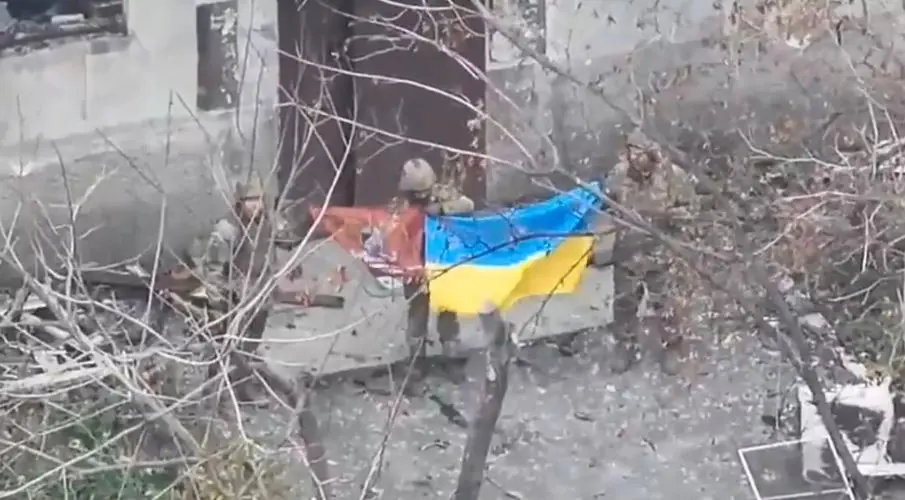
Ukrainische Soldaten halten in nördlichen Teilen von Pokrowsk ihre Flagge.
Ukrainian soldiers are holding their flag in northern parts of Pokrovsk. According to the 7th Corps command, this is a fixed position, not just a raid or assault group. feste Position, nicht nur um einen Vorstoß oder Angriffstrupp.
Anyone who sees Pokrovsk falling automatically looks to the next cities: Sloviansk and Kramatorsk, long fortified strongholds. The closer Russia gets, the stronger the strategic pressure on Ukrainian leadership to hold the front at least there. Some analysts openly question whether staying in Pokrovsk is militarily sensible or rather serves the political signal of avoiding falling into a narrative of Russia’s inevitable victory. Every withdrawal would give Russia momentum - but every day of holding costs soldiers, equipment, and time.
Time that Ukraine has less and less of. In Lyman, Ukrainian units report attacks “in all directions.” Drones, shells, rockets - nothing stops. The fog of recent weeks makes counterattacks even harder and favors Russian advances in small groups. In the streets of Kostiantynivka, cold air mixes with smoke and the smell of burned fuel. A soldier describes how bodies of civilians and soldiers lie among the ruins without being able to be retrieved.

While Pokrovsk is in focus, Russia has taken advantage in Zaporizhzhia and captured around 75 square miles in just a few weeks - almost 40 percent of its November gains. Ukraine is sending reserves, but reinforcement only slightly slows the pace. Kastehelmi warns: “The pace there is alarming.”
Winter and drones are further changing the front. Ground freezes, vehicles get stuck, and drones hang like a constant eye over every trench. Infantry attacks as known from earlier phases of the war are dying out. Instead of a clear line, a wide strip of death emerges in which both sides can gain little ground but lose people steadily.
Putin’s calculation remains stable: he has resources, he has soldiers, he has patience. The Russian army is wearing itself down, but it is wearing Ukraine down even faster. “Russia is fighting a war of attrition,” Kastehelmi says. “They are trying to break Ukraine militarily, slowly.”

For the city of Myrnohrad, which borders directly on Pokrovsk, the situation already looks grim. A Ukrainian platoon commander describes daily attacks, day and night. Every street can become a trap, every path a target for Russian drones. “If we have three people, they have thirty,” he says. “Their resources are unbelievable. But they also did not expect us to fight for so long.”

The visit of Saint Mykolaj at the Rava-Ruska border crossing, properly registered by the 7th Carpathian Border Guard Regiment, stood in the midst of a bleak winter like a quiet counter-image to Russian destruction. While entire cities are being reduced to rubble, Ukraine is holding its border - and its traditions. Mykolaj, far more significant in Ukraine than the western Santa Claus, is a reminder that the Russians may destroy houses but not what holds the country together at its core. The message was unmistakable: we preserve our culture, we remain upright against an enemy who wants to ruin everything but never what defines us.
The decisive question now hangs over all front sections: how much time does Ukraine have before Putin’s army advances so far that political compromise would mean only capitulation? And how realistic are peace talks that do not deserve the name while Russia is simultaneously setting new cities on fire?


Wolodymyr Zelenskyi: “I addressed the participants of the second military prayer breakfast in the history of Ukraine. Today is a special day for us, a day with a double meaning. Today we celebrate the Day of the Armed Forces of Ukraine and Saint Nicholas Day, which is celebrated on December 6 by Christians in many countries in Europe and around the world. Together, we will defend our right to live, our God-given land, we will defend our future and a just peace. I am grateful that all this is today the subject of far more than one prayer. Thank you for being here, for standing close to us, and for making this unity palpable. On this day I believe that every child in Ukraine will receive what it has long deserved - silence instead of strikes, calm instead of air raid alarms, reliable peace instead of all evil. I thank you all for your support, for every warm word, and every good deed done for Ukraine.”
Trump is counting on an agreement that is meant to move quickly and put pressure on Kyiv. Putin is counting on territorial gains that allow him to negotiate from a position of confidence. Ukraine continues to fight in a situation that becomes more threatening each day.
Let us return at this point once more to sanctions against Russia - and especially to how they are implemented. Because investigations in the case of Nikita Mikhalkov show how easily Russian elites can still shield themselves in Europe despite all prohibitions. The Kremlin-funded director and propagandist whose program “Besogon” has spread state messages for years receives around five million rubles per episode from Rosneft - disguised as “advertising and informational placements,” even though not a single Rosneft advertisement appears in the broadcasts.

At the same time, his family owns a villa in the luxury location of Sotogrande worth about five million euros, registered to his wife and children so that European sanctions are rendered ineffective. Mikhalkov’s relatives regularly use the villa and other apartments in Spain. From our friendly Navalny team we also learned that the director even maintains a second family in Spain. While people in Russia talk about “sacrifice” and “patriotic hardship,” this case shows how fragile and full of holes western sanction regimes still are. But a fancy villa, right

There is no end in sight. Only the realization that every lost kilometer makes the next loss easier - and that this winter may decide more than the fate of a single country.
Investigative journalism requires courage – and your support.
Support our work against right-wing populism, disinformation, and violations of human and environmental rights. Every contribution goes directly into our daily reporting – we operate without advertising, without subscriptions, without corporations, without political parties. Our journalism is meant to remain freely accessible. For everyone.
Independent – Critical – For Everyone
Thank you for making our independent work possible.
Updates – Kaizen News Brief
All current curated daily updates can be found in the Kaizen News Brief.
To the Kaizen News Brief In English


Liest man es, kommen viele Fragen auf, meine erste; Warum schreiben andere nicht darüber? Ich bin froh, den Blog von Euch gefunden zu haben. Ein Fundus von großartigen Journalismus.
Es sieht also alles ziemlich düster aus 😿