
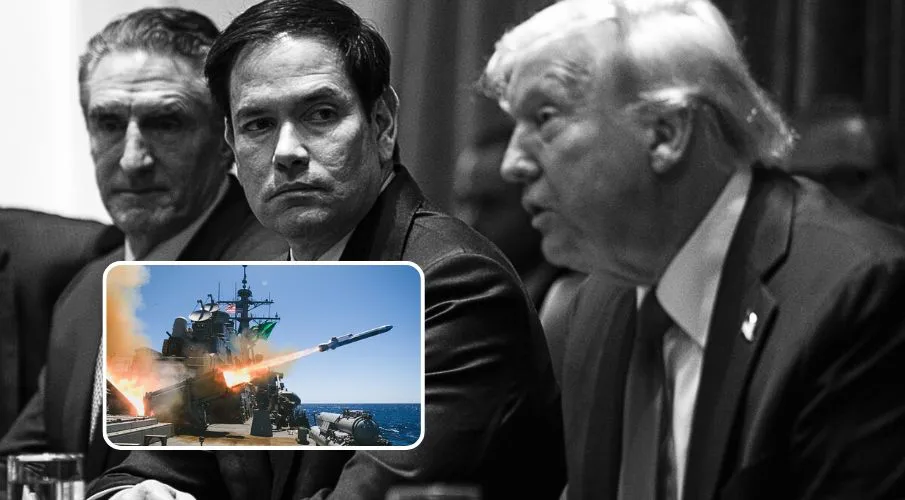
Donald Trump has said something that can no longer simply be left unchallenged. He spoke of ground operations. Not only in Venezuela. He spoke of targets. Of people whom he believes are responsible for drugs, deaths, and suffering in the United States. And he made clear that he was not talking about programs or talks, but about violence.
“It is NOT only about ground strikes in Venezuela.” “It is about ground strikes against horrible people who bring drugs into the country and kill our people.”
Anyone who listens closely realizes quickly that Trump is not describing the situation as crime, not as a social problem, not as a medical crisis. He is describing it as war. If hundreds of thousands of people die in a single year, according to his logic, then this is no longer a failure of authorities. Then it is hostile action. And whoever acts that way forfeits any protection, no matter where they are. What Venezuela has to do with this is another matter entirely, since fentanyl is practically not produced there. Trump deliberately avoided terms such as cooperation, international agreements, or law enforcement. He did not speak about police, not about investigations, not about courts. He spoke about operations. About locations. About enemies. That is the decisive point. A threshold is being crossed here that Washington has long avoided. The open acknowledgment that the United States now sees itself as already being in a state of armed confrontation.
Our extensive investigations show that Trump’s approach is based on internal intelligence papers that demonstrate how the Department of Homeland Security DHS and Immigration and Customs Enforcement ICE have elevated the criminal network Tren de Aragua TdA to a national security threat. In a confidential letter to Representative Lauren Boebert that is in our possession, it states verbatim that the “new information on TdA” has led to a “renewed focus within ICE.” Patrick Lechleitner, then acting ICE director, describes how “members of TdA establish command and control centers in residential complexes that are heavily populated by Venezuelan nationals.” Colorado is highlighted as a focal point, where ICE together with US attorneys and local authorities seeks to identify, dismantle, and arrest TdA structures and their members.
- ICE Memo (2023): "Members of TdA are establishing command and control centers in residential complexes in communities with a high proportion of Venezuelan nationals."
- DHS Analysis: "TdA uses violence as a means to threaten, intimidate, and maintain control."
- NIC Report (April 2025): "The Maduro regime probably does not have a policy of cooperating with TdA or directing TdA operations in the United States."
- ICE Assessment: "Many groups use the name TdA only for reputational reasons, without direct connection to the leadership."
- Congressional Letter to Lauren Boebert: ICE names Colorado as a focal point of TdA investigations and describes close cooperation with federal prosecutors to dismantle cells.
Supplementary evaluation of the documents, Supplementary analysis of the documents reveals striking findings: A declassified assessment by the National Intelligence Council states that the Maduro regime “is unlikely to pursue a policy of cooperating with TdA Tren de Aragua or directing its operations in the United States” and that many cells “operate independently.”

National Intelligence Council Memo of April 7, 2025, the declassified intelligence document on the question of the links between the Maduro regime and TdA. NIC Report (April 2025): Declassified assessment of the National Intelligence Council stating that the Maduro regime "probably does not have a policy of cooperating with TdA (Tren de Aragua) or directing TdA operations in the United States" and that many cells "operate independently."
Our newsroom has evaluated the ICE documents and the declassified National Intelligence Council assessment in full. They show that TdA Tren de Aragua “operates in loosely organized cells” spanning at least seven countries in South America and the Caribbean. The leadership has “historically benefited from permissive conditions and institutional weaknesses in Venezuela.” While there is communication between individual cells, “many of these cells likely operate autonomously and coordinate independently.” Particularly explosive is the passage in which ICE admits that some groups or individuals “use the name TdA only for reputational reasons” and have no direct ties to the leadership. This not only complicates investigative work but also raises the question of how solid the classification as a state linked threat really is and what Trump’s words are actually worth.


In another section it states that the organization focuses on "human trafficking, migrant smuggling, and low-level crime." The decentralized structure makes it "highly unlikely" that TdA is planning large-scale logistical operations such as coordinated attacks or systematic infiltration. Nevertheless, it is emphasized that between 2021 and 2024 there was "an increase in encounters with TdA members at the U.S.-Mexico border" who often traveled together with migrant groups.


The ICE letter also describes how state laws in Colorado make the agency's work more difficult: The "Denver Public Safety Enforcement Priorities Act" prohibits city officials from asking the immigration status of arrested persons or executing ICE orders without a judge's warrant. Other laws prohibit probation officers from sharing personal information with immigration authorities, making jail interviews and detention orders more difficult. ICE emphasizes that these laws "prevent ICE from carrying out its mission effectively and efficiently" - a formulation that suggests Colorado is seen as a kind of safe haven.
The language of the memo sounds more like guerrilla operations than organized crime. The document literally states that TdA "uses violence as a means to threaten, intimidate, and maintain control." In one passage it says TdA uses "tactics and trade routes to disguise memberships, relocate members, and cover their tracks." It is precisely this choice of words that now serves as the basis for military escalation far beyond law enforcement. In Washington, drugs are no longer seen only as a public health crisis but as a reason for war. "A foreign terror network that is poisoning our people with drugs is no different than al-Qaeda - and will be treated as such," Hegseth said after an attack on a suspected drug boat in the Caribbean. President Trump himself calls the fentanyl crisis an "invasion" and thus justifies the use of military force.
But this is where the explosive part begins. Because while DHS and ICE create the impression that the Maduro government controls TdA like a secret army, other parts of the U.S. intelligence community come to completely different conclusions. A declassified report by the National Intelligence Council in April states that the Maduro regime "probably does not have a policy of cooperating with TdA or directing TdA operations in the United States." In other words: There is no solid evidence of a direct chain of command from Caracas to Colorado. The paper further states that many TdA cells abroad "probably operate independently and coordinate independently." This assessment calls into question the official narrative of the White House.
ICE and HSI Denver agents have tracked down and arrested Jesus Ramon Estrada-Ivarguen, a member of a Mexican cartel - HSI (Homeland Security Investigations) is the investigative arm of the U.S. Department of Homeland Security specializing in combating transnational crime, drug and human trafficking, money laundering, and terrorism financing.
Our research also shows that even in Colorado the situation is more complex than Washington portrays it. HSI Denver did launch a major investigation into TdA in the fall of 2023, but relied heavily on confidential informants and patterns of violent crime in migrant neighborhoods. The memo describes how TdA "primarily relies on the exploitation of the weak and newly arrived migrants" and thus "was able to evade law enforcement for years." That criminal networks exploit the plight of migrants and make money from human trafficking, drug trafficking, and arms trafficking is undisputed. But the equation of these cells with an operation directed by the Venezuelan president remains speculative.

Nevertheless, the Department of Justice has increased the pressure and in August placed a 50 million dollar bounty on Nicolás Maduro. The letter to Boebert emphasizes that ICE, together with the "United States Attorney’s Office for the District of Colorado," is working to "identify, indict, arrest, disrupt, and dismantle" TdA cells. This is language that comes from the world of counterterrorism. If an airstrike on Venezuelan installations were to occur, it would not only break with decades of American restraint toward Latin America but would also be a military escalation with incalculable consequences. Caracas has already threatened to respond to any attack, and the Cuban government stands demonstratively at Maduro’s side.
The debate in Congress is growing louder. Not all Republicans are going along anymore, and Democrats in particular criticize the lack of transparency. But the central question, whether there is solid evidence for state direction of the fentanyl trade, is barely being asked. Yet this is precisely the question that would be decisive before the first American cruise missile perhaps strikes a Venezuelan runway. That the United States is facing a massive fentanyl catastrophe is beyond dispute. More than 100,000 deaths per year are a tragedy. But the militarization of drug policy carries the risk of fighting an enemy that may not even exist in this form. Even if TdA cells in US cities are dismantled, whether through police work or military force, demand for drugs will persist, and other cartels will fill the gaps.

In the United States people all too readily close their eyes to the homegrown causes of the crisis and shift the blame to foreign states. The truth is: As long as Washington clings to an outdated social system and pursues policies that neglect prevention, health care, and drug treatment, the fentanyl epidemic will continue to escalate. Thousands of illegal drug labs exist in the United States itself - a fact that is hardly mentioned in the public debate. Against this backdrop, the "drug wars" against Venezuela propagated by Trump appear less like a security concept and more like a political distraction maneuver that obscures the real structural problems at home.
Our research reveals that the administration is prepared to turn an internal political crisis, ongoing violence and the drug epidemic, into a foreign policy project. It wants to demonstrate toughness, project military strength, and present a tangible enemy. But as in 2003, this enemy may prove to be a chimera. A ground assault on Venezuela would neither address the causes of the drug crisis in the United States nor ease social tensions in Colorado. It would, however, dramatically increase the risk of military confrontation in the Western Hemisphere.

If Washington goes down this path, the price could be high - not only for Venezuela but also for the United States itself. A war against a Latin American country would drive millions of people to flee, further intensify migration movements, and worsen precisely the security situation that Trump claims to be fighting. It would be a cycle of escalation from which there would hardly be a way back.

This is politically sensitive, legally explosive, and morally highly problematic. Because anyone who declares a state of war sets different standards. Then different rules apply. Then civilian boundaries become porous. Then violence is no longer an exception, but a means. And then a single sentence is enough to turn a security debate into a military reality. Trump is not speaking only about Venezuela. That is decisive. Venezuela is the entry point, not the end. His words leave open how far this approach is meant to go. And that is precisely what makes them dangerous. What is once framed as an exception can become the norm. The United States has done many things over recent decades without openly calling them war. Drones, special forces, covert operations. What is new is not the violence. What is new is the openness. What is new is the tone. What is new is the willingness to name what has long been happening.

The question is no longer whether this is meant seriously. The question is who will stop him. Who will object. Who will clearly say that this language has consequences. Not somewhere. But concretely. For people. For states. For law. The United States is not a country that believes itself to be at war. It acts as if it already is. And that is the moment when everyone else must look very closely.
Updates – Kaizen News Brief
All current curated daily updates can be found in the Kaizen News Brief.
To the Kaizen News Brief In English


Wer soll die USA aufhalten? Wer widerspricht diesen völkerrechtswidrigen Aktionen?
Diese Frage stelle ich mir seit Monaten.
Und leider finde ich keine Antwort.
Der Westen duckt sich weg.
Putins Pakt mit Maduro ist nicht das Papier wert, auf dem es steht.
MAGA bejubelt diese Aktionen.
Man muss ehrlich sagen, Angebot und Nachfrage.
Je weniger Menschen Drogen nehmen, desto weniger Drogen werden auf den Markt gebracht.
Prävention wäre wichtig. Aber Medicaid wird gekappt, Berufe die diesbezüglich wichtig wären verlieren die Bezeichnung „professional degree“.
Es ging und geht Trump nicht um Drigen.
Ihm ist doch schnurzegal, wieviele Menschen daran sterben.
Es geht ihm um Einfluss und in Venezuela auch ums Öl.
Für seine Basis, gerade die religiösen Fanatiker und MAGA Sektenanhänger, zeigt er einen Kampf gegen Drogen, zum Schutz von US-Amerikanern.
Leider glauben die das vollkommen unkritisch und freuen sich über die Stärke ihres Präsidenten.
Und hinter den Kulissen laufen eben ganz andere Dinge.
Druck auf Colorado, da demokratisch.
Sicherung von Deals im Bereich Öl.
Die leidtragenden sind die Menschen vor Ort … sie haben keine internationale Hilfe zu erwarten.
Danke Rainer, für diese sehr detaillierte Recherche.
ich danke dir, mit den den drogen stimmt, aber dann musst du die tausenden von laboren in den usa auseinandernehmen