
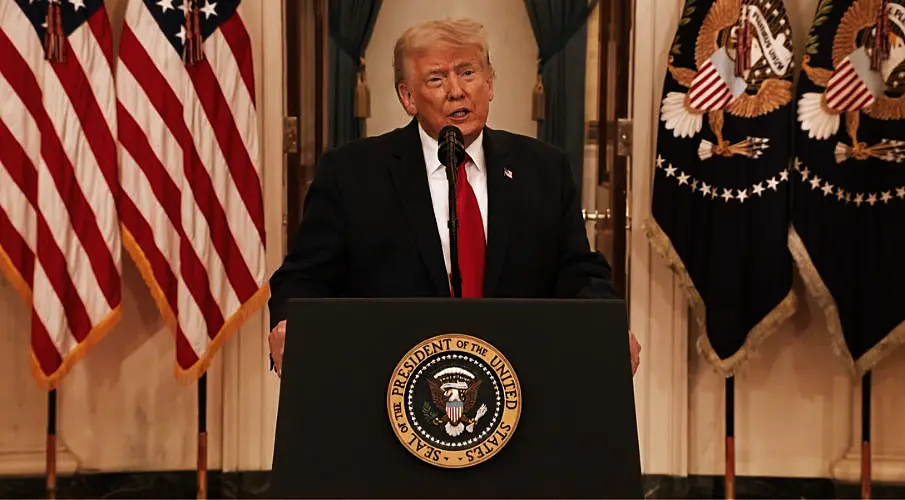
On the evening of April 1, 2026, Donald Trump stepped in front of the cameras in the Cross Hall of the White House. It was his first address to the nation since the start of the war against Iran - and that despite the fact that the United States has been bombing a country for 32 days. Trump had announced the beginning of the war on February 28 only with a short Truth Social post. What presidents normally do - informing the country about the necessity of such a step before the start of a war - he had not done. He now spoke for nineteen minutes. Anyone expecting to hear a plan heard none

Trump opened with what he called “quick, decisive, overwhelming victories.” The Iranian navy was destroyed, the air force ruined, the leadership of the country dead. The Revolutionary Guards were being decimated. Iran’s ability to launch missiles and drones had been “dramatically reduced.” The Pentagon had struck eleven thousand targets. That sounds impressive until you know that Iran had injured twelve American soldiers the week before in a combined missile and drone attack - one of the most serious breaches of US air defense since the war began. Independent data from the conflict monitoring organization ACLED show that Iran is firing less than on the second day of the war - then nearly one hundred attacks - but experts explain that by saying Tehran is deliberately rationing its weapons, not that it no longer has them.
Trump claimed that Iran had “pursued a nuclear weapon like never before” and had been close to building one. US intelligence sees it differently: Iran had enriched uranium to 60 percent, which is technically close to weapons-grade material, but a finished device would have taken months or more than a year. Before the war, US intelligence assessed that Iran had not yet started a weapons program but had undertaken activities that would better position it to build a nuclear weapon if it chose to do so. The claim from his State of the Union address four days before the start of the war - that Iran was close to an intercontinental missile capable of reaching America - Trump quietly dropped this time. American intelligence does not believe that.
Obama got his usual appearance. Trump accused him of having “given” Iran 1.7 billion dollars. The money belonged to Iran and had been frozen in the United States for decades. Obama’s nuclear deal would have led to a “colossal arsenal of massive nuclear weapons” for Iran, Trump said. What he did not mention: under that agreement, 97 percent of Iran’s nuclear material was removed from the country. Trump himself has not achieved that result. He said that nuclear facilities were under “intense satellite surveillance” and that the United States would strike again immediately if Iran so much as moved - but the nuclear material that existed before the war remains on Iranian soil, now under rubble. Trump himself said it would take “months before one even gets near the nuclear dust.”

Trump briefly addressed the economic consequences of the war - and brushed them aside. Gas prices have risen to over four dollars per gallon, for the first time since 2022, when Russia’s invasion of Ukraine drove prices. That is more than a dollar higher than a month ago. Trump called this “short term” and pointed out that America produces more oil than Saudi Arabia and Russia combined. That is correct: the United States produced over 13 million barrels per day in 2025, Russia and Saudi Arabia each over 9.5 million. Still, prices are rising worldwide because Iran has closed the Strait of Hormuz, through which about one fifth of global oil flows. What is produced on American drilling fields does not change what happens on the global market. Economists have already revised their growth forecasts downward and raised expectations for inflation and unemployment. Some see a real risk of recession if the war escalates and oil prices continue to rise. Trump’s often repeated claim that energy prices would quickly fall after the war ends is not shared by economists or industry representatives - many say it could take weeks for prices to normalize even if the fighting stops.
The Strait of Hormuz is the problem of others, Trump said. The countries that need the oil should “take the lead” and secure the strait themselves. America will help, but not lead. “We do not need their oil. We do not need anything they have,” he said. At the same time, he justified American involvement in the war by saying the United States is “there to help allies.” One day earlier, Trump had said he was seriously considering pulling the United States out of NATO because Europe refuses to help secure the strait. In the speech itself, he did not mention NATO at all. The thousands of additional US soldiers deployed to the Middle East this week were also not mentioned.
Trump threatened to bomb Iran’s power grid if no “deal” is reached - without saying what kind of deal he has in mind. Because the power grid supplies civilians, this would, according to legal experts, be a violation of the Geneva Conventions. Intelligence agencies assume that Tehran is currently not willing to make significant concessions - Iran assesses its own position as stronger than expected. Trump announced that US forces would hit Iran “extremely hard in the next two to three weeks” and “bring them back to the stone age where they belong.” At the same time, he said the war was “almost over” and the strategic objectives were “close to completion.” Allies who had hoped for a statement on how the war would end received none. Investors did not either.
At the end, Trump drew a comparison with previous wars - explicitly referring to the duration of American involvement. American involvement in World War I lasted one year, seven months, and five days, in World War II three years, eight months, and 25 days. Vietnam almost twenty years. The Iran war has lasted only 32 days. “We have all the cards, they have none,” Trump said. A current poll shows that six out of ten Americans believe Trump has gone too far in Iran. The number of killed protesters that Trump himself cited has risen from 32,000 in his first address on February 28 to now 45,000.
When Trump finished, the oil price rose. It had fallen before the speech began and climbed by more than 2.5 percent during the address. Markets in Asia barely reacted. Nineteen minutes. Nothing new.
Updates – Kaizen News Brief
All current curated daily updates can be found in the Kaizen News Brief.
To the Kaizen News Brief In English


