
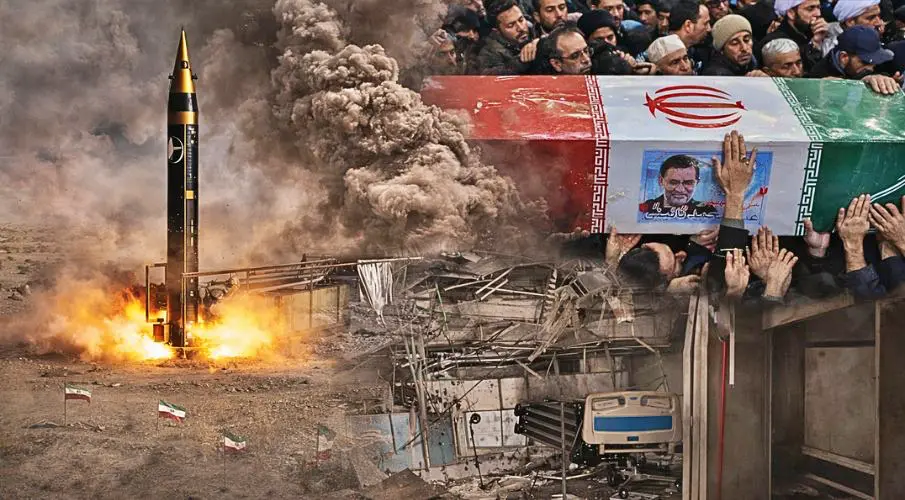
Tehran, March 21, 2026. Iranians are celebrating Nowruz, the Persian New Year. People are praying in the streets, children run through the morning rain, Eid al-Fitr hangs over the country like a final greeting. And while the faithful roll out their carpets, bombs are again falling somewhere over Khuzestan.
Tehran is being bombed, day after day — but anyone who looks at the targets eventually wonders whether there is a plan behind it or just the next missile.
It is the beginning of the fourth week of war. Since February 28, the United States and Israel have been bombing Iran. More than 8,000 targets have been hit so far — military installations, ships, missile depots, underground bunkers along the coast. Admiral Brad Cooper, head of U.S. Central Command, says Saturday morning in a four minute video that Iran’s navy is no longer sailing, fighter jets remain on the ground, the ability to launch missiles and drones at the pace seen at the beginning of the war has been broken.

And then, right after that, an Iranian missile strikes the building of an empty kindergarten in Rishon LeZion, south of Tel Aviv. What is one supposed to make of such an assessment?
That is this war. Both things at the same time, always.

In Ahvaz, in southwestern Iran, a child dies in a leisure complex called Ritaj. The Andimeshk hospital in the same Khuzestan, on the border with Iraq, reports heavy damage — it is no longer admitting patients. No one immediately claims responsibility for these strikes. Israel is silent. The United States as well. The dead remains nameless for now in the flood of reports. The scenes there; beyond comprehension. We are in contact with colleagues on the ground.

At the same time, Iran holds a state funeral in Qom. First for intelligence minister Esmail Khatib, killed in an Israeli strike. Then for Ali Mohammad Naini, spokesperson of the Revolutionary Guards, also killed by Israeli fire. The crowd carries images. The rain over Beirut carries ash, too many who still support the regime — willingly, driven or forced.

In Beirut, shortly before dawn, the Israeli air force strikes. Seven districts were placed under evacuation orders on Friday evening, most stayed anyway. Hasnaa Ali Hashem, 55 years old, had stayed for five days before she fled. Now she sits in a stadium serving as an emergency shelter. The rain comes through the concrete pillars, mattresses get wet, improvised tents do not hold. “Where are we supposed to go?” she asks. “We want to go home.” Over 1,000 people have died in Lebanon since the start of the war, more than one million displaced.
In Khiam, a border town a few kilometers north of Israel, Israeli ground troops are fighting Hezbollah fighters. Tank fire, air support, four dead on the Hezbollah side according to the Israeli military. It is one of those operations that are called “targeted” and still change the village.
And then Natanz
The nuclear facility, 220 kilometers southeast of Tehran, the core of Iran’s uranium enrichment program, is struck again on Saturday morning. Iran’s state news agency Mizan reports the attack. No radiation, no leak, no risk for the surrounding population, Tehran says. The International Atomic Energy Agency confirms it has been informed of the strike. Israel denies attacking Natanz. The United States is silent.
Russia’s Foreign Ministry spokesperson Maria Zakharova calls the strike a “shameless violation of international law” and warns of a “real catastrophe across the entire Middle East.” Russian words about international law, the irony is hard to miss. Shortly afterward, Vladimir Putin congratulates the Iranian people on Nowruz and calls his country Iran’s “loyal friend and reliable partner.” Putin remains consistent: words first, then more words.
In Washington, Congress is waiting. Not for victory — for an explanation.

Senator Thom Tillis, Republican from North Carolina, says he generally supports anything that ends the rule of the mullahs. But then he pauses. “In the end, you have to be able to articulate strategically what the objectives are.” It sounds like a question a soldier would ask. Or a bookseller in a city that cannot yet imagine war.
13 American soldiers are dead. Over 230 wounded. The Pentagon has submitted a war funding request of 200 billion dollars to the White House. Gasoline in the United States costs around four dollars. Crude oil — Brent Crude — is trading above 115 dollars per barrel.
And Donald Trump tweets Friday evening that he is thinking about “winding down” the “great military operations” in the Middle East. The same Trump who told reporters the same day that a ceasefire is not even on the table. Normal? No. Normality? Yes.
The U.S. Treasury on Friday temporarily lifts sanctions on Iranian oil that is already on ships at sea. An exemption valid until April 19. Scott Bessent, the Treasury Secretary, had proposed the step himself — so that China would not be the only country benefiting from Iranian oil while the West is fighting. This is the logic of modern war: you bomb an enemy and at the same time lift sanctions on its oil exports because energy prices would otherwise hit your own population. It does not get more grotesque than this.
Jordan reports 36 Iranian missiles and drones in the third week of war, 240 in total since February 28. One child was injured. The United Arab Emirates shot down three ballistic missiles and eight drones. Saudi Arabia intercepted drones over its Eastern Province. In Bahrain, where the U.S. Navy maintains a base, sirens sounded.
4,000 KM – And then Diego Garcia

The British American base on the atoll in the Indian Ocean, 4,000 kilometers from Iran, was attacked. Iran’s reach is long — but not as long as the headlines suggest. The confirmed range is around 2,000 kilometers, that is medium range, not a world domination program. Diego Garcia lies 4,000 kilometers away — so anyone speaking of an Iranian strike there is speaking of something physics has not yet approved. Iran is dangerous enough, just in a more sober, less cinematic way. Unsuccessful, as the British Ministry of Defense also reports, without explaining how close the missiles came or what weapons were used. A day earlier, London had announced that it would allow American forces to use the base for strikes against Iranian shipping blockades. Iran had already fired before that. Reports say one missile failed, the other was intercepted. The timing is as precise as a bitter joke.
London calls Iran’s actions “reckless.” Tehran’s foreign minister Abbas Araghchi says his country does not want a ceasefire, but a “complete, comprehensive and lasting end to the war.” The war is “illegal and unprovoked.”
Hamas balances. The Palestinian movement has Iran as an ally, Qatar as host country and financial backer. Both countries are currently on different sides. Iyad al-Qarra, a Palestinian analyst, says: Hamas is walking on the edge of a knife. For two weeks the movement remained silent about Iran’s missile attacks on Qatar. Then, in a single statement, it asked Iran to spare neighboring countries — without naming Qatar. Mohammed Darwish, a leading representative of the terrorist organization Hamas, wrote a letter on March 13 to Mojtaba Khamenei, the son of the killed Iranian Supreme Leader, congratulating him on his appointment as successor. Like attracts like, in the East as in the West.
Iranian foreign policy is running through unusual channels these days. Foreign Minister Araghchi tells Japan and South Korea that Iran is ready to let their ships pass through the Strait of Hormuz. Japan imports more than 90 percent of its oil through this strait. Seoul is conducting “multi layered talks” with Tehran. China, India, Pakistan, Malaysia and Iraq already have safe passage.
Europe and the United States do not
Admiral Cooper says Iran has “significantly degraded” capabilities to control the Strait of Hormuz. How and when it will be fully reopened — he does not say. 22 countries, including France, Germany, the United Kingdom, Japan, the United Arab Emirates and Bahrain, call in a joint statement for Iran to withdraw from the strait. “The consequences of Iran’s actions,” it says, “will be felt by people in all parts of the world, most strongly by the most vulnerable.”
Trump wrote something on social media Friday that sounds like a withdrawal. No more regime change as a declared goal. No ultimatum on Iran’s nuclear fuel. Instead: weaken Iran militarily, protect U.S. allies, leave the Strait of Hormuz to the countries that need it. “If they ask us, we will help,” Trump writes. But essentially Japan, South Korea, Europe and China are supposed to solve it themselves.

Israel’s Defense Minister Israel Katz says the same Saturday that the attacks will “significantly escalate” in the coming week. Both are right. Both are wrong. This is the situation on March 21, 2026, the third day of Nowruz, the fourth Friday of the war, the first day on which an Iranian hospital can no longer admit patients.
The death toll: over 1,300 in Iran, over 1,000 in Lebanon, 15 in Israel, 13 Americans.
On March 13 he said it for the first time, on March 16 he repeated it … — it is his answer.
A man who runs wars by bodily feelings — and the dead who no longer feel their bones
Trump says the war ends when he feels it in his bones – Senator Mark Warner calls that simply crazy, and he is not wrong. The goals shift like backdrops: regime change, uranium gone, missiles gone — none of it is achievable without ground troops, and no one wants to say ground troops out loud. Congress is supposed to approve billions for a war whose end is waiting in one man’s bones.
The kindergarten in Rishon LeZion was empty. The child in Ahvaz was not.
Updates – Kaizen News Brief
All current curated daily updates can be found in the Kaizen News Brief.
To the Kaizen News Brief In English


